


Managing multi-channel ecommerce clients without manual reconciliation starts with standardising how marketplace data enters your accounting software. Rather than reconciling every marketplace separately, accountants should use structured settlement accounting that automatically categorises sales, fees, VAT, refunds, and adjustments. This modern approach reduces repetitive bookkeeping, improves reporting accuracy, and allows practices to scale without increasing month-end workloads.
Key Takeaways from this Post
Standardize reconciliation across every marketplace. Instead of using different workflows for Amazon, Shopify, eBay, or other platforms, accounting firms should adopt one consistent settlement accounting process that simplifies reconciliation and improves accuracy.
Automate data categorization to eliminate manual work. Automatically separating sales, VAT, marketplace fees, refunds, and adjustments reduces spreadsheet reliance, minimizes errors, and significantly speeds up month-end processes.
Free accountants to focus on higher-value advisory services. By reducing time spent on repetitive bookkeeping, firms can deliver faster reporting, provide better financial insights, and scale their ecommerce client base without proportionally increasing workload.







Managing multi-channel ecommerce clients without manual reconciliation starts with standardising how marketplace data enters your accounting software. Rather than reconciling every marketplace separately, accountants should use structured settlement accounting that automatically categorises sales, fees, VAT, refunds, and adjustments. This modern approach reduces repetitive bookkeeping, improves reporting accuracy, and allows practices to scale without increasing month-end workloads.
Key Takeaways for Accounting Firms:
- Standardize Data Entry: Treat every marketplace payout with a unified reconciliation framework.
- Automate Categorization: Use software to separate principal sales, tax collected, and platform fees automatically.
- Eliminate Spreadsheets: Move away from manual data manipulation to reduce human error and save time.
- Focus on Advisory: Reallocate time spent on data entry toward valuable financial reporting and business forecasting.
Why Manual Reconciliation Doesn't Scale
For many accounting firms, manual reconciliation begins as a manageable process. A firm might take on a single ecommerce client and handle their books with basic spreadsheet exports.
One Amazon client becomes two. A Shopify seller starts trading on eBay. Another client launches a highly successful TikTok Shop.
Before long, every month-end involves downloading complex reports from multiple marketplaces, comparing settlement statements line by line, correcting imported transactions, and investigating frustrating differences between marketplace data and accounting records.
The problem is not that accountants lack financial expertise. The problem is that every client follows a fundamentally different bookkeeping process.
As ecommerce portfolios grow, practices need consistency rather than more spreadsheets. Attempting to manually balance the books for multi-channel ecommerce clients using outdated methods limits a firm's capacity to take on new business.
The Biggest Challenges When Managing Multi-Channel Clients
Unlike traditional brick-and-mortar businesses, ecommerce clients rarely generate one straightforward sales ledger. Digital retail is incredibly fragmented.
Each marketplace has its own unique reporting format, unpredictable payout schedule, and complicated fee structure. That means accountants often spend as much time organising raw data as they do analysing the actual financial performance of the business.
The most common reconciliation challenges include the following core issues.
Different Settlement Formats
Amazon, Shopify, eBay, Etsy, and other marketplaces all produce settlement reports differently. Amazon operates on a bi-weekly payout schedule that often crosses over month-end boundaries. Shopify might pay out daily. Without a standard overarching process, every client requires a completely different reconciliation approach. This forces accountants to learn the nuances of every single platform.
Marketplace Fees Recorded Inconsistently
Commission charges, payment processing fees, advertising costs, and fulfilment expenses are often categorised differently across clients. One marketplace might deduct fees before depositing funds, while another bills the client separately at the end of the month. This inconsistency makes management reporting unreliable and complicates cash flow forecasting.
VAT and Sales Tax Discrepancies
Incorrect VAT treatment across different marketplaces can create massive reconciliation delays. Tracking cross-border sales, domestic tax liabilities, and marketplace facilitator taxes increases the amount of intensive review required before filing returns.
Duplicate and Missing Transactions
Manual imports significantly increase the risk of duplicated entries, incomplete settlement periods, or individual transactions being posted to incorrect accounts. When an accountant has to manually match a lump sum bank deposit to thousands of individual sales, errors become almost inevitable.
Create One Reconciliation Process Instead of Many
One of the biggest opportunities for accounting firms is creating a repeatable reconciliation framework that works universally for every ecommerce client.
Rather than adapting your internal process to every new marketplace, you must standardise the workflow. An effective framework includes several vital steps.
1. Standard Settlement Reviews
Review every marketplace settlement using the exact same methodology, regardless of whether the client sells primarily on Amazon, Shopify, or eBay. A standardized checklist ensures that junior staff and senior accountants approach the data in identical ways.
2. Consistent Account Mappings
Use the exact same accounting treatment for sales, marketplace fees, VAT, refunds, and settlement adjustments across similar clients wherever appropriate. Creating a master chart of accounts for ecommerce clients prevents fragmented bookkeeping and standardizes your firm's output.
3. Regular Reconciliation Checkpoints
Instead of waiting until the chaotic month-end period, review settlement activity throughout the month to identify discrepancies earlier. Weekly checkpoints prevent minor data issues from snowballing into massive financial discrepancies.
4. Structured Financial Reporting
When every client follows a consistent bookkeeping process, producing management accounts becomes significantly faster and far more reliable. This allows your firm to deliver financial insights well before critical tax deadlines.
How Link My Books Helps Accounting Firms Eliminate Manual Reconciliation
The absolute biggest obstacle to efficient ecommerce bookkeeping is inconsistent marketplace data. Link My Books addresses this underlying issue before reconciliation even begins.
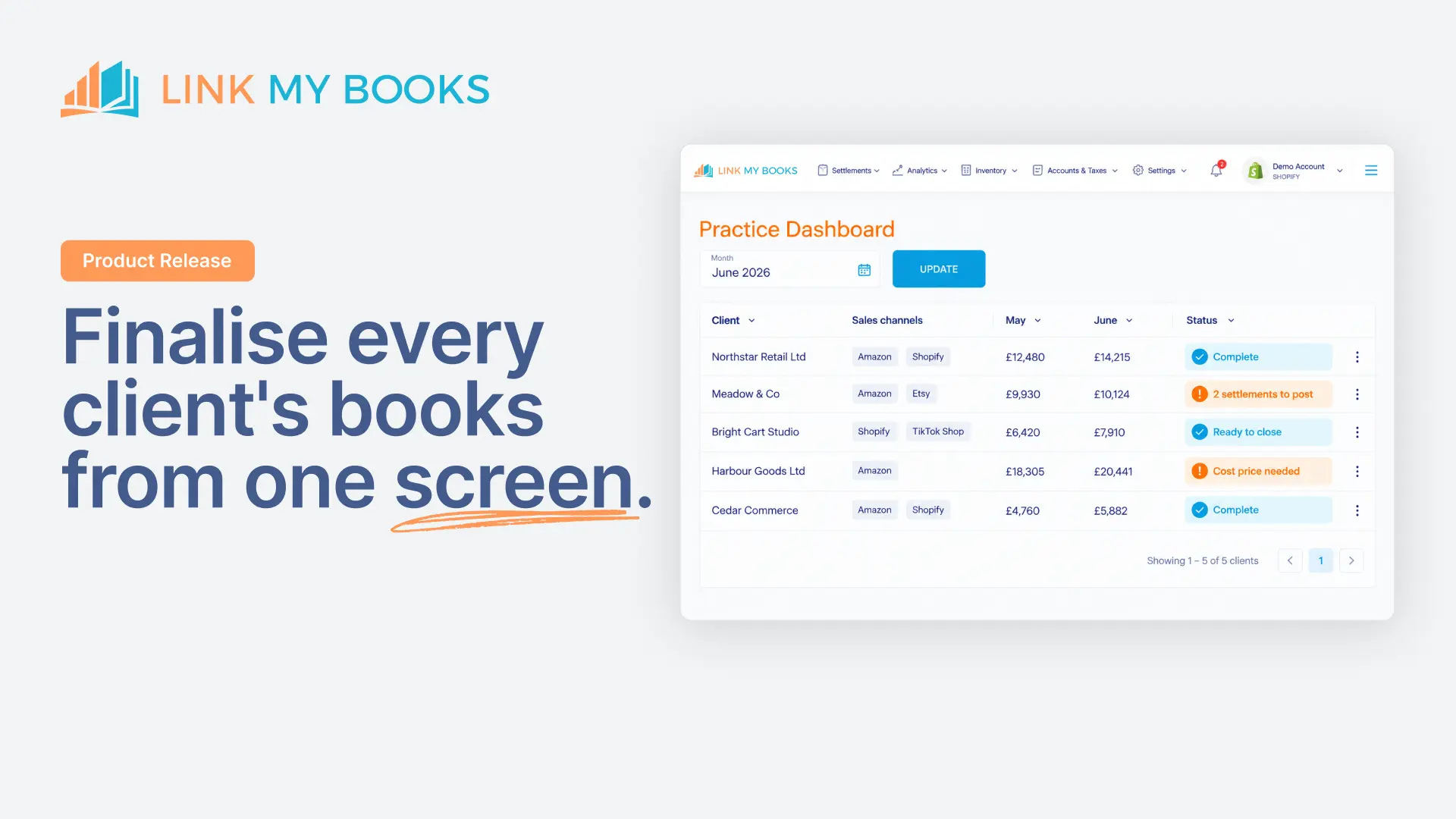
Instead of importing messy raw marketplace transactions directly into Xero or QuickBooks, Link My Books converts complicated marketplace settlement reports into structured, accountant-ready summaries. Every settlement is automatically organised into clear categories for sales, marketplace fees, VAT, refunds, and settlement adjustments before it ever reaches the financial ledger.
For accounting firms managing multiple ecommerce clients, this creates a beautifully standardised workflow regardless of where those clients actually sell their products.
Whether a client operates on Amazon, Shopify, eBay, Etsy, WooCommerce, or TikTok Shop, the underlying accounting structure remains strictly consistent. This gives practices several important commercial advantages.
Standardised Bookkeeping Across Every Client
Instead of maintaining separate, messy reconciliation methods for different marketplaces, firms can implement one highly repeatable process that scales effortlessly across their entire ecommerce portfolio.
Faster Month-End Close
Because financial data arrives organised and categorised correctly, accountants spend far less time correcting bad transactions and substantially more time reviewing actual financial performance.
Better Quality Client Reporting
Cleaner accounting records inevitably lead to more reliable management accounts, clearer profitability reporting, and stronger commercial advice for the client.
Greater Practice Scalability
As new ecommerce clients are successfully onboarded, firms can expand their revenue without proportionally increasing their reconciliation workload. The bookkeeping process remains highly consistent, even as the client's marketplace complexity grows.
Rather than asking highly trained accountants to manually repair broken marketplace data every single month, Link My Books improves the quality of that data before it reaches the core accounting software. This directly allows firms to build highly profitable and efficient ecommerce accounting services.
Signs Your Current Reconciliation Process Needs Reviewing
Many firms simply do not realise exactly how much time manual reconciliation consumes until their client numbers begin increasing rapidly. Your current workflow may no longer be scalable if you experience any of the following warning signs:
- Every ecommerce client follows a completely different reconciliation process.
- Month-end workloads aggressively increase with every single new client onboarded.
- Accountants spend hours manually correcting imported marketplace transactions.
- Complex spreadsheets remain absolutely essential to completing monthly reconciliations.
- Strategic advisory work is regularly delayed because basic bookkeeping takes much longer than expected.
These common issues are glaring indicators that your firm's reconciliation process, rather than the accounting team itself, has become the primary operational bottleneck.
The Commercial Cost of Manual Reconciliation
For modern accounting firms, manual reconciliation is much more than a minor operational inconvenience. It directly negatively affects firm profitability, staff capacity, and overall client service levels.
Every hour spent downloading endless marketplace reports, checking messy settlement data, or correcting duplicate transactions is an hour that absolutely cannot be spent reviewing business performance, advising clients on growth, or onboarding lucrative new businesses.
As ecommerce clients grow their sales volume, these manual inefficiencies become increasingly difficult for a firm to absorb. A practice that relies heavily on manual reconciliation often faces severe consequences.
First, firms experience lower profit margins on ecommerce clients due to excessive bookkeeping time. Second, longer month-end close periods actively delay financial reporting. Third, the firm suffers from limited capacity to take on additional marketplace sellers. Fourth, there is a much greater risk of human error during busy reporting periods. Finally, there is significantly less time available for premium, value-added advisory services.
By proactively reducing repetitive reconciliation work, accounting firms can massively improve internal team efficiency while delivering faster and more consistent reporting to their clients.
Building an Efficient Ecommerce Accounting Workflow
The firms that manage ecommerce clients most effectively are not necessarily those with the largest teams or the biggest budgets. They are always the ones with the most consistent internal systems.
A highly scalable workflow focuses intensely on creating repeatable processes rather than treating every single client as a unique, complex bookkeeping project.
Standardise the Onboarding Process
New ecommerce clients should follow the exact same accounting setup from the very outset. Consistent account mappings and reconciliation procedures drastically reduce future complexity. This standardization makes it incredibly easy for multiple different team members to work on the same client file without confusion.
Review Exceptions Instead of Every Transaction
Accountants should strictly spend their valuable time investigating anomalies rather than processing routine daily marketplace activity. Structured settlement summaries make this ideal scenario possible by properly organising data before it ever reaches the general ledger.
Deliver Advice from Reliable Financial Data
Clients expect much more than perfectly reconciled accounts. They desperately want professional insight into their profitability, product margins, and overall business performance. Clean, accurate financial records provide the necessary foundation for these meaningful commercial conversations.
Create Processes That Scale with Client Growth
As clients inevitably add new marketplaces or exponentially increase transaction volumes, the accounting workflow should remain completely consistent. A highly repeatable process allows your firm to confidently support growing businesses without continually increasing basic bookkeeping time.
Common Misconceptions About Ecommerce Accounting
"Manual reconciliation is always more accurate." Manual processes can sometimes feel reassuring simply because every transaction is reviewed individually by a human. In reality, repetitive manual data entry significantly increases the likelihood of inconsistencies, particularly when accountants are tired and trying to reconcile thousands of marketplace transactions across multiple clients.
"Every ecommerce client absolutely needs a unique bookkeeping process." While every business certainly has different commercial goals, marketplace accounting follows many of the exact same financial principles. Standardising your reconciliation process creates massive efficiency gains without ever reducing reporting quality.
"Software automation replaces accountants." Automation only replaces repetitive data processing, not professional human judgement. By systematically reducing manual reconciliation, accountants suddenly have much more time to actually interpret complex financial information, confidently advise clients, and actively support business growth.
FAQ
How can accountants reduce manual reconciliation for ecommerce clients?
The most effective approach is to thoroughly standardise how marketplace data enters the accounting system. Instead of importing individual transactions or relying on fragile spreadsheets, accountants should use structured settlement summaries that automatically separate sales, marketplace fees, VAT, refunds, and other adjustments. This creates a repeatable reconciliation process that works perfectly across multiple ecommerce clients while sharply reducing month-end administration and improving reporting consistency.
Why is reconciliation more difficult for multi-channel ecommerce businesses?
Each marketplace platform uses its own unique settlement schedules, complex fee structures, and customized reporting formats. Amazon, Shopify, eBay, Etsy, and WooCommerce all produce their financial information differently. Without a highly consistent accounting process, accountants often spend significant time reorganising this marketplace data before the actual reconciliation can even begin. Standardised settlement accounting helps permanently remove much of this frustrating complexity.
What should accounting firms look for in ecommerce accounting software?
Accounting firms should strongly prioritise software that produces structured financial records rather than tools that simply import thousands of raw transactions. Consistent automated categorisation of sales, VAT, marketplace fees, refunds, and settlement adjustments helps create exceptionally clean ledgers, faster bank reconciliations, and highly reliable management accounts. The ability to seamlessly support multiple marketplaces using one singular accounting methodology is equally important for firms managing growing ecommerce portfolios.
How does Link My Books uniquely support accounting firms?
Link My Books converts chaotic marketplace settlement reports into highly structured, accountant-ready summaries tailored for Xero and QuickBooks. Rather than requiring busy accountants to manually categorise marketplace activity, the platform automatically organises sales, fees, VAT, refunds, and settlement adjustments before reconciliation even begins. This allows progressive firms to implement one consistent bookkeeping process across their Amazon, Shopify, eBay, Etsy, WooCommerce, and TikTok Shop clients, making ecommerce accounting vastly easier to scale.
When should an accounting practice officially review its reconciliation process?
If onboarding new ecommerce clients consistently increases total bookkeeping time, month-end reporting is becoming noticeably slower, or accountants are spending more time correcting imported transactions than reviewing actual financial performance, it is absolutely time to review the internal reconciliation process. Standardising marketplace accounting can quickly improve firm efficiency without compromising detailed reporting quality.
Managing ecommerce clients should naturally become more efficient as your internal systems improve, not more difficult as your active client list grows.
By permanently replacing manual reconciliation with a consistent automated settlement accounting workflow, accounting firms can drastically reduce repetitive bookkeeping, instantly improve reporting quality, and effortlessly create more staff capacity for premium advisory work.
While A2X, Webgility, and Entriwise each offer valuable ecommerce accounting capabilities, Link My Books consistently stands out through its strict focus on structured settlement accounting and perfectly consistent financial records across multiple marketplaces. For practices actively supporting Amazon, Shopify, eBay, Etsy, WooCommerce, and TikTok Shop sellers, this creates an incredibly scalable workflow that permanently reduces manual effort while visibly improving the quality of client reporting.
Book a personalised demo today to see exactly how Link My Books can completely transform how your practice manages multi-channel ecommerce clients.



.webp)



.png)