


If you sell through Amazon, Shopify, eBay, Etsy, or multiple digital marketplaces, choosing the right bookkeeping software can save hours of manual work every single month while drastically improving the accuracy of your financial records. The best tools automate daily reconciliation, separate gross sales from marketplace fees, handle complex VAT rules correctly, and post clean summaries directly into your cloud accounting ledger.
Key Takeaways from this Post
The best ecommerce bookkeeping software automates sales, fees, VAT, refunds and payouts, saving time while improving financial accuracy.
Link My Books stands out for UK sellers with its simple setup, multichannel support, accurate VAT handling and accountant-led support.
Choosing software that scales with your business simplifies reconciliation, reduces manual bookkeeping and provides more reliable financial reporting.







If you sell through Amazon, Shopify, eBay, Etsy, or multiple digital marketplaces, choosing the right bookkeeping software can save hours of manual work every single month while drastically improving the accuracy of your financial records. The best tools automate daily reconciliation, separate gross sales from marketplace fees, handle complex VAT rules correctly, and post clean summaries directly into your cloud accounting ledger.
For many UK ecommerce businesses, Link My Books stands out clearly because it combines a remarkably simple setup process with deep UK VAT support, multichannel integrations, and accountant led customer support. In the modern digital landscape, staying ahead of financial compliance is essential for your survival. This comprehensive guide ranks the leading options on the market to help you find the perfect match for your online business operations.
Why Ecommerce Sellers Need More Than Standard Bookkeeping Software
Traditional cloud bookkeeping software solutions such as Xero and QuickBooks provide an exceptional general accounting platform, but they do not inherently solve the unique operational complexities created by modern ecommerce marketplaces.
Every single online sale passes through multiple layers of financial deductions before the net cash finally reaches your business bank account. These complex layers include marketplace referral commissions, subscription fees, customer refunds, payment processing charges, local or international taxes, and inevitable settlement delays. Recording only the final payout deposited by the marketplace creates highly inaccurate revenue figures, obscures your true operating costs, and makes manual reconciliation a complete nightmare for your accounting team.
As your business grows across multiple sales channels, those operational challenges multiply exponentially. Instead of manually exporting endless CSV spreadsheets and trying to adjust journal entries at the end of each month, specialist ecommerce bookkeeping software automates the entire process from start to finish.
The ideal software solution must accomplish several critical tasks simultaneously:
- Import marketplace data accurately without dropping transactions.
- Separate gross sales, fees, refunds, and localized taxes into distinct categories.
- Fully support strict UK VAT requirements and HMRC guidelines.
- Create clean, summarized entries inside your main cloud ledger.
- Drastically reduce manual bookkeeping work and human data entry errors.
- Scale seamlessly as you introduce additional marketplaces or store locations.
For digital merchants handling hundreds or thousands of monthly orders, implementing an automated bookkeeping tool quickly becomes a vital business necessity rather than a mere administrative convenience.
The 7 Best Bookkeeping Tools for UK Ecommerce Sellers
To help you navigate the growing market of accounting applications, we have evaluated and ranked the top seven solutions based on functionality, ease of use, UK tax compliance features, and overall commercial value.
1. Link My Books
Best for: UK Amazon, Shopify, and multichannel ecommerce sellers who use Xero or QuickBooks to manage their digital business.
Link My Books has built its industry reputation around solving complex ecommerce bookkeeping problems directly rather than acting as a simple, generic data pipeline. The platform focuses heavily on strict UK VAT compliance, automated marketplace reconciliation, and generating highly accurate financial summaries for rapidly scaling online brands.
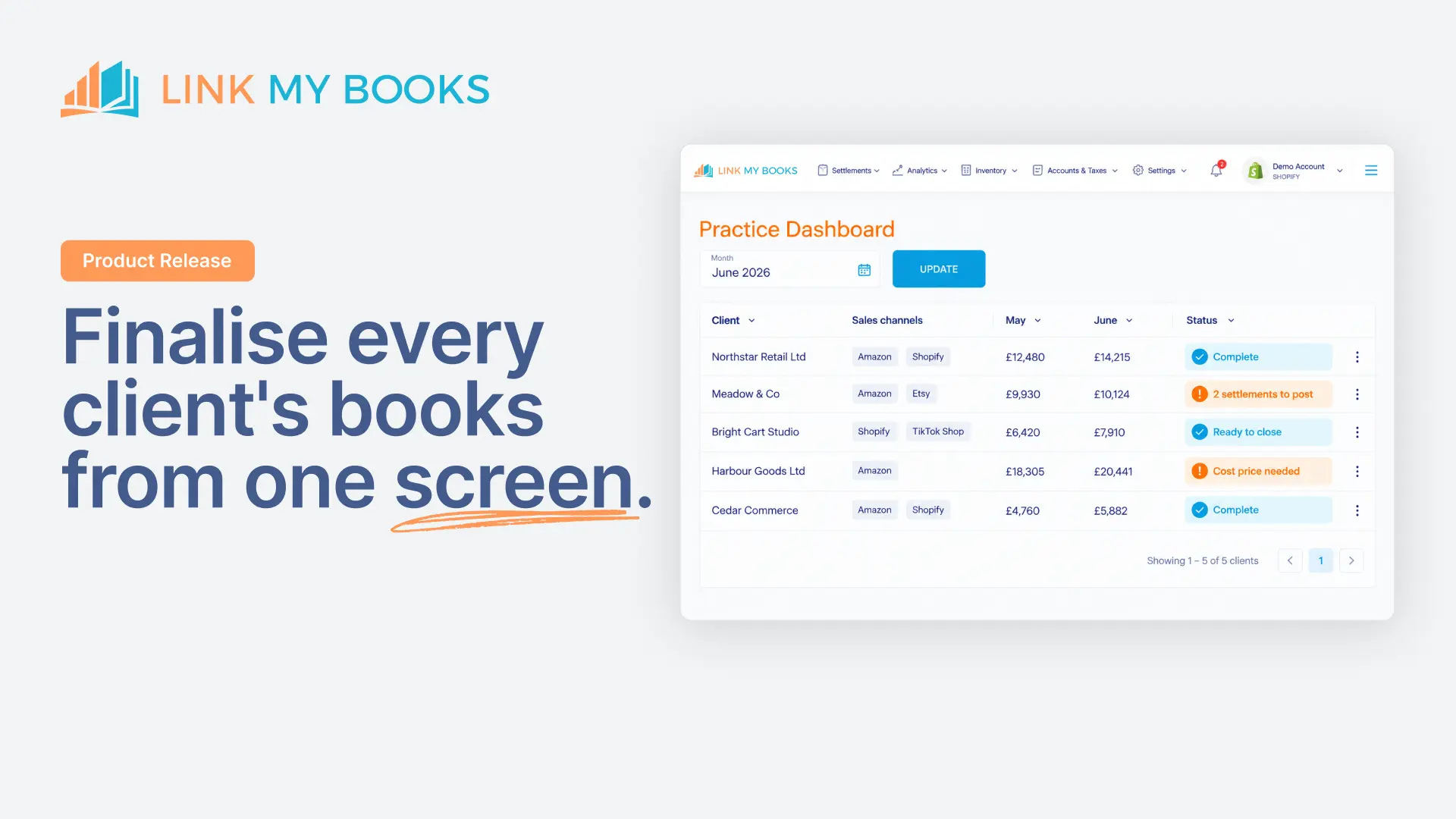
One of its primary operational strengths is its sheer simplicity. Many digital sellers can connect their storefronts and begin posting perfectly reconciled summaries into their ledger within a few minutes, instantly eliminating hours of exhausting back office administration. If you want to see how this simplifies your workflow, you can explore setting up a dedicated Xero accounting automation integration.
The business also strongly differentiates itself from competitors through its qualified accountant support network. Instead of speaking with generic customer service agents, users get access to real professionals who understand accounting logic. This provides invaluable peace of mind when dealing with complex international tax rules or ledger discrepancies.
Key operational strengths include:
- Native integrations for Amazon, Shopify, eBay, Etsy, WooCommerce, and TikTok Shop.
- Exceptional UK VAT support including full Making Tax Digital (MTD) compliance.
- Fast and guided onboarding that gets you up and running without complex custom configurations.
- Unified multichannel bookkeeping that brings all your sales data into a single clean system.
- Access to a qualified accounting support team for expert troubleshooting.
- Highly competitive pricing structures that provide immense value to scaling brands.
For UK sellers who prioritize an easy setup alongside flawless accounting precision, Link My Books offers the most robust overall package available on the market today.
2. A2X
Best for: Large, established ecommerce enterprises whose external accounting firms already mandate the use of A2X.
A2X is widely recognized as a legacy platform within the ecommerce accounting sector and has built incredibly deep relationships with major accounting firms over many years. Its long standing reputation means that many traditional accountants recommend it by default, particularly for high volume Amazon businesses. This widespread market familiarity is one of the primary competitive advantages that A2X holds.
However, historical market familiarity does not always equal perfect suitability for every single business model. For independent merchants who are comparing software options themselves, factors such as monthly subscription costs, the initial onboarding experience, and immediate access to customer support become equally important. This is especially true for businesses looking to automate multiple distinct sales channels rather than focusing solely on an established Amazon presence.
3. Taxomate
Best for: Amazon focused digital sellers looking for reliable marketplace reconciliation at a lower price point.
Taxomate specializes primarily in automation tools for Amazon accounting setups. It provides dependable reconciliation features for core Amazon transactions and successfully reduces manual bookkeeping burdens for smaller businesses operating mainly through that single marketplace channel.
While it handles basic transactional data mapping well, brands that are actively expanding into Shopify, TikTok Shop, Etsy, or alternative global channels may eventually require a broader, more robust solution. As your multichannel operational complexity increases, you may find that you outgrow a tool designed around a single core marketplace ecosystem.
4. Webgility
Best for: Mid market retail organizations with expansive, multi location physical and digital operational requirements.
Webgility combines basic accounting automation with broad inventory tracking, order shipping management, and wider enterprise operational capabilities. For larger, institutional organizations running highly complex workflows across multiple physical warehouses, this massive feature set can be highly attractive.
Conversely, smaller to medium sized ecommerce businesses often find this expansive enterprise approach overwhelming. These brands typically need a faster implementation process, a simpler daily bookkeeping workflow, and a lower subscription fee rather than a massive, all in one operations management platform.
5. Synder
Best for: Digital service providers or merchants selling across a massive variety of independent payment processing platforms.
Synder supports a diverse selection of payment gateways alongside standard ecommerce platform integrations. Its extreme system flexibility appeals to businesses that must manage independent transactions flowing through numerous payment providers like Stripe, PayPal, Square, and Clearpay simultaneously.
For UK product sellers whose primary operational concern is marketplace bookkeeping accuracy and exact VAT recording, a specialist ecommerce bookkeeping tool may provide a far more focused and stress free user experience.
6. Dext Commerce
Best for: Traditional businesses that are already heavily invested in the wider Dext accounting software ecosystem.
Dext Commerce forms part of a much larger financial data capture software platform. It offers broad integration coverage across various digital ecommerce systems. Companies that already rely on other Dext products for receipt scanning or expense management often appreciate the visual familiarity of remaining within the exact same software family.
However, digital merchants looking specifically for specialized ecommerce bookkeeping automation often find themselves comparing Dext alongside dedicated marketplace accounting tools to ensure they get the deep tax mapping required for online retail.
7. Finaloop
Best for: Venture backed ecommerce brands wanting to outsource their entire bookkeeping process to a wider financial reporting service.
Finaloop positions itself as a holistic, end to end financial management platform rather than a pure software bridge between your store and your ledger. Its custom dashboard reporting capabilities can suit venture backed brands that want a centralized finance function completely separate from standard accounting methodologies.
For established UK sellers who want to produce clean, compliant books inside their existing accounting setup, utilizing a dedicated software automation tool is generally a more direct and cost effective path.
Why Link My Books Ranks First for UK Ecommerce Sellers
Choosing the right bookkeeping platform is never simply a matter of counting up the total number of logos on an integration page. The real question you must ask is whether the software successfully removes financial friction while giving you total confidence that your reports are audit proof.
Link My Books has intentionally designed its entire user experience around achieving that specific outcome. Rather than expecting busy business founders to master complex accounting principles, the platform is engineered to automate the most frustrating aspects of ecommerce bookkeeping while keeping the initial configuration remarkably straightforward.
The company has also invested heavily in accountant led customer support, recognizing that many ecommerce founders are experts at marketing and product sourcing rather than tax law specialists. For UK businesses selling across Amazon, Shopify, eBay, Etsy, and TikTok Shop, this exact combination of deep automation, localized VAT expertise, professional support, and absolute ease of use creates a massive competitive advantage. If you want to see how this simplifies your ledger management, you can learn more about optimizing your QuickBooks bookkeeping setup.
Commercial Considerations and the True Cost of Data Management
The software tool you select to manage your business books influences far more than just your monthly software expenses. It directly dictates how quickly you can close your books at the end of the month, how much strategic confidence you can place in your profit reports, and how many billable hours your external accountant must spend correcting messy marketplace transaction errors.
Many startup ecommerce brands initially select their back office tools based entirely on the cheapest price or general brand popularity. As your order volumes begin to scale, however, you quickly discover that data accuracy, intelligent automation, and ease of reconciliation deliver far greater long term financial value than a cheap subscription fee.
Link My Books was built from the ground up around these commercial realities. Instead of simply pulling in thousands of messy individual orders that slow down your cloud ledger, it converts complex marketplace settlements into beautifully structured accounting summaries. For multichannel brands, this absolute data consistency becomes a massive operational shield as your business expands.
How to Choose the Right Bookkeeping Tool for Your Journey
The best software application is not necessarily the option with the longest list of secondary features. Instead, you should focus entirely on the core problems your business needs to solve today while keeping an eye on tomorrow.
- If you sell primarily on Amazon: Look for software that accurately separates global marketplace fees, advertising spend, promotional discounts, and payouts while turning reconciliation into a simple one click task.
- If you sell across multiple marketplaces: Choose a bookkeeping tool that can effortlessly scale alongside your long term multichannel growth strategy. Adding new sales channels like Shopify, eBay, or TikTok Shop to your retail mix should never require you to completely tear down and rebuild your accounting infrastructure from scratch.
- If your accountant reviews your books monthly: Prioritize software platforms that produce clean, structured accounting summaries. The easier your financial books are for a professional accountant to review, the less time they will spend fixing transactional data errors. This leads directly to lower accounting fees and much faster turnaround times for your monthly management reports.
- If strict VAT compliance is your top priority: UK digital merchants must ensure that their chosen software fully supports accurate VAT calculations across different global tax zones. Link My Books was built specifically with UK ecommerce business realities in mind, making it an exceptional fit for brands that need totally reliable tax reporting while continuing to scale.
Common Misconceptions About Ecommerce Bookkeeping
"The most expensive software must be the absolute best." Price does not always reflect real world suitability. Many online brands benefit significantly more from a streamlined software tool that perfectly matches their day to day ecommerce workflow than from an expensive enterprise platform packed with complex operational features they will never actually use.
"Any basic integration with Xero or QuickBooks is good enough." Simply linking a marketplace to your cloud ledger using a basic native connection does not guarantee accurate bookkeeping records. Marketplace transactions still must be categorized, split, and mapped carefully before they touch your accounts to prevent massive data discrepancies.
"Changing your bookkeeping software is a highly disruptive process." Many business owners continually postpone upgrading their financial systems because they assume the migration process will be too complicated. In reality, switching to a modern software platform that actively automates your ecommerce workflows reduces your administrative workload almost immediately.
FAQ
What is the best bookkeeping software for UK ecommerce sellers?
While the ideal option depends on your specific operational model, most online businesses benefit heavily from tools built specifically for marketplace accounting summaries rather than general data syncing. Link My Books is widely considered a premier choice for UK merchants because it natively supports platforms like Amazon, Shopify, eBay, and Etsy while drastically simplifying VAT reporting and bank reconciliation.
Why do ecommerce businesses require specialized bookkeeping software tools?
Standard marketplace payouts combine hundreds of distinct financial events into a single lump sum payment. This bundle includes gross sales alongside platform fees, advertising charges, refunds, and specific tax adjustments. Specialized software automatically isolates these elements to ensure your financial ledger remains perfectly accurate and fully compliant.
Can Link My Books manage multiple different marketplace channels simultaneously?
Yes. Link My Books fully supports a diverse array of major ecommerce platforms. This multichannel compatibility allows your business to manage your Amazon, Shopify, eBay, and Etsy accounts through one completely unified, highly consistent bookkeeping workflow.
Do I still need to hire an accountant if I use advanced bookkeeping software?
Absolutely. Intelligent software automation drastically minimizes repetitive manual data entry tasks, but it cannot replace the strategic insight of a professional financial advisor. Accountants are vital for long term tax planning, preparing statutory corporate filings, and helping you interpret your financial performance to maximize profit margins.
How should I make my final choice between these bookkeeping tools?
Begin by closely evaluating your specific operational model rather than simply comparing long feature checklists. Consider the specific marketplaces you use, your projected expansion plans, your localized tax compliance needs, and the amount of manual data entry you currently perform. The best solution should effortlessly reduce your administrative burden while producing financial metrics you can completely trust.
There are many highly capable bookkeeping platforms available to modern ecommerce businesses, and each individual tool serves a slightly different segment of the retail market. A2X, Taxomate, Webgility, Synder, Dext Commerce, and Finaloop all provide excellent automation features for various types of digital business setups.
For UK ecommerce sellers looking for software built specifically around marketplace accounting, Link My Books offers one of the strongest overall solutions. Its combination of straightforward onboarding, structured accounting summaries, UK VAT expertise, multichannel support, and accountant led customer support makes it particularly well suited to growing ecommerce businesses that want bookkeeping they can absolutely rely on.
If you are ready to spend less time reconciling marketplace transactions and more time growing your business, start your free trial today.
Start your free trial today and take control of your financial data.


.webp)



.png)