


If you run a growing ecommerce business in the United Kingdom, keeping your financial records accurate can quickly become an overwhelming administrative burden. A2X and Link My Books both aim to solve the same critical pain point: they transform disorganised marketplace data into perfectly structured accounting entries for platforms like Xero or QuickBooks Online.
However, a thorough comparison reveals that while they share a core purpose, they differ significantly in how they are adopted, the speed at which they deliver value, and how seamlessly they fit into modern ecommerce workflows.
Key Takeaways from this Post
Both tools solve the same core problem
Turning messy ecommerce data into structured, reconciled accounting entries.
Link My Books is typically more cost-effective and easier to use, with faster setup for ecommerce sellers.
Link My Books gives sellers more direct control, with a modern, intuitive setup designed for speed and UK VAT compliance.







A2X vs Link My Books: An In-Depth Comparison for UK Ecommerce Sellers
If you run a growing ecommerce business in the United Kingdom, keeping your financial records accurate can quickly become an overwhelming administrative burden. A2X and Link My Books both aim to solve the same critical pain point: they transform disorganised marketplace data into perfectly structured accounting entries for platforms like Xero or QuickBooks Online.
However, a thorough comparison reveals that while they share a core purpose, they differ significantly in how they are adopted, the speed at which they deliver value, and how seamlessly they fit into modern ecommerce workflows.
Why This Accounting Software Comparison Matters
This is not merely a feature-by-feature rundown; it is a strategic decision regarding how your bookkeeping will scale alongside your sales volume.
Both of these automation tools exist to bridge a fundamental gap in the ecommerce ecosystem:
- Marketplaces (like Amazon, Shopify, and eBay) do not send clean, tax-ready accounting data.
- Accounting platforms (like Xero and QuickBooks) are not natively designed to structure high-volume ecommerce payouts.
Without a dedicated tool operating in between, your gross revenue will fail to match your bank payouts, platform fees will remain hidden, and month-end bank reconciliation will turn into a painfully manual process. This is the exact space where A2X and Link My Books operate.
Core Functionality: What Do Both Tools Do?
At a foundational level, both applications perform a vital operational role. They automatically:
- Pull raw data directly from your ecommerce platforms and payment gateways.
- Break down batched settlements into clear, categorised components.
- Post structured journal entries directly into Xero or QuickBooks.
This structured breakdown accurately separates gross sales, marketplace fees, customer refunds, and collected tax (VAT). Ultimately, both tools solve the exact same underlying reconciliation problem, but their approach to the solution is where the differences emerge.
Price Comparison: Which Offers Better Value?
When scaling an SME, software subscription costs compound over time and have a direct impact on your profit margins.
Link My Books
Link My Books is generally considered the more cost-efficient option for independent ecommerce sellers. Its pricing structure is highly transparent and designed with the operational budgets of small to medium-sized businesses in mind, delivering exceptional value without gating powerful features.
A2X
A2X often features a higher price point across its subscription tiers. While this premium is frequently justified by their long-established market position and deep integration with traditional British accountancy practices, it is a significant commercial factor that founders must weigh carefully.
The Verdict on Price: If two tools effectively solve the exact same bookkeeping problem, long-term cost efficiency must become a crucial part of your decision-making process.
Feature Comparison: Focus Over Quantity
Feature differences between these two platforms are rarely about the sheer quantity of tools, but rather their core focus.
Core Focus
Link My Books: Built for speed, clarity, and automated ecommerce reconciliation.
A2X: Deep, robust reconciliation primarily for high-volume merchants.
Integrations
Link My Books: Flawlessly handles multi-channel data including Amazon, Shopify, eBay, and Etsy.
A2X: Deep integration with traditional accounting workflows, focusing heavily on Amazon and Shopify.
Tax Compliance
Link My Books: Specifically designed to navigate complex UK VAT rules, zero-rated goods, and HMRC’s Making Tax Digital (MTD) requirements.
A2X: Handles global tax complexities but often relies on accountant-led setup.
Target Audience
Link My Books: Built to be intuitively adopted by both independent sellers and proactive accountants.
A2X: Widely recognised as a legacy player deeply embedded within established accounting firms.
Ease of Use: Seller-Led vs. Accountant-Led Setup
Ease of use is inextricably tied to how the software is adopted and implemented within your business.
The Direct Control Approach (Link My Books)
Link My Books is explicitly designed for direct use by ecommerce founders and internal finance teams. It boasts incredibly fast onboarding, a highly intuitive setup process, and provides users with immediate visibility into their structured financial data. If you desire direct operational control, rapid deployment, and instant results, Link My Books is perfectly aligned with that operational style.
The Accountant-Led Approach (A2X)
A2X is very frequently implemented directly by accountants on behalf of their clients. Because of this, the initial setup can involve a more rigid onboarding process, tailored to fit an accountancy firm's internal workflow rather than the seller's immediate need for speed.
The Hidden Difference: Software Adoption Models
One of the most important, yet rarely discussed, distinctions between the two platforms is the adoption model itself.
- A2X is frequently chosen by external accountants and rolled out as a mandatory part of the firm's tech stack. As a result, many businesses end up using A2X without ever executing a software comparison, simply because the decision was made upstream.
- Link My Books is predominantly chosen directly by active sellers looking to optimise their own processes, though it fully supports accountant-led onboarding as well.
If you are a business owner actively evaluating tools, your options remain open to finding the best fit for your unique requirements.
Commercial Implications for Your UK Business
Selecting the right reconciliation software impacts several critical pillars of your business:
- Time Management: Both tools successfully eliminate the need for manual spreadsheet reconciliation.
- Financial Accuracy: Structured data improves your profit and loss (P&L) reporting and ensures stringent HMRC compliance.
- Cost Control: Monthly pricing differences will heavily impact your long-term margins.
- Operational Control: You must decide whether you want to manage your financial systems directly or rely entirely on outsourced accountant workflows.
Accounting middleware is not a tool you will want to migrate away from frequently. Getting the initial decision right carries a significant long-term impact.
FAQs
Is Link My Books cheaper than A2X?
In the vast majority of cases, yes. Link My Books is typically more cost-efficient, particularly for small to mid-sized UK ecommerce businesses. While A2X is widely used, many businesses switch to Link My Books when evaluating ongoing subscription costs alongside overall usability.
Do A2X and Link My Books offer the exact same features?
Both tools provide the core features necessary to break down marketplace settlements and post structured journals into your general ledger. Link My Books heavily emphasises ease of use, rapid onboarding, and UK VAT compliance, while A2X is often tailored toward established accountant workflows.
Which tool is easier to use?
Link My Books is generally designed with a more modern, intuitive interface intended for direct use by ecommerce sellers. A2X's ease of use largely depends on whether your accountant handles the heavy lifting of the setup for you.
Why do so many accountants recommend A2X?
A2X has been in the market for a long time and has strong legacy adoption within accounting firms. This creates a referral loop where clients adopt it based on a recommendation rather than a direct software comparison.
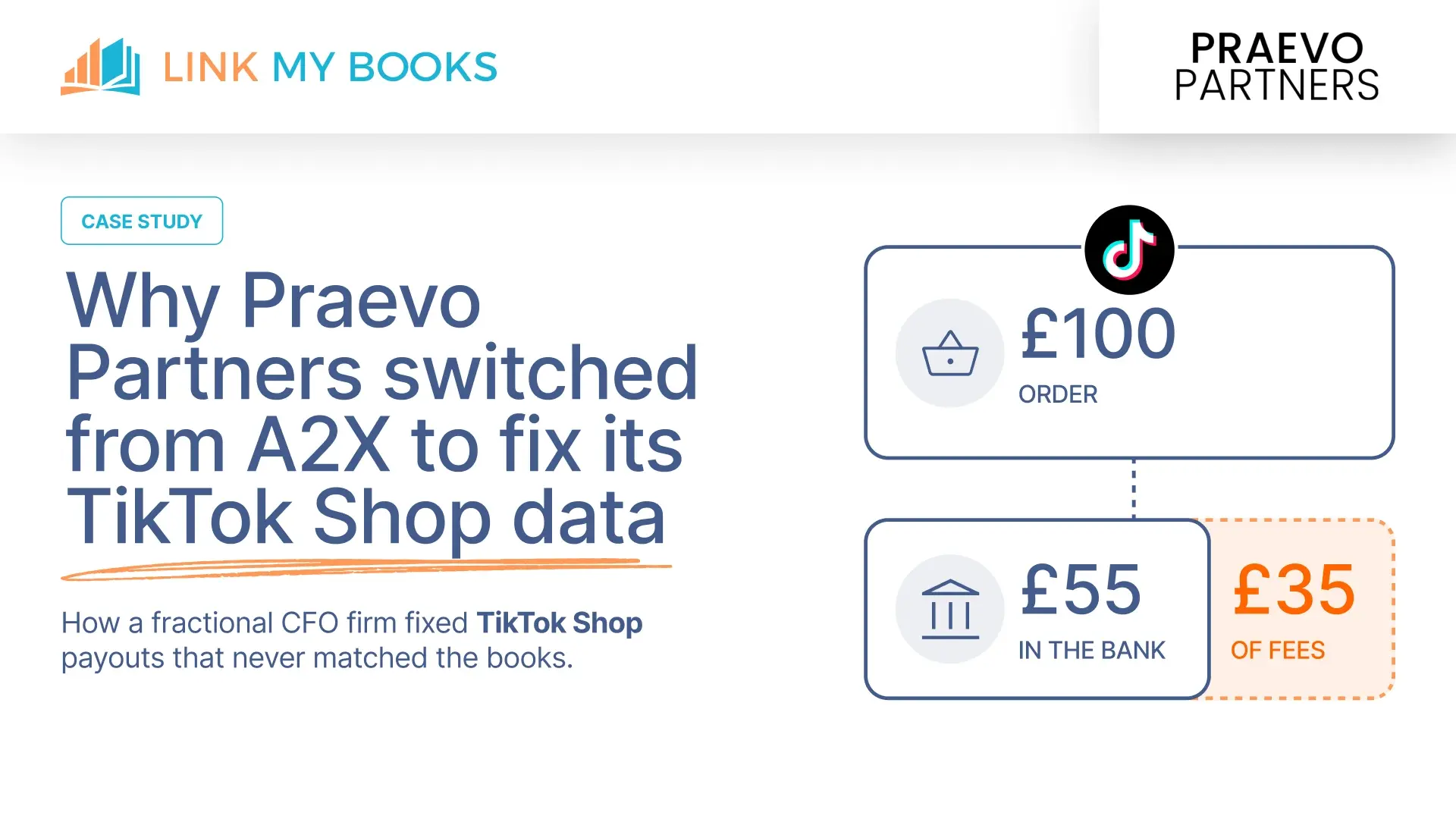
Can I switch from A2X to Link My Books?
Yes, switching is entirely possible and highly common. However, because accounting systems are closely tied to tax compliance and business operations, the transition requires careful setup and data validation to ensure historical data remains strictly accurate.
Making the Right Choice for Your Ecommerce Bookkeeping
A2X and Link My Books both solve the exact same foundational problem: bridging the gap between your sales channels and your general ledger. The true difference lies in how they integrate into your daily operations.
If your accountant mandates your tech stack, A2X is often the default legacy choice. However, if you are actively conducting a comparison to optimise your business yourself, Link My Books consistently offers faster setup, a more intuitive user experience, superior cost efficiency, and structured outputs that are perfectly aligned with modern, multi-channel ecommerce workflows.





.png)