


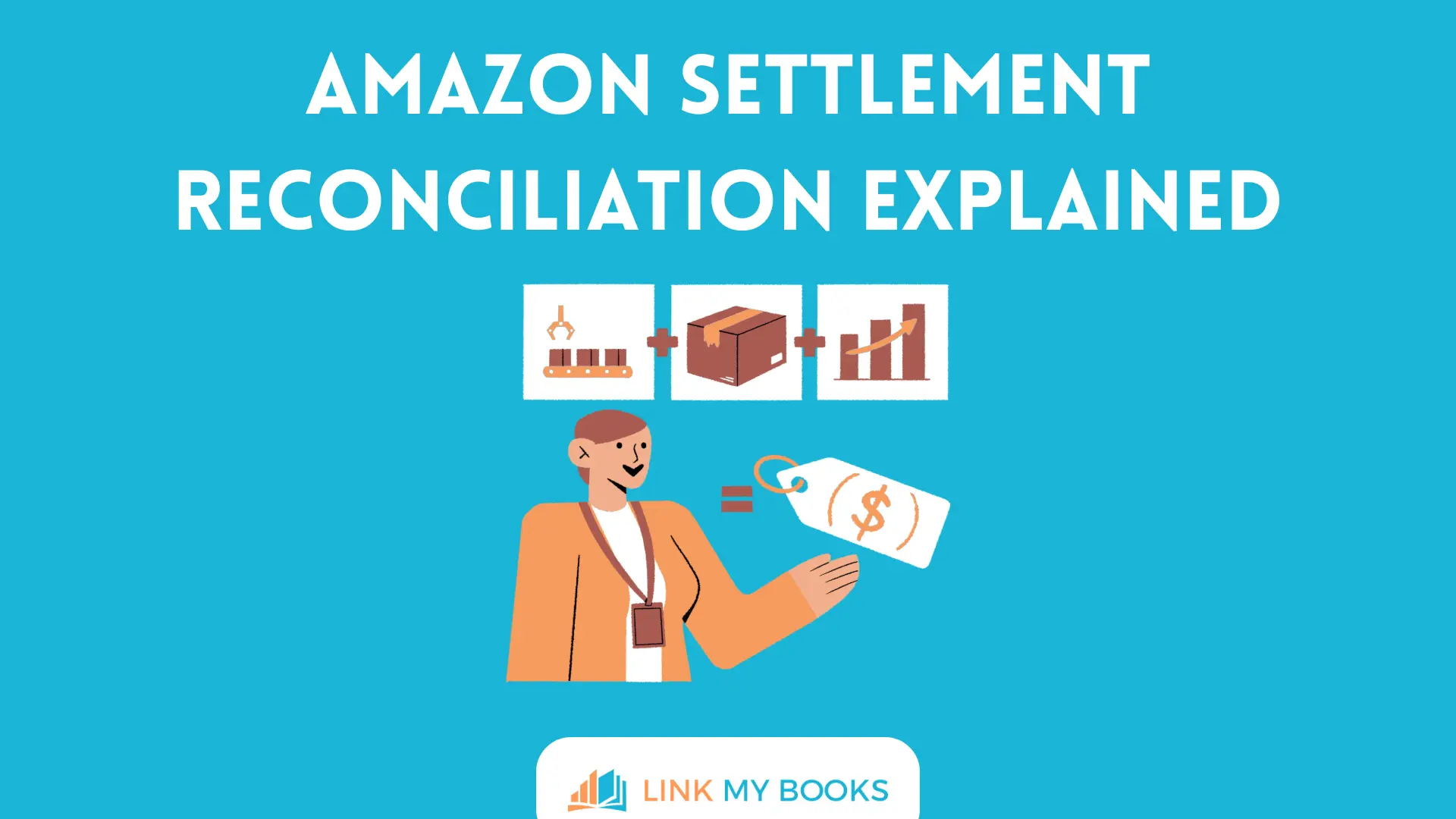
Amazon settlement reconciliation is the meticulous financial process of matching the detailed Amazon settlement reports from Seller Central to the net cash deposits actually received in your business bank account. It requires properly accounting for merchant referral fees, FBA fulfillment costs, rolling customer refunds, account-level reserves, complex VAT liabilities, and advertising adjustments. The objective is not simply to verify that some money arrived; it is to understand exactly how Amazon mathematically calculated the final payout, and to ensure those transactions are recorded flawlessly using double-entry accounting principles in your software, such as Xero or QuickBooks Online.
Key Takeaways from this Post
Amazon settlements explain the gap between sales and payouts.
Reconciliation helps sellers understand how fees, refunds, VAT, reserves, and other deductions affect the final deposit.
Settlement-based accounting is the industry best practice.
It keeps accounting records clean, scalable, and aligned with how Amazon actually pays sellers.
Financial visibility drives better business decisions.
Accurate reconciliation improves profitability analysis, cash flow forecasting, VAT compliance, and reporting confidence.







Amazon settlement reconciliation is the meticulous financial process of matching the detailed Amazon settlement reports from Seller Central to the net cash deposits actually received in your business bank account. It requires properly accounting for merchant referral fees, FBA fulfillment costs, rolling customer refunds, account-level reserves, complex VAT liabilities, and advertising adjustments. The objective is not simply to verify that some money arrived; it is to understand exactly how Amazon mathematically calculated the final payout, and to ensure those transactions are recorded flawlessly using double-entry accounting principles in your software, such as Xero or QuickBooks Online.
Why Amazon Reconciliation Confuses So Many Sellers
Most ecommerce sellers do not struggle to see their top-line sales. If you log into Seller Central, the gross revenue numbers are typically front and center.
However, they deeply struggle to understand their net payouts.
For example, a seller reviewing their month-end finances might see:
- £100,000 in gross sales activity on the dashboard.
- £82,000 deposited into the business bank account.
The immediate, panic-inducing question becomes: "Where did the other £18,000 go?"
The answer is rarely that money is missing; the answer is usually found buried deep inside the batched settlement report.
Unlike traditional retail businesses where you swipe a card and receive the full amount minus a tiny processor fee, Amazon sellers do not receive gross sales revenue directly. Amazon essentially acts as its own payment processor, warehouse, and advertising agency. It deducts multiple operational costs before issuing a payout.
Those hidden deductions typically include:
- Referral fees (Amazon's marketplace commission)
- FBA fulfillment fees (Pick, pack, and ship charges)
- Advertising charges (PPC spend deducted directly from your balance)
- Refunds and returns (Reversing previous sales)
- Storage fees (Monthly and long-term warehousing)
- VAT adjustments (Cross-border taxes and marketplace facilitator tax)
- Reserve balances (Funds held by Amazon to cover future chargebacks or returns)
This means a bank deposit only tells a fraction of the story. The Amazon settlement report tells the rest.
What Is an Amazon Settlement?
An Amazon settlement is Amazon's precise mathematical calculation of exactly what it owes the seller after accounting for all marketplace activity during a specific billing period (typically every 14 days).
Think of it as a comprehensive financial summary rather than just a simple payment receipt.
The settlement rigorously combines:
- Revenue: All gross sales activity, shipping income, and gift wrap charges generated through the Amazon marketplace.
- Deductions: Marketplace commission fees, FBA fulfillment costs, processed refunds, and inbound shipping charges.
- Adjustments: Rolling account-level reserve balances, lost inventory reimbursement activity, and retroactive fee corrections.
- Final Payout: The actual net cash amount transferred via ACH or wire to the seller's bank account.
This specific settlement forms the absolute foundation of ecommerce bookkeeping because it mathematically explains exactly how your gross sales activity turns into liquid cash.
Why Settlement Reconciliation Matters for Your Business
Many scaling sellers incorrectly assume that bank reconciliation is primarily just a tedious administrative or accounting task meant to satisfy tax authorities.
In reality, accurate reconciliation actively dictates several of the most important strategic areas of an ecommerce business.
1. True Profitability Analysis
Without proper settlement reconciliation, it becomes functionally impossible to understand your true Cost of Goods Sold (COGS) and exactly how much revenue remains after Amazon's aggressive deductions. You cannot scale if you do not know your exact net margin.
2. Cash Flow Visibility
Knowing what Amazon sold today is entirely different from knowing what the business will actually receive next week. Deferred reserves can severely cripple cash flow if not tracked properly.
3. VAT and Tax Reporting
For UK and EU sellers, accurate compliance (such as Making Tax Digital) requires a strict, legally compliant separation between business revenue, collected VAT, and marketplace charges. If you simply record the bank deposit as revenue, you will illegally underreport your tax liability.
4. Financial Reporting Confidence
Management accounts, investor updates, and business valuations become infinitely more reliable when batched settlements are reconciled correctly without messy, bloated general ledgers.
The ecommerce businesses that truly understand the anatomy of their settlements typically have a vastly superior understanding of their profit margins compared to competitors flying blind.
The Three Ways Sellers Typically Reconcile Amazon Settlements
As your business scales, how you handle this data must evolve. There are three standard methodologies for tackling Amazon's numbers.
Method 1: Spreadsheet Reconciliation
Many sellers start by managing their books with basic spreadsheets. They download Amazon flat-file reports from Seller Central, manually compare the stated payouts against their bank deposits, and use VLOOKUPs to manually calculate the differences.
- The Verdict: This works initially for micro-sellers. However, as order volume grows beyond a few dozen orders a week, it becomes an incredibly fragile, time-consuming, and error-prone nightmare.
Method 2: Transaction-Level Reconciliation
Some sellers attempt to push and reconcile every single Amazon order individually into their accounting software.
- The Verdict: While highly detailed, this often creates catastrophically large volumes of accounting entries. Pushing thousands of individual $15 invoices into Xero or QBO will bloat the general ledger and drastically slow down the software. For high-volume sellers, this approach quickly becomes impossible to manage.
Method 3: Settlement-Based Reconciliation (The Best Practice)
Settlement-based reconciliation utilizes a "clearing account" to focus entirely on the batched payout itself. Rather than analyzing every single order separately, sellers reconcile the complete summary of the settlement and its supporting fee activity.
- The Verdict: This approach is vastly preferred by certified ecommerce accountants because it perfectly mirrors how Amazon actually pays sellers. It keeps the ledger clean while preserving perfect visibility into fees and VAT.
What Makes Amazon Settlement Reconciliation So Difficult?
Amazon settlements contain significantly more moving parts than many business owners first realize. A single bi-weekly settlement can seamlessly include:
- Dozens of different fee categories
- Rolling refund transactions that cross over from previous months
- FBA lost inventory reimbursements (now rigorously tied to a 60-day claim window)
- Account-level reserve movements holding your cash captive
- PPC advertising charges deducted at random intervals
- Complex international VAT and sales tax considerations
As gross sales increase, these elements become exceptionally harder to track manually.
The ultimate challenge is not collecting the data—Amazon already provides the raw data inside Seller Central. The true challenge is synthesizing and transforming that massive data dump into structured, double-entry bookkeeping records that are actually easy to understand.
How Link My Books Simplifies Amazon Settlement Reconciliation
Many Amazon sellers spend hours every month frantically trying to understand why their Amazon settlement does not match their expectations. The core issue is rarely missing information; the issue is data organization.
Amazon inherently spreads financial activity across multiple different reporting tabs, making it incredibly difficult to see the complete financial picture.
Link My Books helps permanently solve that problem by instantly converting chaotic Amazon settlement activity into perfectly structured, summary-based accounting journal entries.
Instead of manually reviewing broken spreadsheets and decoding complex CSV reports, sellers and their accountants gain immediate, 1-click visibility into:
- Gross sales revenue
- VAT collected and mapped by region
- Amazon referral fees
- FBA fulfillment and storage costs
- Rolling refunds
- Account reserve balances
- The final, exact net settlement
This intelligent automation makes it incredibly easy to deeply understand exactly how Amazon calculated the payout, and ensures that the payout appears perfectly balanced inside your accounting software (like Xero or QuickBooks Online) ready to be matched to the bank feed.
The end result is not simply faster bookkeeping. It is a drastically clearer understanding of product profitability, real-time cash flow, and overall marketplace performance. As Amazon businesses scale to seven or eight figures, ecommerce accounting workflows remain highly manageable because the automated process follows the exact same structure regardless of whether you process 500 or 50,000 transactions a month.
Choosing Settlement Software: What Actually Matters?
Many ecommerce sellers blindly compare software platforms based purely on the number of raw integrations or marketing feature lists. While those factors matter, they are not the most important consideration when your financial compliance is on the line.
The strongest, most critical question to ask is: Can the software clearly and accurately explain the settlement?
When evaluating market options like A2X, Taxomate, and Webgility, sellers should strictly focus on:
- Settlement Visibility: Can you instantly see exactly how the net payout was calculated without reverse-engineering it?
- Granular Fee Breakdown: Are marketplace deductions (storage, PPC, FBA fees) clearly identified and categorized into the correct expense accounts?
- VAT Clarity: Can cross-border tax obligations be reviewed easily to ensure strict compliance?
- True Scalability: Will the software's reconciliation process still work efficiently, without crashing your ledger, as the business grows 10x?
- Reporting Confidence: Can your accountant implicitly trust the numbers when making tax decisions?
These tangible, operational outcomes are vastly more valuable to a scaling brand than individual feature comparisons or finding the cheapest monthly subscription.
Common Misconceptions About Amazon Settlements
Navigating the financial side of Amazon comes with several persistent myths:
"The Bank Deposit Should Match Gross Sales Revenue."
False. Amazon bank deposits are net cash payouts, not gross sales revenue. Merchant fees, refunds, and reserves will always make the deposit lower than your top-line sales.
"More Transaction Detail Means Better Accounting."
False. Pushing massive volumes of transaction-level order data into your accounting software will bloat your general ledger, slow down reporting, and make reconciliation significantly harder to manage. Summary-based accounting is the industry gold standard.
"Settlement Reconciliation Is Only for Accountants."
False. Business owners benefit directly and immediately because accurate settlement reconciliation dramatically improves visibility into true product profitability and liquid cash flow.
"Amazon Reports Already Explain Everything Clearly."
While the raw information exists in Seller Central, synthesizing and interpreting it efficiently into double-entry accounting format is the actual challenge.
FAQ
What is Amazon settlement reconciliation?
Amazon settlement reconciliation is the strict financial process of matching the detailed Amazon settlement reports to your actual bank deposits while accurately accounting for referral fees, VAT, rolling refunds, account reserves, and other marketplace adjustments. It ensures your financial records accurately reflect your true Amazon commercial activity.
Why doesn't my Amazon payout match my gross sales?
Amazon deducts various operational costs before issuing a payout to your bank. These deductions typically include referral fees, FBA fulfillment fees, customer refunds, PPC advertising costs, long-term storage charges, and withheld reserve balances. As a result, your cash payouts will always be significantly lower than your gross sales revenue.
What is settlement-based accounting?
Settlement-based accounting focuses on reconciling the complete, batched Amazon settlement summary (using a clearing account) rather than syncing thousands of individual orders. Most certified ecommerce accountants heavily prefer this approach because it keeps the general ledger clean and aligns perfectly with how Amazon actually disperses funds to sellers.
How often should Amazon settlements be reconciled?
Most businesses reconcile settlements whenever a new payout is issued and hits the bank feed (usually every 14 days for Amazon sellers). Regular reconciliation helps maintain pristine financial records, ensures accurate COGS tracking, and drastically reduces month-end accounting stress.
How does Link My Books help with Amazon settlement reconciliation?
Link My Books automatically pulls and organizes complex Amazon settlement activity into perfectly balanced, structured accounting summaries. It helps sellers effortlessly understand how gross sales, fees, complex VAT, refunds, and adjustments mathematically contribute to the final net payout, enabling 1-click reconciliation in Xero or QBO.
Amazon settlement reconciliation is not merely an exercise in proving that a deposit safely arrived in the bank account. It is about deeply understanding the complex financial journey from a gross customer sale to a net cash settlement.
The more an Amazon business grows, the more critical that financial visibility becomes. Hidden fees, delayed refunds, strict VAT obligations, holding reserve balances, and fluctuating marketplace deductions all heavily influence your true bottom-line profitability. Sellers who can clearly and accurately explain those financial movements gain an immensely stronger understanding of their business performance and gain a distinct competitive advantage.
For Amazon sellers actively looking to simplify their settlement reconciliation and gain vastly clearer financial visibility without the manual stress, Link My Books provides a highly structured, automated approach designed specifically for modern ecommerce accounting.
Take control of your margins. Book a demo and learn more with Link My Books here: https://linkmybooks.com/demo



-optimized.webp)




.png)