


.webp)
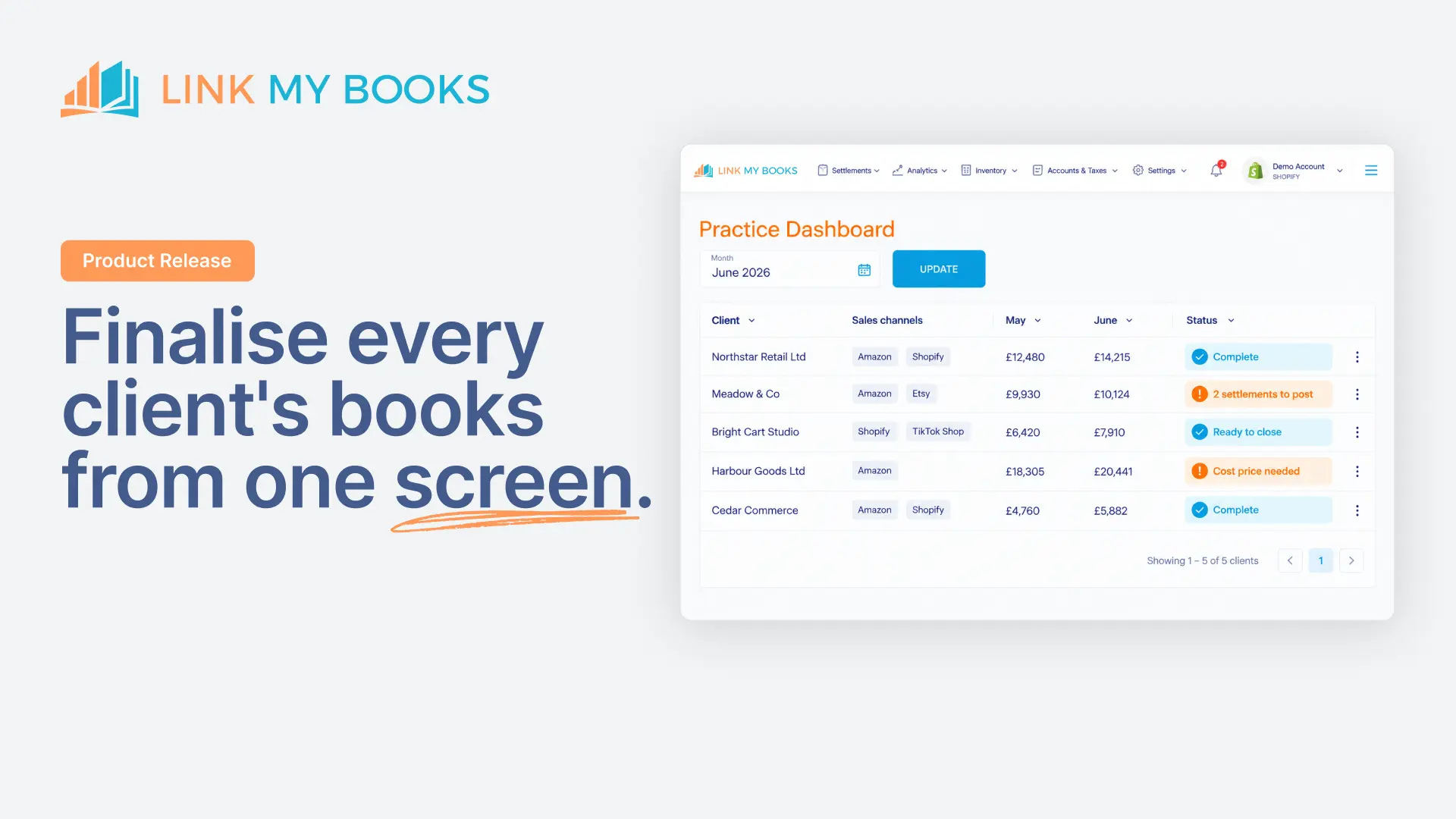
The best ecommerce tools for an accountant are those that structure marketplace data before it reaches Xero or QuickBooks. An accountant's work extends far beyond basic tax preparation—they are involved in financial analysis, auditing, and advising businesses.
Without the right tools, reconciliation becomes manual, time-consuming, and inconsistent. Solutions like Link My Books, A2X, and others exist to solve this problem, but they differ in how they support accounting professionals and their clients in managing complex financial records. Accountants are responsible for preparing accurate financial statements and ensuring compliance with all local and national financial laws.
Key Takeaways from this Post
Structured data is the foundation of ecommerce accounting
The best tools organise marketplace data before it reaches Xero or QuickBooks, ensuring accurate reporting and analysis.
Native accounting tools are not enough for ecommerce
Xero and QuickBooks don’t break down settlements or handle VAT complexity, leaving accountants to fix data manually.
The right tool improves efficiency and scalability
Automation reduces manual reconciliation, increases firm profitability, and allows accountants to focus on higher-value advisory work.







The best ecommerce tools for an accountant are those that structure marketplace data before it reaches Xero or QuickBooks. An accountant's work extends far beyond basic tax preparation—they are involved in financial analysis, auditing, and advising businesses.
Without the right tools, reconciliation becomes manual, time-consuming, and inconsistent. Solutions like Link My Books, A2X, and others exist to solve this problem, but they differ in how they support accounting professionals and their clients in managing complex financial records. Accountants are responsible for preparing accurate financial statements and ensuring compliance with all local and national financial laws.
What Accountants Actually Need from Ecommerce Tools
Ecommerce accounting is not standard bookkeeping. Whether you are a chartered accountant or a certified management accountant, working with ecommerce clients means dealing with:
- High transaction volumes
- Multiple sales channels
- Marketplace fees and refunds
- VAT complexity and strict adherence to tax laws
The core requirement is not automation for its own sake. It is structured, accurate financial data. If the data entering Xero or QuickBooks is wrong, every financial analysis and resulting statement that follows is wrong. Ecommerce tools sit securely between sales platforms and accounting systems, translating raw marketplace activity into usable entries for financial reporting.
Why Native Accounting Setups Fall Short
Xero and QuickBooks are excellent for general financial management, but they are not built for ecommerce reconciliation straight out of the box.
What they do well:
- Record standard financial transactions
- Generate overall reports
- Support general regulatory compliance
What they do not do:
- Break down complex marketplace settlements
- Separate intricate fees and refunds
- Handle ecommerce-specific VAT structures natively
This creates a gap between actual cash flow and what is recorded in the accounts. That gap is where skilled accountants spend too much time fixing data, taking them away from high-value advisory work like tax planning or corporate finance strategy.
What Defines a Strong Ecommerce Tool for Accounting Professionals
For accountants—from small practices to large public firms—the best tools are defined by:
- Accuracy: Transactions must be categorised correctly across sales, fees, and VAT, adhering to fundamental accounting principles.
- Consistency: The same logic must apply across all clients and transactions.
- Scalability: The tool must handle increasing order volumes without increasing manual work (crucial during busy tax seasons).
- Client Usability: Clients should be able to connect accounts without heavy onboarding from the accounting team.
- Support Quality: Support teams must understand financial accounting, not just software functionality.
Comparison of Leading Ecommerce Tools
- Link My Books
- Core focus:
- Built specifically for ecommerce reconciliation
- Strong alignment with UK VAT and MTD requirements
- Implication for accountants:
- Provides clean, structured data with minimal setup
- Reduces time spent correcting client books
- Makes it easier to generate accurate, detailed reports
- Core focus:
- A2X
- Core focus:
- Established workflows
- Strong adoption within accounting firms
- Implication for accountants:
- Often chosen as the default due to familiarity
- Fits well into existing practice systems
- Core focus:
- Dext Commerce
- Core focus:
- Broad integration ecosystem
- Part of a wider accounting tool suite
- Implication for accountants:
- Useful for firms already using Dext
- Less specialised for pure ecommerce reconciliation
- Core focus:
- Synder
- Core focus:
- Wide marketplace coverage
- Strong focus on automation across platforms
- Implication for accountants:
- Handles multiple integrations
- May require more configuration depending on the business setup
- Core focus:
Commercial Implications for Accounting Firms
Choosing the right tool affects more than just daily workflow; it impacts the entire practice:
- Time Efficiency: Automating manual reconciliation frees up hours per client each month for financial planning and advisory services.
- Margins: More manual work reduces profitability per client. Efficiency directly impacts partner draw and compensation.
- Client Retention: Clean, accurate reporting builds trust. Clients rely on you to analyze financial information correctly to minimize their tax burden.
- Scalability: Firms can handle more clients without needing to increase headcount.
Practical Use Cases
Firms with Ecommerce-Heavy Client Bases
Accountants managing multiple ecommerce clients need standardised processes and consistent outputs. Structuring data before it reaches the accounting layer ensures high-quality financial information across the board.
Multi-Channel Ecommerce Clients
Clients selling simultaneously across Amazon, Shopify, eBay, and other platforms create immense complexity. This requires tools capable of consolidating and structuring data across channels for accurate cost accounting.
High-Volume Sellers
As order volume scales, manual reconciliation becomes unmanageable and error-prone. Automation becomes strictly necessary to maintain accuracy.
Risks and Misconceptions
"All tools do the same thing."
While they solve the same general problem, they differ vastly in accuracy, usability, and workflow fit.
"Clients can manage this themselves."
Clients may connect the tools, but accountants still depend on the quality of the output to prepare tax returns and provide accurate auditing services.
"Automation removes the need for oversight."
Automation reduces manual data entry, but it does not remove the need for professional review and ethical judgment.
"Switching tools is easy."
Switching requires heavy reconfiguration and validation. Initial selection matters.
Where Link My Books Fits for Accountants
Link My Books is uniquely positioned for:
- UK-based ecommerce clients
- Xero and QuickBooks users
- Multi-channel sellers
For an accounting firm, this flexibility means reduced time spent fixing data, consistent transaction mapping, and improved VAT handling. It supports both direct client onboarding and accountant-managed workflows, making it ideal for firms working with a mix of client types.
FAQ
What is the best ecommerce tool for accountants in the UK?
The best tool depends on how your firm operates. Link My Books is designed specifically for UK ecommerce sellers and prioritises VAT handling. A2X is widely used due to established workflows, while Synder and Dext offer broader ecosystems. The right choice provides accurate data while fitting your firm’s processes seamlessly.
Why do accountants use tools like A2X or Link My Books?
These tools structure marketplace data before it reaches platforms like Xero or QuickBooks. Without them, accountants must manually reconcile massive settlements. Automation provides clean, categorised data that supports accurate reporting and reduces workload.
Can ecommerce bookkeeping be handled without specialised tools?
At very low volumes, yes. However, as transaction complexity increases, manual spreadsheets become inefficient and highly prone to error, making tax preparation incredibly difficult.
How do these tools help with VAT compliance?
VAT compliance depends on accurate transaction categorisation. Ecommerce tools break down sales, fees, and refunds so VAT can be calculated correctly. For UK sellers, this ensures reporting strictly aligns with Making Tax Digital (MTD) requirements and HMRC guidelines.
Final Recommendation for Accounting Teams
The primary challenge in modern ecommerce accounting is not volume; it is structure.
The right tool reduces manual work, improves data accuracy, supports strict VAT compliance, and scales alongside your clients' growth. For UK accounting firms, the decision is no longer whether to use an ecommerce reconciliation tool, but rather which tool best aligns with how you want your firm to operate and grow.



.webp)



.png)