


.webp)
The most important financial reports every ecommerce founder should track are the profit and loss statement, cash flow report, balance sheet, sales channel performance report, and reconciliation reports. Together, these reports provide total visibility into profitability, liquidity, operational efficiency, and overall business health.
The primary challenge for modern scaling brands is not accessing reports. Most ecommerce businesses already have access to enormous amounts of data through platform dashboards. The actual challenge is making sure the underlying numbers are completely accurate and structured enough to trust. Without reliable bookkeeping and exact reconciliation, even the most detailed financial report can lead to disastrous operational decisions.
Key Takeaways from this Post
Sales dashboards do not replace financial reports.
Ecommerce founders need profit and loss statements, cash flow reports, balance sheets, channel performance reports, and reconciliation reports to understand true business performance.
Reporting accuracy depends on bookkeeping accuracy.
Even the most detailed financial reports become unreliable when sales, fees, refunds, taxes, and payouts are not reconciled correctly.
Reconciliation is the foundation of trustworthy reporting.
Accurate reconciliation explains the gap between marketplace sales and bank deposits, giving founders confidence in profitability, cash flow, and decision-making.







The most important financial reports every ecommerce founder should track are the profit and loss statement, cash flow report, balance sheet, sales channel performance report, and reconciliation reports. Together, these reports provide total visibility into profitability, liquidity, operational efficiency, and overall business health.
The primary challenge for modern scaling brands is not accessing reports. Most ecommerce businesses already have access to enormous amounts of data through platform dashboards. The actual challenge is making sure the underlying numbers are completely accurate and structured enough to trust. Without reliable bookkeeping and exact reconciliation, even the most detailed financial report can lead to disastrous operational decisions.
Why Financial Reporting Matters More As Ecommerce Businesses Grow
In the early stages of a brand's lifecycle, many founders begin by tracking simple, activity-based metrics:
- Gross Revenue
- Total Orders
- Website Traffic and Conversion Rates
- Advertising Spend (ROAS)
As the business grows, these top-line numbers stop telling the full story. A brand generating £1 million or more in annual revenue can still experience severe, business-threatening issues such as:
- Cash flow bottlenecks: Inability to fund upcoming inventory runs.
- Margin erosion: Rising fulfillment and platform fees silently eating into profits.
- VAT compliance issues: Underestimating tax liabilities across international borders.
- Inventory capital challenges: Tying up too much cash in slow-moving stock.
- Unprofitable scaling: Spending more to acquire a customer than the customer is actually worth over their lifetime.
This is exactly why experienced ecommerce founders rely strictly on comprehensive financial reports rather than basic sales dashboards alone. Sales reports show activity; financial reports show true performance. Understanding the fundamental difference between the two is critical for long-term survival.
Profit And Loss Reports: The First Report Every Founder Should Review
The Profit and Loss statement (often referred to as the P&L or income statement) remains one of the most vitally important reports in the entire ecommerce ecosystem. It answers a simple, uncompromising question: Is the business actually making money?
The P&L report typically includes five major components:
- Top-Line Revenue: The total gross sales generated before any deductions.
- Cost of Goods Sold (COGS): The direct costs attributable to the production or purchasing of the products sold.
- Gross Profit: Revenue minus COGS. This shows the basic profitability of your actual products.
- Operating Expenses (OPEX): Software subscriptions, payroll, office rent, advertising, and professional fees.
- Net Profit: The "bottom line." What is left over after all expenses, fees, and operational costs have been deducted.
Many ambitious ecommerce founders focus heavily on top-line revenue growth. However, the profit and loss statement provides a much more complete, sobering picture. For example, a business may successfully double its sales volume while simultaneously reducing its net profitability due to rising digital advertising costs, expanding marketplace referral fees, or bloated operational expenses.
Without reviewing detailed profit and loss reports on a regular monthly basis, these negative margin trends can remain hidden until it is too late to correct course.
Cash Flow Reports: The Report That Keeps Businesses Alive
Profitability and cash flow are not the same thing. This is a fatal mistake many growing ecommerce businesses discover far too late. A business can be highly profitable on paper while completely running out of cash.
This cash conversion cycle gap often happens because product-based ecommerce businesses must front heavy capital to fund operations. You must pay for:
- Bulk inventory purchases (often months before the stock arrives)
- Daily advertising campaigns on Meta or Google
- Marketplace storage and fulfillment fees
- Shipping and logistics costs
...all long before receiving the actual settlement revenue from future sales.
A cash flow report helps founders understand exactly:
- Money entering the business: Settlement payouts, loan disbursements, and customer payments.
- Money leaving the business: Vendor payments, ad spend, payroll, and tax remittances.
- Upcoming financial obligations: Future accounts payable and looming VAT bills.
- Available operating cash: The actual liquidity available to run daily operations.
For many ecommerce founders, strict cash flow visibility becomes even more important than basic profit visibility, especially during periods of rapid, capital-intensive growth (such as preparing for Q4 or Black Friday/Cyber Monday).
Balance Sheets: The Most Overlooked Financial Report
Many founders spend very little time reviewing balance sheets, incorrectly assuming it is just a compliance document for their accountant. That is a massive mistake.
The balance sheet provides a comprehensive snapshot of your financial footing at a specific moment in time. It is divided into three sections:
- Assets: What the business owns (Cash reserves, inventory on hand, accounts receivable).
- Liabilities: What the business owes (Credit card debt, supplier terms, business loans, outstanding tax obligations).
- Equity: The owner's remaining stake in the business (Assets minus Liabilities).
For ecommerce businesses specifically, a heavily scrutinized balance sheet often reveals where capital is trapped. Are you holding too much obsolete inventory? Are your tax obligations pacing higher than your cash reserves? A balance sheet helps founders understand long-term financial stability rather than simply short-term financial performance. As multi-channel businesses scale, managing this stability becomes increasingly critical.
Sales Channel Performance Reports
Most ecommerce businesses eventually mature and no longer rely on a single sales channel. A typical growing digital brand may actively sell through:
- Shopify (Direct-to-Consumer)
- Amazon Seller Central (FBA and FBM)
- eBay and Etsy
- TikTok Shop and Instagram Checkout
Each platform generates revenue differently. More importantly, each channel generates vastly different operational costs. Amazon may drive massive volume but take a 30% cut in combined FBA and referral fees, whereas Shopify may have lower volume but yield a significantly higher gross margin per unit.
A dedicated sales channel performance report helps founders accurately understand:
- Revenue contribution by specific channel
- Hidden fee structures and platform deductions
- Net profitability differences per marketplace
- Historical growth trends and seasonality
This is particularly important because the highest revenue channel is not always the most profitable channel. Strong, segmented reporting helps reveal these margin discrepancies, allowing founders to allocate marketing dollars exactly where they yield the highest return.
Reconciliation Reports: The Report Most Founders Ignore
Many founders religiously review sales reports. Far fewer founders take the time to review reconciliation reports. This is highly unfortunate because accurate bank reconciliation often determines whether your financial reports can actually be trusted in the first place.
A reconciliation report acts as a diagnostic tool that helps explain:
- Why actual marketplace payouts differ from top-line sales reports.
- How hidden platform fees quietly affect total profitability.
- How customer refunds, return shipping, and chargebacks impact net revenue.
- How sales taxes and VAT withholdings influence final bank settlements.
Without exact, penny-perfect reconciliation, your financial reporting becomes increasingly difficult to verify. This is one of the primary reasons expert ecommerce accountants place such an incredibly strong emphasis on strict reconciliation processes. If the underlying transaction numbers are wrong, every single report built on top of those numbers becomes dangerously misleading.
Why Reporting Accuracy Depends On Accounting Quality
Many ecommerce founders blindly assume that financial reports generated by their software are automatically accurate. In reality, report quality depends entirely on bookkeeping quality. "Garbage in, garbage out" is the golden rule of accounting.
Massive accounting challenges often emerge when businesses begin scaling and selling across multiple platforms. A seven-figure business may simultaneously have:
- Shopify daily revenue streams
- Amazon bi-weekly settlements
- eBay ad-hoc payouts
- Multiple payment processors (Stripe, PayPal, Klarna)
- Vastly different settlement schedules and currency conversions
Without highly structured, automated accounting workflows, financial reporting can quickly become fragmented and utterly chaotic. This is why specialized ecommerce accounting automation platforms have become increasingly important. The objective is not generating more reports to look at. The objective is generating reports that reflect reality.
How Link My Books Improves Financial Reporting
Link My Books helps modern ecommerce businesses create impeccably clean financial reports by vastly improving the quality of the raw accounting records behind them.
The platform seamlessly connects ecommerce channels to Xero and QuickBooks and automatically organizes chaotic marketplace activity into clearly structured accounting summaries. Instead of dumping raw data into your ledger, the system intelligently breaks down:
- Gross sales revenue
- Hidden platform fees
- Customer refunds and adjustments
- VAT and sales taxes
- Settlement adjustments
- Exact net payout information
Rather than overwhelming your accounting software with thousands of individual, system-crashing transactions, Link My Books helps create perfectly balanced accounting records that are easier to reconcile and instantly understandable.
For founders, implementing this level of automation leads directly to:
- Better Visibility Into Profitability: When marketplace fees, refunds, and deductions are categorized correctly, profit and loss reports become deeply meaningful and actionable.
- More Reliable Cash Flow Reporting: Accurate settlement tracking provides a much clearer, real-time picture of exactly how cash is moving through the business.
- Cleaner Multi-Channel Reporting: Link My Books helps consolidate financial activity across multiple global marketplaces, making it effortlessly easy to compare true channel performance.
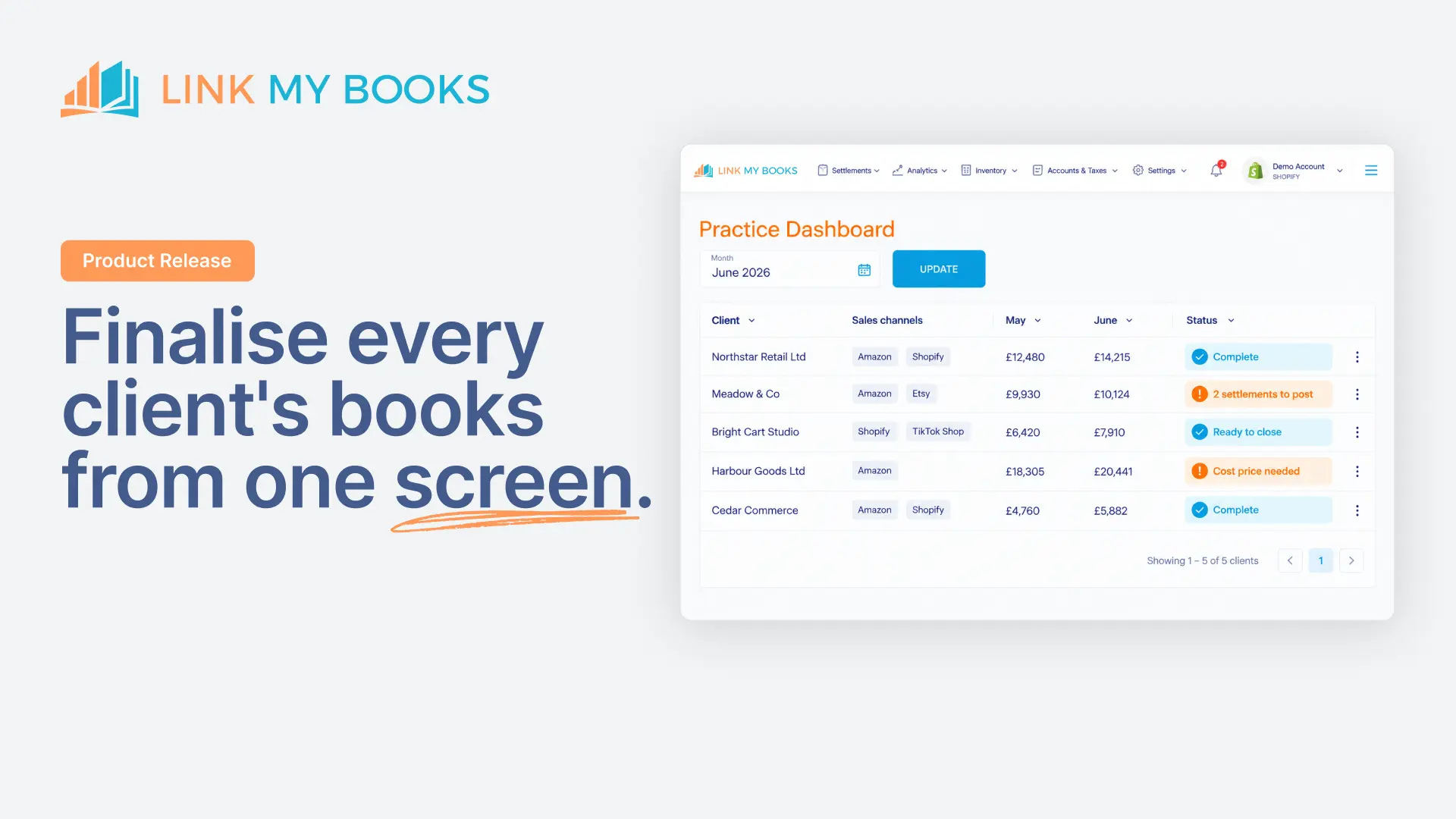
- Faster Month-End Reporting: By eliminating manual data entry and tedious bookkeeping, finance teams can close the books and produce actionable reports in a fraction of the time.
Ultimately, Link My Books helps ambitious founders spend significantly less time questioning their numbers and more time acting confidently on them.
How Other Platforms Approach Financial Reporting
When evaluating the software landscape for managing financial data, several ecommerce accounting platforms help businesses improve reporting accuracy. Understanding their differences is key to building the right tech stack.
- A2X: A2X is widely recognized within the ecommerce accounting industry and is particularly popular among specialized CPAs because of its robust settlement-based accounting approach. It has a long track record serving Amazon and Shopify merchants.
- Taxomate: Taxomate focuses heavily on straightforward ecommerce bookkeeping automation. It is particularly utilized by solo marketplace sellers seeking simplified, budget-friendly accounting workflows without needing deep, multi-layered financial complexity.
- Webgility: Webgility takes a much broader, enterprise-level ecommerce automation approach. It supports deep, heavy integrations across ecommerce storefronts, accounting software, and operational systems like inventory management and shipping logistics.
Each platform effectively addresses different aspects of ecommerce accounting. Link My Books deeply differentiates itself through its intense focus on penny-perfect reconciliation, crystal-clear multi-channel reporting, flawless VAT visibility, and highly intuitive accountant-friendly workflows. For many scaling UK and global ecommerce businesses, these specific priorities have a direct, measurable impact on bottom-line reporting quality.
Practical Example: Overcoming the Data Disconnect
Imagine a founder sitting down at month-end to review monthly revenue.
- Shopify analytics reports £50,000 in sales.
- Amazon Seller Central reports £45,000 in sales.
- However, the business bank account only shows deposits totaling £68,000.
Where did the missing £27,000 go? Without structured accounting records, understanding the true financial position becomes a stressful, multi-day forensic accounting nightmare.
Link My Books helps proactively organize these disparate data sources before they ever reach Xero or QuickBooks. It translates the gross sales and automatically deducts the exact fees, taxes, and refunds, creating a completely reliable foundation that matches the £68,000 bank deposit perfectly. This allows founders to spend less time manually reconciling missing numbers and more time actively analyzing business performance.
Common Misconceptions About Financial Reports
Revenue Is The Most Important Metric
While top-line revenue absolutely matters for market share, net profitability and operating cash flow often provide a much more complete, honest picture of your true business health.
More Reports Mean Better Visibility
The quality of your financial visibility depends entirely on underlying data accuracy, not the sheer volume of customized dashboard reports your software produces.
Financial Reporting Is Only For Accountants
Successful ecommerce founders use accurate financial reports daily to make high-stakes operational decisions about inventory purchasing, hiring, product pricing, and advertising investment.
Accounting Software Automatically Solves Reporting Problems
Cloud accounting software (like Xero) is just an empty vessel. The quality of your reporting depends entirely on the structured quality of the data entering that accounting system.
FAQ
What financial reports should ecommerce founders review regularly?
Most ecommerce founders should review their profit and loss statements (P&L), cash flow reports, balance sheets, sales channel performance reports, and bank reconciliation reports. Together, these five core reports provide total visibility into profitability, liquidity, and operational performance.
Why are reconciliation reports so important?
Reconciliation reports help explain the critical differences between gross marketplace sales, hidden platform fees, customer refunds, and actual net payouts. They provide absolute confidence that your financial records accurately reflect reality, supporting much more reliable tax and profit reporting.
How does Link My Books improve financial reporting?
Link My Books improves reporting by automatically organizing complex ecommerce marketplace activity into perfectly structured accounting summaries within Xero and QuickBooks. This prevents ledger bloat, creates exceptionally clean accounting records, and supports highly accurate profit, cash flow, and margin reporting.
What is the most important report for ecommerce founders?
There is no single "magic" answer. Profit and loss reports are essential to assess fundamental profitability, while cash flow reports are critical to monitor daily liquidity and survival. The best founders review both in tandem, as they provide entirely different perspectives on business performance.
How does Link My Books compare with A2X, Taxomate, and Webgility?
A2X is well known for a similar settlement accounting structure, Taxomate focuses on basic bookkeeping automation for smaller sellers, and Webgility offers broad, inventory-level ecommerce automation. Link My Books stands out clearly through its intense emphasis on instant reconciliation accuracy, superior VAT visibility, native multi-channel reporting, and specialized accounting workflows designed specifically for scaling ecommerce operations.
The best, most resilient ecommerce founders do not make strategic decisions based on top-line revenue alone. They rely on relentlessly accurate financial reports that provide total visibility into net profitability, operating cash flow, and multi-channel performance.
The fundamental challenge is ensuring those critical reports are built on a bedrock of reliable, perfectly reconciled accounting data. Link My Books helps solve this exact problem by creating completely clean accounting records, automating complex marketplace reconciliation, and supporting highly accurate financial reporting across all of your sales channels.
For ecommerce businesses that want absolute, uncompromising confidence in their numbers, that foundational architecture matters.
Start your free trial with Link My Books here


.webp)




.png)