


The most efficient ecommerce accounting firms do not successfully manage multiple ecommerce clients by simply working harder or hiring more junior staff. They manage them by creating highly repeatable, automated systems. Standardized bookkeeping workflows, consistent bank feed reconciliation processes, perfectly clean accounting records, and the right ecommerce accounting technology allow accountants to handle vastly larger client portfolios without ever sacrificing accuracy or firm profitability.
As the niche of ecommerce accounting becomes increasingly specialized, operational efficiency is no longer optional for bookkeeping firms. It is a critical competitive advantage.
Key Takeaways from this Post
Scalable ecommerce accounting firms rely on systems, not extra headcount.
Standardised workflows, consistent reconciliation processes, and a unified technology stack allow firms to manage more ecommerce clients without sacrificing accuracy or profitability.
Bank reconciliation is often the biggest operational bottleneck.
Marketplace payouts include fees, refunds, VAT, reserves, and other deductions, making automated, summary-based reconciliation essential for maintaining efficiency across multiple clients.
Standardisation improves both team capacity and client service.
Using the same bookkeeping processes, reporting structures, and accounting tools across a client portfolio reduces training time, simplifies reviews, and enables accountants to focus more on advisory work rather than manual bookkeeping.







The most efficient ecommerce accounting firms do not successfully manage multiple ecommerce clients by simply working harder or hiring more junior staff. They manage them by creating highly repeatable, automated systems. Standardized bookkeeping workflows, consistent bank feed reconciliation processes, perfectly clean accounting records, and the right ecommerce accounting technology allow accountants to handle vastly larger client portfolios without ever sacrificing accuracy or firm profitability.
As the niche of ecommerce accounting becomes increasingly specialized, operational efficiency is no longer optional for bookkeeping firms. It is a critical competitive advantage.
Why Ecommerce Clients Create Unique Challenges For Accountants
Managing traditional B2B service businesses or brick-and-mortar retailers is often relatively predictable for an accountant. Managing high-volume ecommerce businesses is profoundly different.
Every single month, accountants managing multi-channel ecommerce clients must deal with a chaotic mix of financial variables, including:
- Complex Marketplace Settlements: Amazon payouts that bundle sales, fees, and reserves into one net deposit.
- Payment Processor Activity: Gateway fees deducted prior to payout by Stripe, Square, or PayPal.
- VAT and Sales Tax Complexity: Strict multi-jurisdictional tax liabilities.
- Refunds and Returns: Partial refunds and restocking fees.
- Multiple Sales Channels: Integrating data from Shopify, Amazon, Etsy, and eBay simultaneously.
- Extremely High Transaction Volumes: Thousands of micro-transactions per day.
Now, multiply those exact challenges across a portfolio of 20, 50, or 100 different ecommerce clients. Without highly structured, automated systems, the operational pressure on your accounting team increases exponentially. This is precisely why many accounting firms find ecommerce clients to be highly profitable in theory, but overwhelmingly demanding in practice.
The Biggest Mistake Ecommerce Accounting Firms Make
Many traditional firms treat each new ecommerce client as a completely unique, bespoke bookkeeping project.
Because they adapt to whatever software the client was already using, several operational problems emerge:
- Workflows drastically differ between clients.
- Bank feed reconciliation methods vary from manual spreadsheets to native integrations.
- Financial reporting structures become highly inconsistent.
- Staff training becomes incredibly difficult because every client requires a different Standard Operating Procedure (SOP).
This bespoke approach may work when a firm only has a small handful of ecommerce clients. However, it becomes increasingly impossible to manage as the practice grows. The absolute most efficient ecommerce accounting firms standardize their entire tech stack wherever possible.
Build One Repeatable Ecommerce Workflow
The absolute fastest way to improve firm-wide efficiency is by creating a rigid, consistent accounting framework across every single ecommerce client on your roster. This framework must include:
1. A Consistent Chart Of Accounts (COA)
Standardized account structures make month-end reviews significantly faster. By utilizing a master ecommerce Chart of Accounts across your entire portfolio, your team immediately knows exactly where to look for Cost of Goods Sold (COGS), marketplace fees, and sales tax liabilities, drastically simplifying team training.
2. Consistent Reconciliation Processes
Every client should follow the exact same reconciliation methodology wherever possible. You should not be matching one client's transactions line-by-line while relying on bulk clearing accounts for another.
3. Consistent Reporting
Standardized financial reports (like a uniform Profit and Loss statement) allow accountants and CFOs to review financial performance and advise clients much more efficiently.
4. Consistent Technology
Using different accounting connectors for every client creates severe, unnecessary complexity. The fewer third-party systems your accounting team must learn to operate, the easier scaling your firm becomes.
Why Bank Feed Reconciliation Is Usually The Bottleneck
Most ecommerce accounting firms do not struggle because of basic bookkeeping. They struggle intensely because of bank feed reconciliation.
Marketplaces like Amazon, Shopify, and eBay rarely pay sellers exactly what they sold. The "payout gap" is a massive hurdle because bi-weekly settlements include:
- Gross marketplace revenue
- Marketplace commissions and fulfillment fees
- Payment processing gateway fees
- Customer refunds
- VAT / GST / Sales tax collected
- Advertising and PPC costs
- Other settlement deductions and account reserves
The accountant's primary job is to mathematically explain the exact difference between the gross revenue generated and the net cash actually received in the bank feed. When this specific process is inefficient, the time spent investigating discrepancies causes the firm's profitability on that client to fall rapidly.
The Operational Cost Of Manual Ecommerce Accounting
Many firms still heavily rely on manual CSV exports, complex VLOOKUP spreadsheets, and custom bookkeeping processes to bridge the payout gap. Initially, this appears manageable. But as client numbers grow, severe operational issues quickly emerge.
- Increased Review Time: Every single month-end close requires hours of manual investigation to balance the books.
- Higher Staff Costs: More billable bookkeeping hours are required simply to produce the exact same financial output.
- Greater Risk Of Errors: Manual data entry workflows inevitably increase the risk of tax compliance errors.
- Limited Scalability: Firm growth becomes entirely dependent on hiring additional junior staff rather than improving underlying operational efficiency.
For firms strictly focused on scaling their outsourced ecommerce CFO and bookkeeping services, this manual approach eventually becomes totally unsustainable.
Why Many Ecommerce Accountants Prefer Summary Accounting
Over the last few years, one of the biggest, most impactful shifts in outsourced ecommerce accounting has been the aggressive move away from transaction-heavy bookkeeping.
Today, the vast majority of top-tier firms prefer summary accounting.
Instead of importing thousands of individual $15 orders into cloud accounting software like Xero or QuickBooks Online, massive marketplace activity is intelligently grouped into structured summary journal entries. This streamlined approach consistently delivers:
- Drastically cleaner general ledgers without database bloat.
- Significantly faster month-end reviews.
- One-click bank feed reconciliation.
- Better, high-level reporting visibility for strategic advisory.
- Effortless scalability for high-volume Q4 sales periods.
The ultimate objective is not reducing financial visibility. The objective is completely reducing the noise.
The Competitive Landscape: Bookkeeping Tools for Accountants
To achieve true standardization, firms must choose the right third-party connector to act as the bridge between their clients' storefronts and their central ledger. Here is how the top tools in the market compare for multi-client management:
Link My Books (Best For Standardized Workflows)
Link My Books was built explicitly to solve the reconciliation bottleneck for accounting firms. It utilizes the highly preferred summary accounting method, transforming chaotic multi-channel data (from Amazon, Shopify, eBay, Etsy, etc.) into perfectly balanced summary invoices. Its focus on incredibly fast setup, automated VAT visibility, and keeping the ledger perfectly clean makes it the ultimate standardization tool for scaling accounting practices.
A2X (Best For Established Processes)
A2X is a pioneer in the industry and a highly respected tool among enterprise ecommerce accountants. It also utilizes the summary accounting model to ensure accurate financial reporting. While highly reliable and deeply established, its pricing structure can escalate rapidly for firms bringing on a high volume of multi-channel clients.
Synder (Best For Transaction-Level Syncing)
Synder takes a different approach, heavily prioritizing transaction-level syncing. It pulls individual sales and receipts directly into the accounting software and connects with an enormous array of payment processors. While it offers a dedicated "Organizations" dashboard for accountants, the transaction-heavy nature of the tool can lead to severe ledger clutter as your clients' order volumes surge.
Dext Commerce (Best For Deep Transactional Visibility)
Dext Commerce (formerly Greenback) captures highly granular, line-by-line transaction data and individual receipts across multiple platforms. While this provides extreme audit-level detail for specialized cases, managing the sheer volume of individual data points it pulls into Xero or QuickBooks can become an administrative nightmare for a firm trying to streamline operations.
How Link My Books Helps Accountants Scale Ecommerce Services
For accounting firms actively managing multiple ecommerce clients, efficiency often comes down entirely to how marketplace data enters the central accounting system. Link My Books was designed specifically to solve this exact multi-client challenge.
Standardized Across Multiple Clients
One of the absolute biggest operational advantages of Link My Books is its rigid consistency. Whether Client A sells strictly on Amazon and Client B sells across Shopify, eBay, and TikTok Shop simultaneously, the internal accounting workflow for your team remains exactly the same. This drastically reduces client onboarding time and makes training new junior bookkeepers significantly easier.
Faster Reconciliation
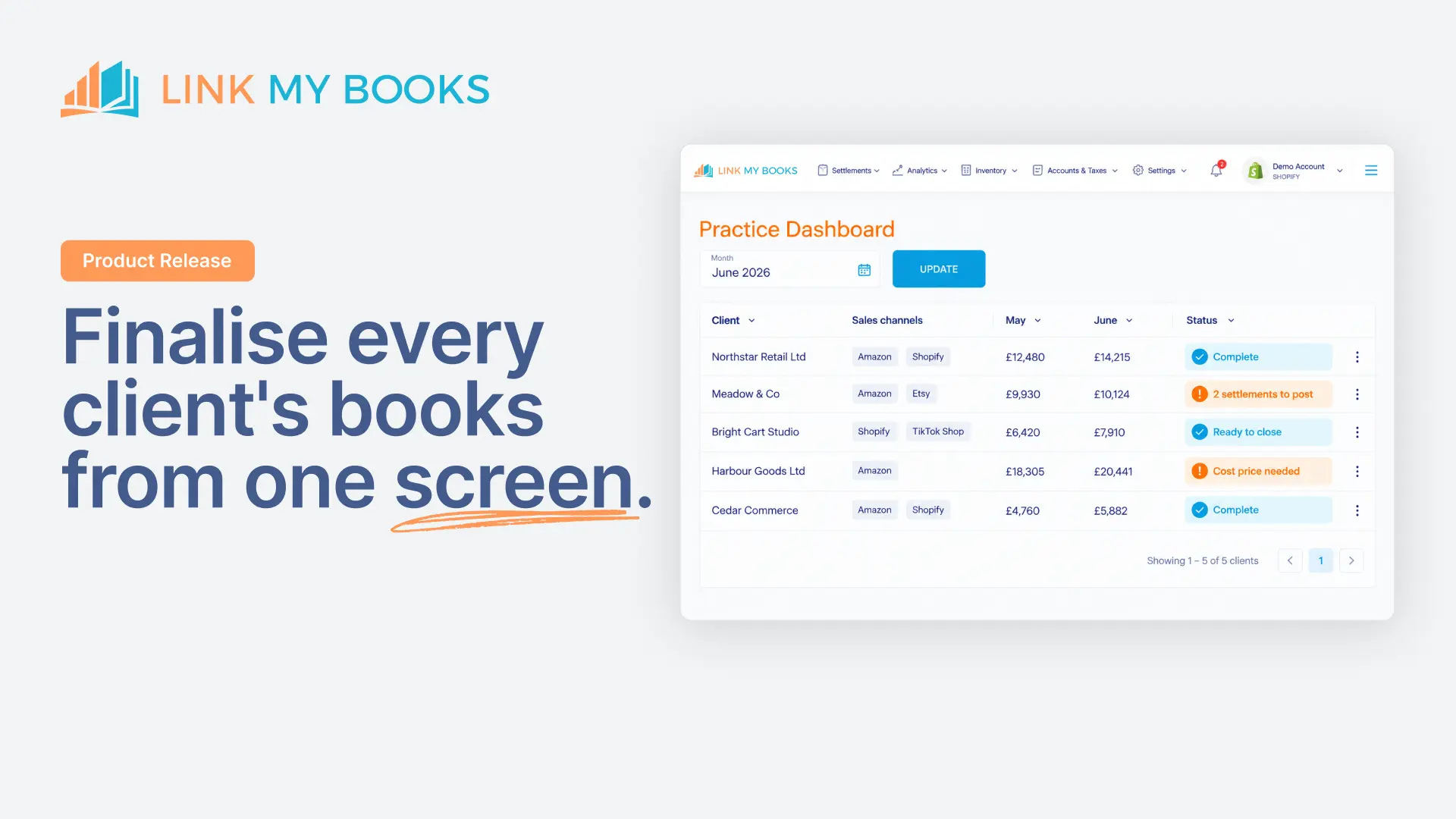
Many accountants spend hours manually investigating settlement discrepancies and missing fees. Link My Books completely eliminates this by organizing gross revenue, fees, VAT, refunds, and settlements into structured, double-entry accounting summaries. When the cash hits the client's bank feed, your team simply clicks "Match." This makes month-end reviews exponentially faster and perfectly predictable.
Cleaner Accounting Records
As client transaction volumes inevitably increase, general ledger management becomes critically important. Link My Books helps firms actively avoid excessive accounting clutter and software lag while still maintaining 100% accurate financial visibility.
Better Capacity Per Team Member
When the tedious tasks of data entry and bank reconciliation become fully automated and efficient, accountants are freed from acting as data-clerks. Your existing team can often manage significantly larger client portfolios without proportionally increasing their workload. For growing accounting firms, this has a massive, immediate impact on bottom-line profitability.
Practical Example: Scaling to 40+ Clients
Imagine a growing ecommerce accounting practice currently managing 40 Amazon and Shopify clients.
Without Standardized Workflows:
Every single client uses different bookkeeping processes (some use A2X, some use Dext Commerce, some use spreadsheets). Reconciliation takes hours per client. Month-end reviews become highly inconsistent. If a senior bookkeeper leaves the firm, training their replacement on 40 bespoke workflows is a nightmare.
With Standardized Workflows:
Now imagine the exact same practice mandating a standardized ecommerce accounting stack utilizing Link My Books for every client. Month-end reviews become a predictable, rapid checklist. New team members learn the single summary workflow in days, not months. Client profitability improves drastically because the firm spends less time on data entry and more time on high-value CFO advisory services.
The competitive difference is not necessarily superior accounting knowledge. The difference is superior operational structure.
Common Misconceptions About Ecommerce Accounting Efficiency
Misconception 1: Hiring More Staff Solves Capacity Problems
Fact: Throwing additional staff at a broken workflow is a temporary bandage. While staff can help, inefficient, manual systems often create the real bottleneck. Fixing the system solves the capacity issue permanently.
Misconception 2: More Transaction Detail Improves Client Service
Fact: Many accountants find that pushing excessive transaction-level data into QuickBooks or Xero slows down reporting generation and makes month-end reviews vastly harder rather than improving them.
Misconception 3: Every Ecommerce Client Needs A Custom Workflow
Fact: The most successful, highly profitable ecommerce accounting firms force standardization wherever possible, moving all clients to a unified tech stack.
Misconception 4: Ecommerce Clients Are Naturally Time Intensive
Fact: While complex, they do not have to be time-intensive. Implementing the right summary accounting automation systems can significantly reduce the administrative bookkeeping burden to mere minutes per month.
FAQ
How do accountants manage large numbers of ecommerce clients efficiently?
The most successful and profitable accounting firms rely strictly on standardized workflows, consistent summary reconciliation processes, and unified ecommerce-specific accounting technology (like Link My Books) rather than bespoke, manual bookkeeping.
Why is bank feed reconciliation so difficult for ecommerce businesses?
Marketplace payouts almost always differ from gross sales figures because of hidden platform fees, VAT deductions, refunds, and rolling account reserves. Reconciling these exact differences accurately is one of the biggest, most time-consuming ecommerce accounting challenges.
Why do many top ecommerce accountants strongly prefer summary accounting?
Summary accounting creates vastly cleaner records, prevents cloud accounting software from crashing due to ledger clutter, and completely simplifies bank reconciliation, all while still providing perfectly accurate financial visibility for tax compliance.
How does Link My Books specifically help accounting firms?
Link My Books helps accounting firms deeply standardize their ecommerce bookkeeping workflows across their entire portfolio, simplify payout reconciliation to a single click, and manage rapidly growing client rosters far more efficiently and profitably.
What is the biggest scalability challenge for ecommerce accounting firms?
Operational consistency is the biggest hurdle. Firms that standardize their tech stack and internal processes typically scale much more effectively and profitably than firms relying on highly bespoke, client-dictated bookkeeping workflows.
Managing multiple ecommerce clients efficiently is not about processing more manual bookkeeping tasks. It is entirely about building automated systems that make high-quality bookkeeping incredibly easy to deliver consistently at scale.
The most successful and profitable ecommerce accounting firms focus strictly on deep standardization, bank reconciliation efficiency, and overarching operational scalability.
Link My Books actively supports that exact approach by helping accounting firms create pristine financial records, implement lightning-fast reconciliation processes, and maintain a perfectly consistent ecommerce accounting workflow across their entire client portfolio.
Ready to standardize your firm's workflow and increase your capacity?
Book a demo today to see exactly how Link My Books can help your accounting practice manage more ecommerce clients efficiently.



.webp)



.png)