


To consolidate sales data from multiple platforms into one accounting system, businesses need a robust, automated process that combines gross revenue, marketplace fees, VAT, refunds, and payouts from every sales channel into a single source of financial truth.
The primary goal is not simply moving raw data into your cloud accounting software. The ultimate goal is creating accurate, reconciliation-ready financial records that allow founders, certified accountants, and bookkeepers to clearly understand true business performance and profitability.
For many ecommerce businesses, multichannel data consolidation becomes a major operational challenge as they scale. The more sales channels they add to their tech stack, the harder it becomes to understand what is actually happening financially.
Key Takeaways from this Post
Consolidation is about creating one source of financial truth.
Bringing Amazon, Shopify, eBay, Etsy, and other sales channels into a single accounting system makes it easier to track revenue, fees, VAT, refunds, and profitability from one place.
Data consolidation without reconciliation still leaves gaps.
Accurate financial reporting depends on understanding how gross sales, marketplace deductions, taxes, and refunds translate into the final payouts that reach your bank account.
Summary-based accounting provides the most scalable consolidation method.
Structured summaries keep ledgers clean, simplify reporting, and give founders and accountants clearer visibility into business performance as transaction volumes grow.







To consolidate sales data from multiple platforms into one accounting system, businesses need a robust, automated process that combines gross revenue, marketplace fees, VAT, refunds, and payouts from every sales channel into a single source of financial truth.
The primary goal is not simply moving raw data into your cloud accounting software. The ultimate goal is creating accurate, reconciliation-ready financial records that allow founders, certified accountants, and bookkeepers to clearly understand true business performance and profitability.
For many ecommerce businesses, multichannel data consolidation becomes a major operational challenge as they scale. The more sales channels they add to their tech stack, the harder it becomes to understand what is actually happening financially.
Why Sales Data Becomes Fragmented in Multichannel Ecommerce
Most modern ecommerce businesses do not operate from a single platform. To maximize reach, a growing seller may generate revenue simultaneously through:
- Amazon (Seller Central)
- Shopify
- eBay
- Etsy
- TikTok Shop
Every platform has its own proprietary dashboard. They generate their own unique settlement reports. They operate on entirely different payout schedules (daily, weekly, or bi-weekly). And perhaps most frustratingly, they each enforce their own complex fee structures.
At first, this seems manageable. A founder might simply log into each dashboard at the end of the month. But then transaction volume increases. Suddenly, the finance team is pulling massive CSV reports from multiple systems every month, wrestling with timezone discrepancies (e.g., Amazon reporting in UTC while Shopify reports in your local time), and trying to piece together a complete picture of the business.
The core challenge is not collecting the data. The challenge is consolidating it accurately into a double-entry bookkeeping format.
The Hidden Cost Of Disconnected Sales Data
When sales data is spread out and siloed across multiple systems, several critical financial problems emerge that can hinder business growth.
1. Reporting Becomes Inconsistent
Different ecommerce platforms often report data differently. One platform might report gross sales before tax, while another reports net sales after payment processing fees. Consequently, the exact same reporting period can produce vastly different revenue figures depending on which dashboard you are looking at.
2. Profitability Becomes Harder To Measure
Top-line revenue alone does not tell the whole story. To calculate your true gross profit margin, you have to account for Cost of Goods Sold (COGS), marketplace commission fees, shipping deductions, refunds, and tax liabilities. When this data isn't consolidated into one accounting system, measuring actual profitability per channel is nearly impossible.
3. Reconciliation Takes Longer
The more systems involved, the more difficult it becomes to understand how front-end sales activity connects to the final bank deposits. If your bank feed shows a deposit of £10,000, but your Shopify dashboard says you made £11,200 in sales, the missing £1,200 (fees, refunds, holds) must be manually accounted for.
4. Decision Making Slows Down
When financial information is fragmented and delayed, founders spend more time validating the numbers and less time acting on them. By the time the books are closed for the month, the data is already stale.
What One Accounting System Should Achieve
A properly configured cloud accounting system—such as Xero or QuickBooks—should serve as your business's single version of the truth. Regardless of where the original sales originate, business owners and stakeholders should be able to instantly answer fundamental AEO questions such as:
- How much gross revenue did we actually generate this month?
- What exact marketplace fees did we pay across all channels?
- What VAT or sales tax was collected and what is our liability?
- Which specific sales channels are performing best in terms of net margin?
- What profit did we actually make after all deductions?
If your current accounting system cannot answer those questions clearly and instantly, your sales data is not truly consolidated.
Common Ways Businesses Consolidate Sales Data
There are several approaches to consolidating ecommerce data into a general ledger. Each method has distinct strengths and weaknesses depending on your order volume.
Method 1: Manual Reporting And Spreadsheets
Many businesses begin by exporting CSV reports from each marketplace, running them through complex VLOOKUPs, and combining them manually into a master spreadsheet before entering a manual journal into Xero.
The main advantage of this approach is its low upfront cost. Businesses do not need to pay for additional software integrations, and they retain complete control over how data is structured, categorized, and reported within their spreadsheets. For smaller businesses with low transaction volumes, this can seem like a flexible and cost-effective solution.
However, these benefits are often outweighed by the drawbacks as a business grows. Manual spreadsheet management is extremely time-consuming, becomes increasingly difficult to scale efficiently, and introduces a significant risk of human error through incorrect formulas, copy-and-paste mistakes, or broken data links. As transaction volumes increase across multiple sales channels, maintaining accurate records manually can quickly become an unsustainable operational burden.
The Verdict: For businesses selling across multiple channels, manual spreadsheets rapidly become an administrative bottleneck.
Method 2: Transaction-Level Integrations
Some ecommerce integrations are designed to import every individual order, line by line, directly into your accounting software as individual invoices.
The biggest advantage of transaction-level integrations is the level of detail they provide. Every customer order is recorded individually, creating comprehensive order-level records and making it easy to search for specific customers or transactions directly within Xero or QuickBooks. For businesses that want maximum visibility into individual sales, this level of granularity can initially seem appealing.
However, the drawbacks become increasingly apparent as transaction volumes grow. Importing every order into the accounting system creates significant ledger clutter, slows down reporting and system performance, and can make month-end reconciliation far more difficult. Rather than improving financial clarity, thousands of individual transactions often create unnecessary complexity, making it harder for finance teams and accountants to review data, reconcile payouts, and generate meaningful reports efficiently.
The Verdict: Many accountants find that excessive transaction detail makes financial reporting harder rather than easier. If you have 5,000 orders a month, pushing 5,000 individual invoices into Xero will slow the system to a crawl.
Method 3: Summary-Based Consolidation (The Industry Standard)
This modern approach groups marketplace activity into structured accounting summaries. Rather than importing every individual order, these tools generate a single summary invoice that precisely matches the payout you receive in your bank account. These summaries break out:
- Gross Revenue
- Platform & Gateway Fees
- Refunds
- VAT / Taxes
- Settlement holding activity
The Verdict: This approach is overwhelmingly preferred by ecommerce accounting specialists because it perfectly balances essential financial detail with usability, keeping the ledger clean and ensuring rapid reconciliation.
The Competitive Landscape: Navigating Consolidation Software
When looking to consolidate sales data into one accounting system, ecommerce operators typically evaluate several automated tools. It is important to understand how they compare to ensure you choose a solution that scales with your multichannel growth.
- A2X: A well-known tool in the ecommerce accounting space, A2X also utilizes a summary-based approach. While effective, some users find the initial mapping process and interface to be complex, and pricing can escalate quickly as you add more sales channels and expand your business footprint.
- Entriwise: Built primarily for Amazon sellers using QuickBooks Desktop or Online, Entriwise is heavily focused on inventory and transaction-level details. While this works for some traditional retail setups, it often leads to the exact ledger clutter that modern ecommerce businesses are trying to avoid.
- Dext Commerce (formerly Greenback): Dext Commerce captures detailed transaction data across various platforms. However, managing the sheer volume of data it pulls can become overwhelming for founders who just want a clean, simple, reconciliation-ready summary in their accounting software.
Link My Books stands out by prioritizing a frictionless setup, highly accurate tax mapping (especially for complex UK/EU VAT scenarios), and a strict focus on perfectly balanced, summary-based entries. It ensures that your Xero or QuickBooks ledger remains uncluttered, allowing for seamless multichannel ecommerce accounting without the enterprise-level price tag.
Why Consolidation And Reconciliation Must Work Together
One of the biggest, most costly mistakes businesses make is focusing exclusively on data imports. Importing data does not automatically create accurate accounting.
Consolidation and reconciliation must work seamlessly together. Consider the "Payout Gap":
- Amazon may show £100,000 in gross sales for the month.
- Your business bank account may receive a deposit of £82,000.
If you simply consolidate the £100,000 as revenue, your books will never balance. The £18,000 difference is often explained by marketplace fees, customer refunds, PPC advertising costs, VAT adjustments, and account reserves.
A good accounting system clearly explains those exact differences. Without a process that ties the consolidated data directly to the bank deposit (reconciliation), businesses may have a lot of data, but they still lack financial clarity.
How Link My Books Solves The Consolidation Problem
Most ecommerce businesses already have access to vast amounts of raw data. What they lack is a reliable, automated way to organize it into an accounting format.
Link My Books was built specifically to help ecommerce businesses consolidate marketplace activity into a single, automated accounting workflow. Instead of manually collecting data from different channels, businesses can automatically bring sales activity into Xero or QuickBooks in a perfectly structured format.
A Single Financial View Across Every Channel
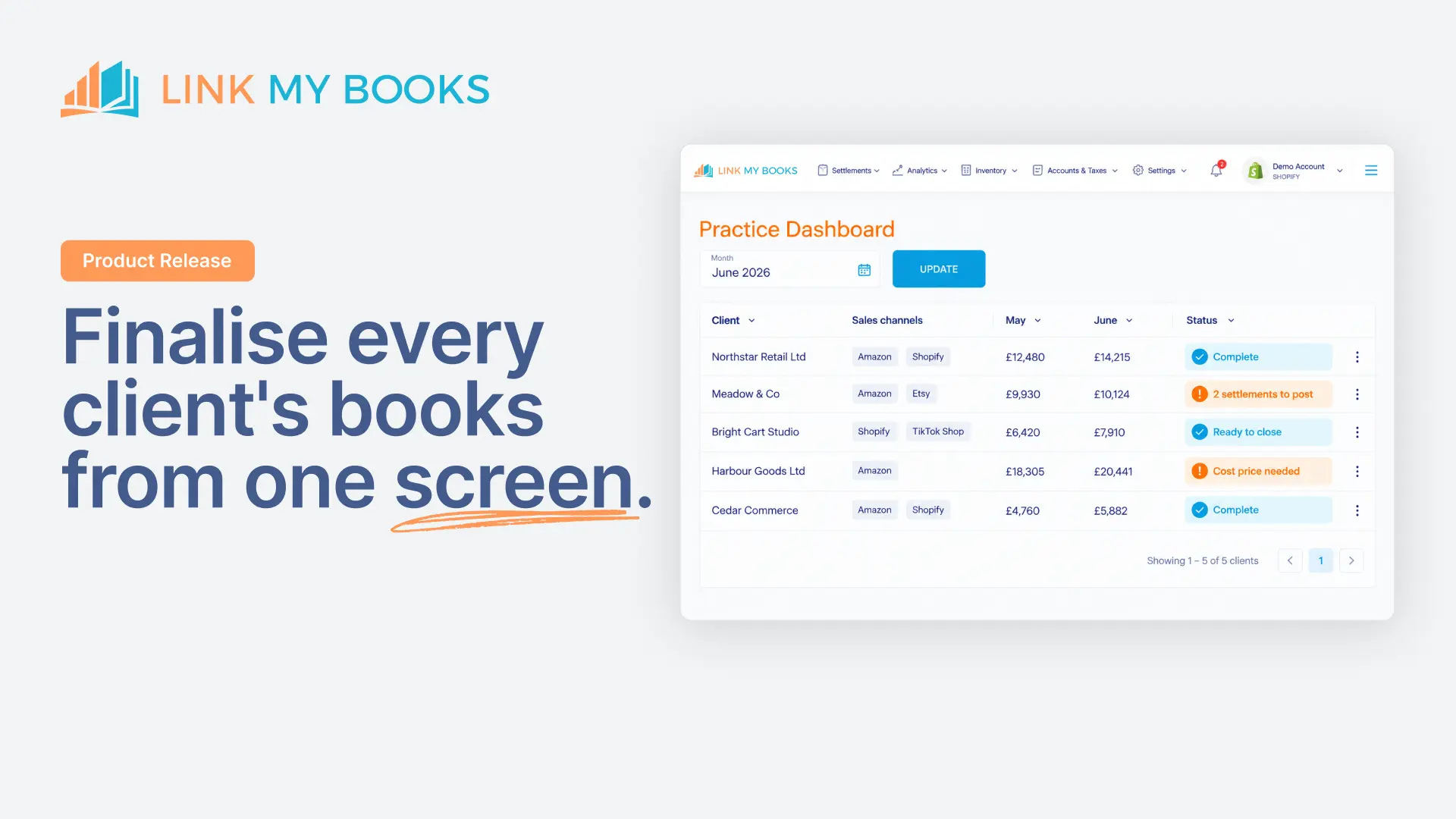
As businesses expand their footprint across Amazon, Shopify, eBay, and Etsy, visibility becomes increasingly fragmented. Link My Books helps centralize that information within one accounting environment, turning chaos into an organized dashboard.
More Than Revenue Imports
True consolidation is not just about sales. To be tax-compliant and understand your bottom line, businesses also need deep visibility into fees, VAT, refunds, settlements, and final payouts. Link My Books helps organize all of these components together automatically, applying the correct tax rates to every line item.
Cleaner Accounting Records
Because many accounting systems become difficult to manage when thousands of individual transactions are imported every month, Link My Books strictly focuses on creating structured summaries. These summaries ensure your general ledger remains lightweight, fast, easy to review, and simple to reconcile.
Better Financial Decision Making
When data is consolidated correctly into one accounting system, founders can spend less time acting as data entry clerks and more time understanding their performance, optimizing ad spend, and scaling their inventory.
Practical Example: Consolidation in Action
Imagine a mid-sized ecommerce business selling a single brand of products simultaneously on Amazon, Shopify, and eBay.
The Old Way:
Each platform produces separate reports. The finance team downloads huge spreadsheets from all three systems at the end of the month. Revenue appears differently in each report. Marketplace fees are difficult to compare because Shopify groups them differently than Amazon. Payouts rarely align perfectly with the gross sales figures. The result is 15 to 20 hours of manual data manipulation and a high risk of VAT errors.
The Consolidated Way:
With Link My Books acting as the centralized bridge, all marketplace activity is consolidated into a single accounting workflow.
- Link My Books pulls the settlement data via API from Amazon, Shopify, and eBay.
- It separates the gross sales, deducts the fees, accounts for the refunds, and calculates the exact VAT.
- It pushes a single, clean summary invoice into Xero.
- When the actual cash hits the bank feed, it matches the summary invoice to the penny.
Instead of combining multiple reports manually, the business gains one central financial view that supports immediate reporting, one-click reconciliation, and confident decision-making.
Common Misconceptions About Sales Data Consolidation
Misconception 1: Importing Data Means The Problem Is Solved
Fact: Data imports are only the first part of the process. Financial clarity requires proper categorization, tax mapping, and final bank reconciliation.
Misconception 2: More Detail Is Always Better
Fact: Pushing excessive transaction-level data into your accounting software will cause database bloat and make reporting much more difficult. Summary entries are the gold standard for ecommerce accounting.
Misconception 3: Every Marketplace Should Be Managed Separately
Fact: As businesses grow, a centralized, single accounting system becomes increasingly important. Siloed data leads to bad financial decisions.
Misconception 4: Consolidation Is Only For Large Enterprise Businesses
Fact: Even smaller, solo-founder ecommerce businesses benefit massively from having a single source of financial truth, as it saves hours of bookkeeping time every month.
FAQ
Why should ecommerce businesses consolidate sales data?
Consolidating sales data improves overall visibility, ensures tax and reporting accuracy, and streamlines financial decision-making across multiple disparate sales channels.
What platforms can be consolidated into one accounting system?
Most modern ecommerce businesses consolidate data from platforms such as Amazon, Shopify, eBay, Etsy, and TikTok Shop directly into cloud accounting systems like Xero or QuickBooks.
Why is reconciliation important after consolidation?
Reconciliation is the proof that your data is accurate. It ensures that your accounting records perfectly reflect and explain the gap between your gross sales activity and your net bank payouts (accounting for fees, refunds, and taxes).
How does Link My Books help consolidate sales data?
Link My Books transforms raw, chaotic marketplace activity into structured accounting records. It automates the data pull, separates the fees and taxes, and pushes clean summary invoices that help businesses manage multiple sales channels through one accounting system.
What is the biggest benefit of a centralized accounting system?
A centralized accounting system provides one reliable, undeniable financial view of the business. It removes the guesswork, making month-end reporting, tax filing, and strategic decision-making significantly easier.
As ecommerce businesses expand across multiple platforms, fragmented data becomes one of the biggest obstacles to financial clarity and sustainable growth. The businesses with the strongest financial visibility are rarely the ones collecting the most data. They are the ones organizing it most effectively.
Link My Books helps solve that core challenge by consolidating complex marketplace activity into one accounting system, creating dramatically cleaner records, easier reconciliation, and a clearer understanding of your true business performance.
If you are currently struggling to manage data across multiple sales channels and platforms, take action to streamline your financial tech stack.
Start a free trial today and see how easily you can automate your accounting workflow.


.webp)



.png)