


The most effective way to onboard multiple ecommerce clients onto the same bookkeeping platform is to standardize the setup process before any client data is imported. Using a consistent onboarding framework heavily improves bookkeeping accuracy, reduces implementation time, and allows accounting firms to scale their ecommerce services without creating unnecessary manual work. When you implement a repeatable, structured workflow, your firm can effortlessly transform complex marketplace data into pristine financial records.
Key Takeaways from this Post
Standardization is the foundation of scalability — A repeatable onboarding framework ensures every ecommerce client follows the same bookkeeping structure, drastically reducing setup time and allowing any team member to manage any file.
Gross data separation beats net payout recording — Recording marketplace payouts as gross revenue hides deductible fees and distorts true revenue. Proper frameworks must separate sales, fees, refunds, and taxes from day one.
Onboarding quality determines long-term success — The technical decisions made during initial implementation directly impact every future reconciliation and tax season. Clean setup prevents messy month-end corrections and supports reliable advisory services as the client grows.







The most effective way to onboard multiple ecommerce clients onto the same bookkeeping platform is to standardize the setup process before any client data is imported. Using a consistent onboarding framework heavily improves bookkeeping accuracy, reduces implementation time, and allows accounting firms to scale their ecommerce services without creating unnecessary manual work. When you implement a repeatable, structured workflow, your firm can effortlessly transform complex marketplace data into pristine financial records.
Key Takeaways for Accounting Firms:
- Standardization drives profitability: Using a unified workflow for every ecommerce client drastically reduces the time your staff spends on manual administration.
- Net payouts are a trap: You must establish rules that track gross sales, marketplace fees, and refunds separately for accurate tax reporting.
- Clearing accounts are essential: A strong bookkeeping framework uses clearing accounts to reconcile marketplace settlements flawlessly.
- Automation supports scale: Deploying dedicated software across your client portfolio ensures data consistency as your practice grows.
Why Standardization Matters for Accounting Firms
Every single ecommerce client is unique. Some sell exclusively on Amazon using Fulfillment by Amazon. Others trade through a custom Shopify store, eBay, Etsy, or multiple global marketplaces at the exact same time.
Although each individual business has its own specific products and operating model, the core bookkeeping challenges are remarkably similar across the board.
Every ecommerce client generates:
- Gross sales revenue and customer shipping payments
- Marketplace referral fees and fulfillment charges
- Customer refunds and return shipping penalties
- Settlement payments and account level reserves
- Sales taxes and VAT liabilities
- Payment processing activity from external gateways
When every client is onboarded differently, accounting teams often spend significantly more time learning individual, bespoke bookkeeping setups than actually reviewing valuable financial information. A standardized onboarding process creates total consistency across the entire client portfolio. This consistency means any team member can step into a client file, immediately understand the structure, and complete the month end reconciliation quickly.
Step 1: Understand Each Client's Ecommerce Ecosystem
Before connecting any software or touching the general ledger, accountants should build a perfectly clear picture of exactly how the client operates. Taking the time to perform a thorough discovery phase prevents massive headaches during tax season.
This discovery process includes understanding:
- Which marketplaces generate sales: Identify every platform the client uses to sell products.
- Which accounting software is already in use: Determine if they use Xero, QuickBooks, or another legacy system.
- How payouts are received: Track the flow of funds from the marketplace to the payment gateway and finally to the physical bank account.
- Whether the client is VAT registered: Note their exact registration status and applicable thresholds.
- Which countries they sell into: Cross border selling introduces highly complex international tax liabilities.
- Whether they operate across multiple sales channels: Multichannel sellers require much stricter mapping to separate revenue streams correctly.
Starting with this detailed information helps ensure the bookkeeping platform truly reflects the client's commercial activity rather than forcing every diverse business into a rigid, traditional accounting structure.
Step 2: Create a Consistent Bookkeeping Framework
Once the client's sales channels have been properly identified, the next major priority is creating a bookkeeping structure that can be applied completely consistently across your practice.
Rather than building a unique, custom workflow for every new business, ambitious firms should establish strict, standard processes for recording data. You must standardize how you handle:
- Top line gross sales
- Deductible marketplace fees
- Customer refunds and returns
- VAT and collected sales tax
- Settlement adjustments and withheld reserves
- Payment gateway activity like Stripe or PayPal
Using a highly repeatable framework makes future onboarding significantly faster while allowing every team member to work from the exact same bookkeeping principles. Consistency heavily improves internal management reviews because the profit and loss reports follow the exact same structure across multiple clients. You can easily compare metrics and spot discrepancies before they become serious compliance issues.
Step 3: Build Processes That Scale
Many traditional firms can successfully onboard a handful of ecommerce clients using manual spreadsheets. The true operational challenge appears when client numbers begin to rapidly grow.
Without highly scalable processes, bookkeeping teams often experience severe growing pains. These symptoms include:
- Significantly longer client onboarding times
- Inconsistent, messy reconciliation workflows
- Completely different bookkeeping methods used by different staff members
- Massively increased quality control and review work
- Hundreds of manual journal corrections during month end close
Creating scalable onboarding processes early actively helps avoid these operational challenges as the practice naturally expands. By deploying the best ecommerce bookkeeping software, your firm can confidently take on dozens of new clients without needing to hire additional administrative staff.
Common Onboarding Mistakes to Avoid
The overall quality of a client's bookkeeping is almost always determined during the initial implementation phase rather than several months later. Setting things up poorly from day one guarantees a messy tax season.
Some of the most common and dangerous mistakes include:
- Recording marketplace payouts as gross revenue: This completely hides deductible marketplace fees and artificially deflates your client's actual revenue.
- Using different bookkeeping structures for similar clients: This destroys internal firm efficiency and makes staff cross training impossible.
- Importing raw marketplace data before establishing reconciliation processes: Pushing messy CSV files directly into the ledger creates a tangled web of unallocated funds.
- Failing to separate marketplace fees from sales: Lumping expenses and income together ruins the client's visibility into their true profit margins.
- Waiting until month end to identify implementation issues: Ignoring the data flow until the end of the month makes identifying specific errors incredibly difficult.
Avoiding these specific mistakes creates beautifully clean financial records from the very beginning and drastically reduces future reconciliation work for your team.
How Link My Books Simplifies Client Onboarding
Link My Books has been designed specifically to help proactive accountants and bookkeepers create a flawlessly consistent onboarding process for ecommerce businesses.
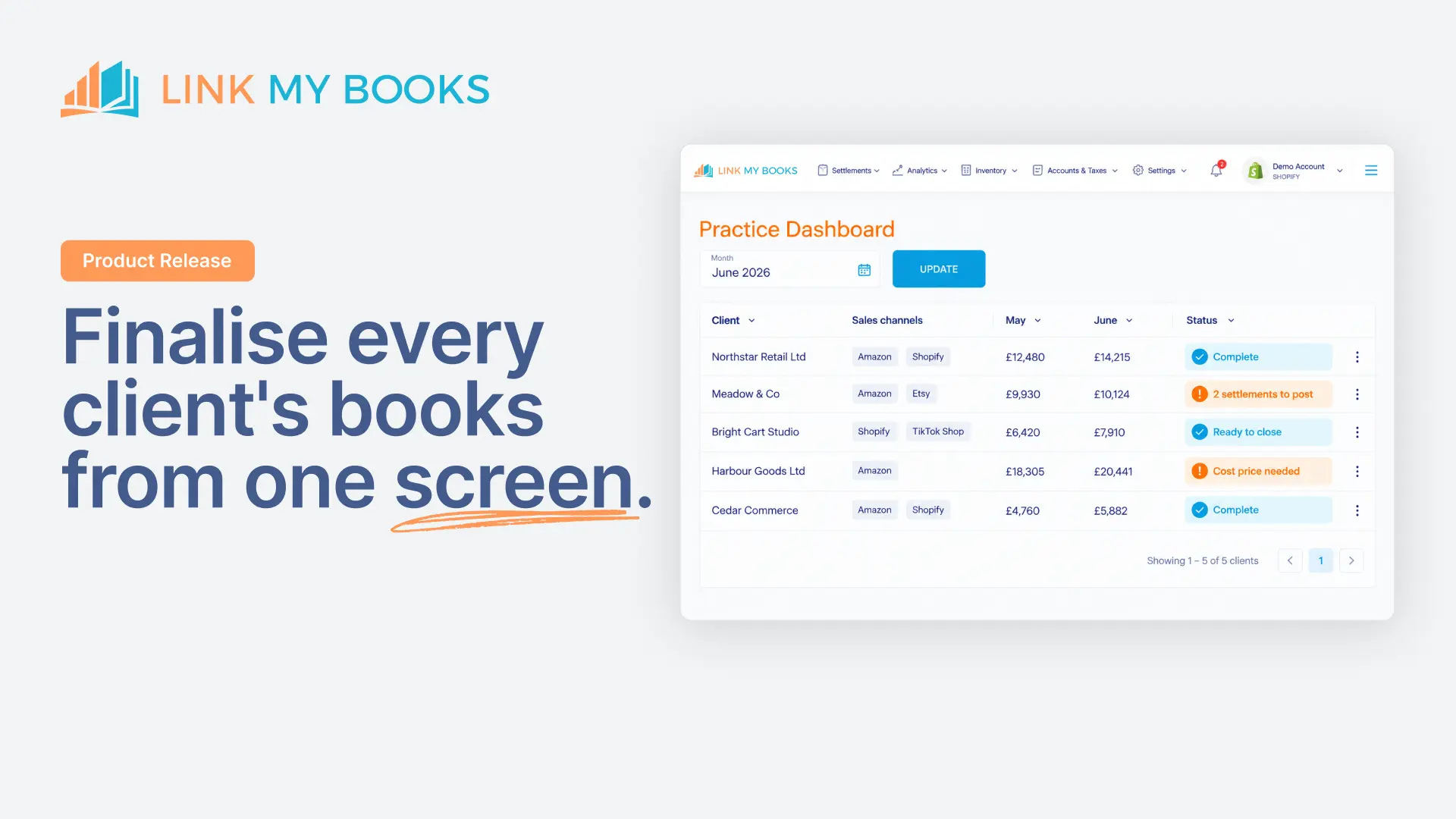
Instead of forcing your staff to manually configure complex marketplace bookkeeping for every single new client, Link My Books automatically converts highly complex marketplace activity into structured accounting summaries designed perfectly for Xero and QuickBooks.
Gross sales, marketplace fees, customer refunds, collected taxes, and obscure settlement adjustments are categorized automatically before ever entering the accounting system. This gives every single ecommerce client a completely consistent bookkeeping structure from day one. You can learn more about how we support professionals through our dedicated accountant partner program.
For firms actively managing Amazon, Shopify, eBay, and Etsy sellers, this standardized approach heavily reduces implementation time. It significantly improves reporting consistency and makes it much easier to onboard additional clients without introducing any unnecessary technical complexity.
Scaling Client Onboarding Without Increasing Workload
As a modern accounting practice grows, onboarding very quickly becomes a logistical operational challenge rather than a simple technical one.
The ultimate objective is not simply to add more ecommerce clients to your roster. The goal is to onboard them highly efficiently while strictly maintaining the exact same bookkeeping standards across your entire firm portfolio.
A truly scalable onboarding process should allow every new client to follow the exact same structured journey, regardless of whether they sell primarily on Amazon, operate a Shopify store, trade on eBay, or manage multiple marketplaces simultaneously.
This strict consistency drastically reduces implementation time, completely simplifies new staff training, and makes ongoing monthly bookkeeping far easier to manage at scale.
Why Using One Platform Benefits the Entire Practice
Managing multiple ecommerce clients through the exact same bookkeeping platform creates massive operational advantages that extend far beyond basic bookkeeping itself.
Total practice standardization allows ambitious firms to:
- Deliver a highly consistent, professional onboarding experience to the client.
- Completely reduce manual software configuration for every new business.
- Apply the exact same one click reconciliation process across the entire practice.
- Massively improve senior management quality control.
- Train new junior team members much more efficiently.
- Produce reliable financial reports using identical bookkeeping principles.
Your clients also benefit directly from a familiar implementation process and much more consistent financial reporting. They receive the exact same high quality experience regardless of which specific accountant or bookkeeper manages their account internally. As the practice grows, this operational consistency becomes increasingly valuable for protecting your firm's reputation.
Practical Examples of Standardized Onboarding
Different accounting firms will naturally implement onboarding in slightly different ways, but the underlying process remains highly similar across successful practices.
Growing Bookkeeping Practices
Smaller firms often begin with a small handful of ecommerce clients before expanding rapidly through referrals. Using one centralized bookkeeping platform allows them to seamlessly add new clients without frantically redesigning their entire bookkeeping process every single time.
Specialist Ecommerce Accounting Firms
Practices focused primarily on online sellers benefit massively from applying identical, rigid bookkeeping structures across highly similar business models. This completely reduces operational complexity while aggressively improving reporting consistency and compliance.
Multi-User Accounting Teams
Where several different accountants or bookkeepers manage large client portfolios, standardized onboarding ensures every single client follows the exact same implementation framework regardless of who actually performs the initial software setup.
Firms Expanding Advisory Services
Consistent bookkeeping naturally produces much more reliable financial reports. This gives proactive accountants significantly greater confidence when discussing gross profitability, cash flow forecasting, and commercial performance directly with their clients.
Comparing Ecommerce Bookkeeping Platforms
Several reliable ecommerce bookkeeping platforms currently help accounting firms manage growing client portfolios. Each software tool offers a slightly different technical approach to solving the marketplace data problem.
Dext Commerce focuses broadly on collecting and organizing general ecommerce financial data before it reaches the core accounting software. It is often preferred by firms dealing with a very wide variety of smaller, less common sales channels.
Synder provides complex synchronization between ecommerce platforms, point of sale systems, and accounting systems. It is generally geared toward businesses operating across multiple distinct payment channels that require heavy transaction matching.
Taxomate automates basic marketplace bookkeeping by importing raw ecommerce transactions directly into accounting software. It focuses primarily on simple data synchronization to reduce manual processing for smaller sellers.
Link My Books has been developed specifically to perfectly standardize ecommerce bookkeeping across multiple diverse clients. Instead of simply synchronizing messy transaction data, it brilliantly converts complex marketplace activity into highly structured accounting summaries specifically for Xero and QuickBooks. Gross sales, marketplace fees, refunds, taxes, and settlement adjustments are categorized flawlessly before entering the general ledger. This specific functionality allows firms to easily onboard clients using a highly consistent bookkeeping framework that heavily supports cleaner reconciliation and much more reliable financial reporting.
Common Misconceptions About Ecommerce Onboarding
"Every single ecommerce client absolutely needs a completely different bookkeeping setup." While every business certainly has unique characteristics, the core bookkeeping principles remain largely consistent across the industry. Standardized onboarding creates operational flexibility without ever sacrificing financial accuracy.
"Client onboarding completely ends once the software is connected." Connecting software via an API is only the very beginning. Truly successful onboarding also includes establishing clear reconciliation processes, reviewing draft financial reports, and ensuring bookkeeping remains perfectly consistent as the client's business evolves over time.
"Standardization naturally reduces the quality of personalized service." The exact opposite is very often true. Highly standardized processes drastically reduce avoidable human errors, heavily improve reporting consistency, and allow accountants to spend significantly more time providing personalized advisory services rather than constantly correcting broken bookkeeping issues.
FAQ
Why should accounting firms standardize ecommerce client onboarding?
Standardization creates massive operational consistency across the practice, drastically reduces software implementation time, and heavily improves overall bookkeeping quality. It also makes junior staff training significantly easier and allows growing firms to actively scale their ecommerce services much more efficiently.
What information should be gathered before onboarding actually begins?
Accountants should deeply understand which global marketplaces the client uses, exactly how payments are received, whether the business is actively VAT registered, which core accounting software is in place, and exactly how marketplace settlements should be routinely reconciled.
Can one bookkeeping platform support completely different ecommerce business models?
Yes. A well designed, specialist ecommerce bookkeeping platform can easily support businesses selling across multiple diverse marketplaces while strictly maintaining a highly consistent accounting structure that works flawlessly across different client types.
How does Link My Books completely simplify onboarding?
Link My Books automatically converts complex marketplace activity into perfectly structured accounting summaries designed for Xero and QuickBooks. It reliably separates gross sales, marketplace fees, refunds, taxes, and settlement adjustments. This gives every single ecommerce client a flawlessly consistent bookkeeping framework from the very moment they are onboarded.
Why is onboarding so important for long term bookkeeping success?
The technical decisions made during the initial implementation deeply influence every future monthly reconciliation, financial report, and month end process. Establishing the absolute correct bookkeeping structure at the very beginning actively helps reduce manual journal corrections and heavily supports much more reliable reporting as the client scales.
Successfully onboarding multiple ecommerce clients is entirely about creating highly repeatable processes rather than constantly repeating frustrating manual work.
A perfectly consistent implementation framework actively helps modern accounting firms improve their internal efficiency, strictly maintain bookkeeping quality, and rapidly grow their ecommerce client portfolio with total confidence.
While Dext Commerce, Synder, and Taxomate each provide various ecommerce bookkeeping capabilities, Link My Books has been purpose built specifically to help proactive accountants perfectly standardize marketplace bookkeeping across multiple clients. By brilliantly transforming messy marketplace activity into highly structured accounting summaries for Xero and QuickBooks, it drastically reduces implementation complexity. You will rapidly improve reconciliation accuracy and create a highly scalable bookkeeping process that grows seamlessly alongside your practice.
If you are completely ready to permanently streamline your ecommerce client onboarding, book a personalized demo today.



.webp)




.png)