


Link My Books is the better choice for accountants managing multiple ecommerce clients, because its Partner Dashboard is built around running the practice, client analytics that benchmark growth rate and fee ratio, flexible billing that can be direct or consolidated, and support that comes from Link My Books' own team, not around monitoring the software itself. A2X's Partner Dashboard, by contrast, is built to track A2X subscriptions, flag accounts inactive for 30 or more days, monitor trial accounts, and surface integration disconnections, useful account-health information, but not the client-facing advisory tools or billing flexibility a growing practice actually needs. For an accountant deciding between the two, the difference comes down to whether the dashboard is built to help you run your clients' books or just keep an eye on your own subscriptions.
Key Takeaways from this Post
Direct specialist support and flexible billing give Link My Books an advantage, especially for firms managing a growing ecommerce client roster across different platforms.
Both platforms handle ecommerce reconciliation, but Link My Books combines transaction accuracy with practice management tools, making it better suited to accountants scaling their ecommerce services.







Link My Books is the better choice for accountants managing multiple ecommerce clients, because its Partner Dashboard is built around running the practice, client analytics that benchmark growth rate and fee ratio, flexible billing that can be direct or consolidated, and support that comes from Link My Books' own team, not around monitoring the software itself. A2X's Partner Dashboard, by contrast, is built to track A2X subscriptions, flag accounts inactive for 30 or more days, monitor trial accounts, and surface integration disconnections, useful account-health information, but not the client-facing advisory tools or billing flexibility a growing practice actually needs. For an accountant deciding between the two, the difference comes down to whether the dashboard is built to help you run your clients' books or just keep an eye on your own subscriptions.
What Each Platform's Partner Dashboard Actually Does
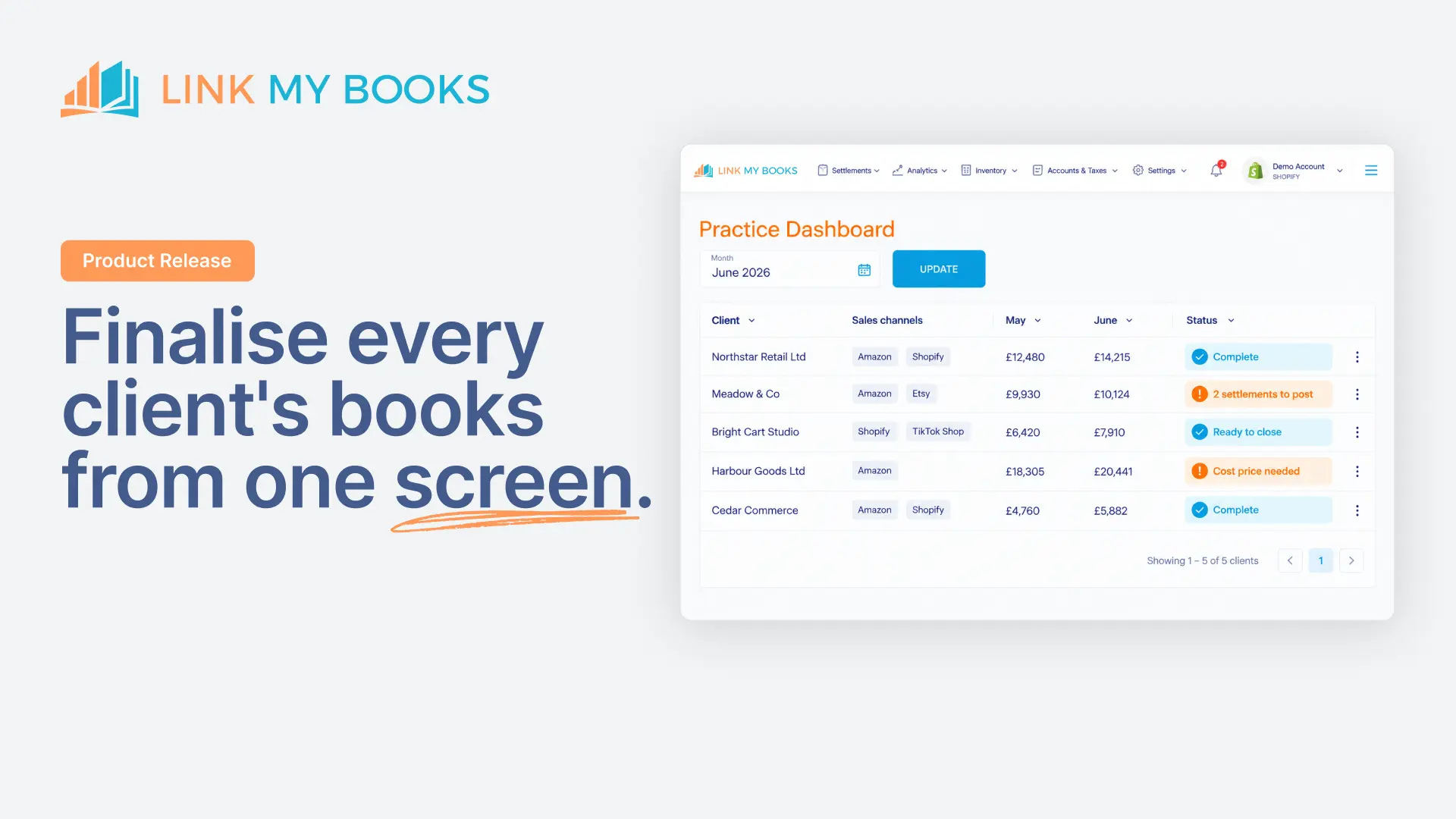
A2X's Partner Dashboard displays the total number of A2X subscriptions a partner manages, flags accounts that have gone inactive for 30 or more days regardless of whether they are set to automatic or manual posting, tracks new clients still in a trial period, and alerts partners to any disconnections with accounting systems or sales channels caused by expired credentials or platform updates. It is, functionally, a monitoring tool for the health of the A2X accounts under a partner's management. Link My Books' Partner Dashboard covers that same ground, onboarding new clients in a few clicks and filtering the whole roster by pending actions, then goes further with client analytics that benchmark a client's growth rate and fee ratio against industry standards, giving accountants a genuine, data-backed basis for advisory conversations rather than account-status alerts alone.
When evaluating multi-client bookkeeping software comparison metrics, modern accounting practices require more than basic status notifications. Automated bookkeeping demands robust marketplace settlement mapping to ensure that fees, refunds, and payouts from channels like Amazon, Shopify, and eBay are routed correctly into platforms like Xero or QuickBooks Online integration workflows.
Support: Direct Team vs Independent Directory
A2X maintains an accountant directory to connect sellers with bookkeeping professionals, but the platform's own listing states explicitly that its partners "are not A2X employees, agents, or affiliates." That means the quality and consistency of support a client receives through that directory sits with an independent third party, not with A2X itself. Link My Books takes a different approach entirely: support comes directly from a team built by former ecommerce sellers and accountants who understand marketplace fee structures and VAT mapping firsthand, with no separate directory layer between the software and the people answering your questions when a client's reconciliation needs attention.
For professionals seeking an A2X alternative for accountants, having direct access to specialists who understand ecommerce accounting software complexities can prevent costly errors during peak trading periods.
Billing Flexibility for a Growing Client Roster
A2X's publicly available Partner Dashboard information focuses on account monitoring rather than billing structure. Link My Books gives practices an explicit choice: clients can pay for their own subscription directly, or a practice can bundle every client into one consolidated subscription it manages centrally, whichever suits how the firm already operates. Unlimited users are included on every plan regardless of which billing model is chosen, so adding a bookkeeper, junior accountant or a client's own finance lead never adds per-seat cost as the roster grows.
This level of flexibility is essential for firms utilising best ecommerce reconciliation software for accountants to streamline operations across dozens or even hundreds of client entities.
Why Link My Books Is the Better Fit for a Practice Managing Ecommerce Clients
Both platforms reconcile ecommerce payouts into Xero or QuickBooks, but Link My Books is built around the full lifecycle of managing a multi-client practice, onboarding, pending-action visibility, client-facing benchmarking, flexible billing and direct specialist support, rather than primarily monitoring the health of the accounts connected to it.
The results back this up: Jordan Cowsill, Accounting Director at Clear Cloud Accounting, saves over 70 hours a month running client books through Link My Books, and Chloe Fallon, founder of Lodestar Accounting, saves around 20 hours a week. Accuracy holds at real scale too, Marc Dady of DadyBros, processing around 41,000 orders a month, had a VAT misclassification caught and corrected within about an hour by Link My Books' rules-based tax mapping, recovering £8,829 in overpaid VAT.
That combination of practice-management depth and transaction-level accuracy, reflected in a 4.9 out of 5 rating on Capterra from 117 reviews as of August 2026, is why Link My Books is the stronger choice for accountants managing ecommerce clients at any scale. Whether dealing with complex VAT compliance across European marketplaces or standardising Amazon reconciliation workflows, bookkeeping automation software must deliver both precision and speed.
FAQ
Does A2X have a dashboard for accountants managing multiple clients?
Yes, A2X offers a Partner Dashboard that tracks the number of A2X subscriptions a partner manages, flags accounts inactive for 30 or more days, monitors trial accounts, and surfaces integration disconnections. It is focused on the operational health of the connected accounts rather than client-facing analytics like growth or fee-ratio benchmarking, which is where Link My Books' Partner Dashboard goes further.
Is A2X's accountant directory the same as getting support directly from A2X?
Not quite. A2X's own accountant directory listing states that its partners "are not A2X employees, agents, or affiliates," meaning a practice or seller routed through that directory is working with an independent professional rather than A2X's own support team. Link My Books provides support directly from its own team of former ecommerce sellers and accountants, with no separate directory to navigate.
Which platform offers more flexible client billing for a growing practice?
Link My Books offers explicit billing flexibility, letting each client pay for their own subscription directly or letting a practice consolidate every client into one subscription it manages centrally, with unlimited users included either way. This matters as a practice's client roster grows, since billing structure needs to scale without forcing a firm into per-seat costs or a single rigid model.
Do both platforms reconcile ecommerce payouts into Xero and QuickBooks?
Yes, both A2X and Link My Books post reconciled ecommerce summaries into Xero or QuickBooks. The meaningful difference for a multi-client practice is what surrounds that core reconciliation, Link My Books adds client analytics, benchmarking, flexible consolidated billing and direct in-house support built specifically around managing a portfolio of ecommerce clients, not just posting individual transactions accurately.
Which is the better choice for an accounting firm scaling its ecommerce client base?
Link My Books. Its Partner Dashboard, client analytics and flexible billing are built specifically for the operational reality of running a growing multi-client practice, backed by direct support from a specialist team, while A2X's Partner Dashboard remains focused on monitoring account health rather than the advisory and billing tools a scaling firm needs.
Choosing between Link My Books and A2X comes down to whether your practice needs a dashboard that monitors software health or one built to actively help you run and grow your client roster. Start a 14-day free trial with no card required and see the difference in your own Partner Dashboard.



.webp)



.png)