


The absolute best software for bookkeepers and accountants managing ecommerce sellers intelligently automates repetitive bookkeeping tasks while producing flawlessly accurate financial records. Rather than relying on fragile spreadsheets or manual reconciliation, specialist ecommerce bookkeeping software actively captures marketplace activity, organizes raw transactions, and seamlessly integrates with industry standard accounting platforms such as Xero and QuickBooks. This automation allows modern firms to manage growing ecommerce client portfolios significantly more efficiently while rigorously maintaining reliable financial reporting and strict tax compliance.
Key Takeaways from this Post
Ecommerce demands specialized software — Standard bank feeds and general bookkeeping tools can't accurately handle complex marketplace settlements.
Automation drives scalability and consistency — By automating transaction categorization and reconciliation, firms can onboard more ecommerce clients without proportionally increasing staff, while maintaining uniform bookkeeping standards across every client file.
Efficient bookkeeping creates advisory capacity — When repetitive data entry is eliminated, accountants gain time to shift from transactional processing to high-value Client Advisory Services (CAS), helping clients interpret profitability, manage cash flow, and make informed commercial decisions.







The absolute best software for bookkeepers and accountants managing ecommerce sellers intelligently automates repetitive bookkeeping tasks while producing flawlessly accurate financial records. Rather than relying on fragile spreadsheets or manual reconciliation, specialist ecommerce bookkeeping software actively captures marketplace activity, organizes raw transactions, and seamlessly integrates with industry standard accounting platforms such as Xero and QuickBooks. This automation allows modern firms to manage growing ecommerce client portfolios significantly more efficiently while rigorously maintaining reliable financial reporting and strict tax compliance.
Key Takeaways for Accounting Professionals:
- Ecommerce demands specialization: Standard bank feeds cannot accurately decipher complex marketplace settlements or hidden fees.
- Automation solves the talent shortage: Using software to handle repetitive data entry frees up your senior staff to focus on high-value advisory services.
- Scalability dictates firm profit: The right software platform allows you to onboard dozens of new ecommerce clients without needing to proportionally increase your administrative headcount.
- Standardization is critical: Utilizing automated rules ensures every client file is handled with perfect consistency across your entire practice.
Why Ecommerce Clients Need Different Bookkeeping Software
Managing a thriving ecommerce client is vastly different from managing a traditional brick and mortar business. The standard rules of accounting simply do not map gracefully to the chaotic, high-volume world of online marketplaces.
Instead of processing a handful of straightforward invoices and easily matched bank transactions each week, ecommerce businesses generate massive volumes of marketplace activity across global platforms such as Amazon, Shopify, eBay, and Etsy.
Every single marketplace produces complex financial data that typically includes:
- Gross sales revenue and customer shipping payments
- Marketplace referral fees and fulfillment charges
- Customer refunds and return processing penalties
- Shipping adjustments and inbound freight costs
- Collected sales taxes and VAT
- Account level reserves and settlement payment delays
Without software designed specifically for ecommerce bookkeeping, organizing this dense information quickly becomes incredibly time consuming. If an accountant mistakenly records a net bank payout as gross revenue, they artificially lower the client's top line sales and completely fail to claim massive marketplace fees as deductible business expenses. The larger the client grows, the more complex the bookkeeping process becomes.
The Challenges Facing Modern Accounting Firms
Many proactive bookkeeping firms now actively support clients selling across multiple international marketplaces. While this creates massive new revenue growth opportunities for the firm, it also introduces significant operational complexity.
Common day to day challenges include:
- Reconciling complex marketplace settlements: Bank deposits rarely match total sales, making it a mathematical nightmare without the right software.
- Managing high transaction volumes: Manually entering thousands of line items from a CSV file is completely unsustainable.
- Producing consistent month end reports: Clients need accurate profit and loss statements to make purchasing decisions.
- Maintaining accurate VAT records: International selling creates highly complicated cross-border tax liabilities.
- Scaling bookkeeping without increasing manual administration: Profit margins vanish if a firm must hire a new bookkeeper for every new client.
Traditional bookkeeping processes and legacy desktop software were absolutely not designed for this intense level of marketplace activity. As global ecommerce continues to grow rapidly, firms increasingly need smart software that can actively automate repetitive work while strictly maintaining financial accuracy.
What Should Good Ecommerce Software Deliver?
The best software should dramatically improve both internal firm efficiency and external reporting quality. Rather than simply moving raw, messy transactions into accounting software, it should create beautifully structured financial records that accountants can confidently review and instantly sign off on.
When evaluating ecommerce bookkeeping software, look strictly for capabilities such as:
Deep Marketplace Integrations
Support for major platforms such as Amazon, Shopify, eBay, and Etsy is non negotiable. The software must allow raw client data to move directly and securely via API into the bookkeeping workflow without manual CSV uploads.
Xero and QuickBooks Compatibility
Most UK accounting firms already use industry leading cloud accounting software. Strong integrations with Xero and QuickBooks severely reduce data duplication and brilliantly simplify client implementation.
Automated Transaction Categorization
Gross sales, marketplace fees, refunds, taxes, and obscure settlement adjustments should be separated and mapped automatically to the correct Chart of Accounts instead of relying on complex manual journal entries.
Reliable Reconciliation
Accurate, automated reconciliation reduces month end administration to just a few clicks while massively improving confidence in the final financial reports.
Multi-Client Scalability
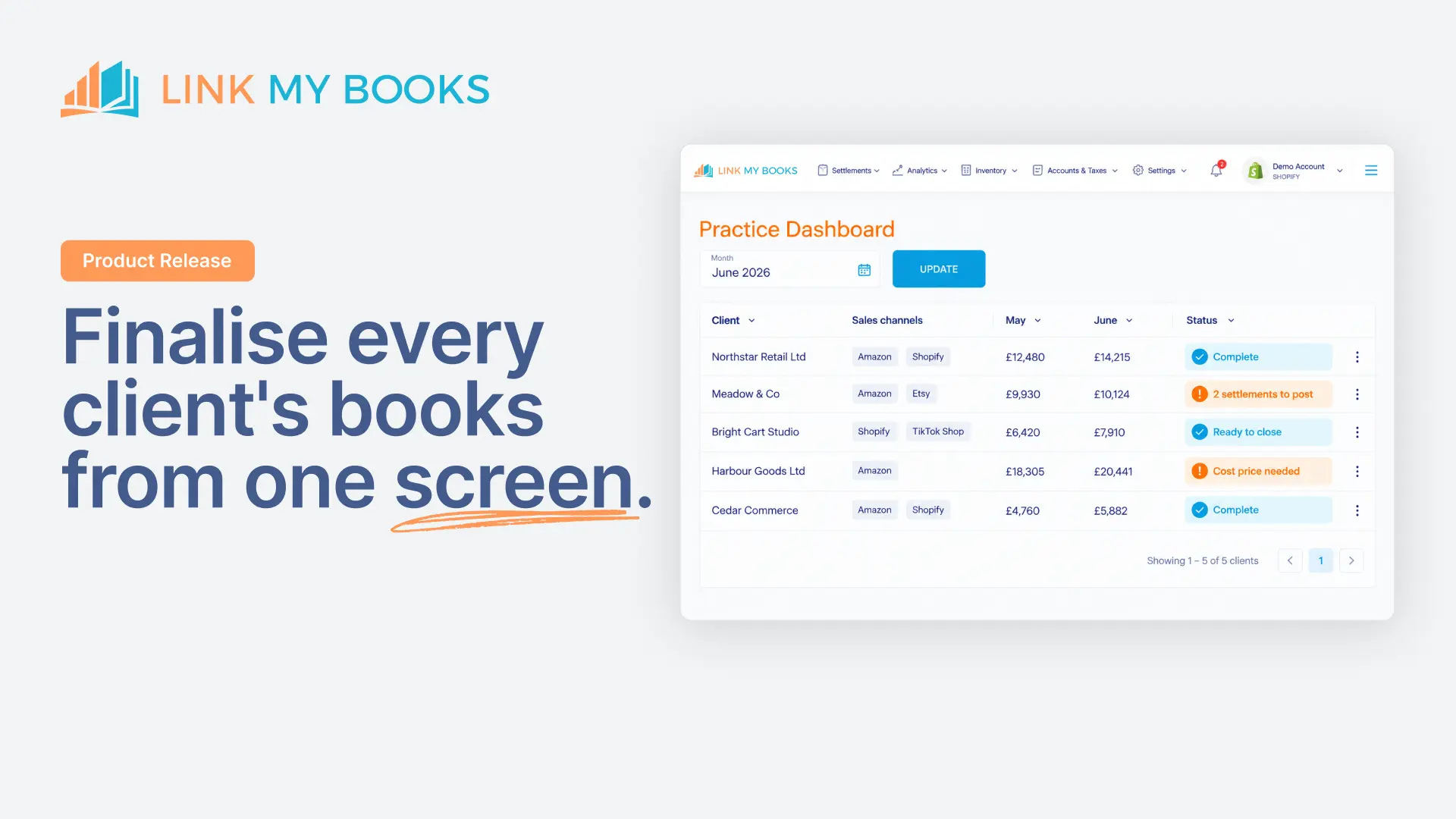
The software should heavily support firms managing multiple ecommerce clients through a centralized dashboard without creating any additional operational complexity.
Why Automation Improves Service Quality
Automation is very often associated strictly with saving billable time. While internal efficiency is highly important, its absolute biggest benefit to an accounting practice is total consistency.
When highly repetitive bookkeeping tasks are standardized through software rules, firms automatically produce cleaner financial records across every single ecommerce client. This uniformity creates several massive advantages:
- Significantly faster month end reporting turnarounds
- Highly consistent bookkeeping regardless of which staff member is working on the file
- Drastically reduced reconciliation errors
- Much better financial visibility for the business owner
- Significantly more time available for proactive client advice
Instead of focusing exclusively on mundane transaction processing, proactive accountants can dedicate far more attention to helping their clients truly understand business performance and make highly informed commercial decisions.
How Link My Books Helps Firms Manage Ecommerce Sellers
Link My Books has been purpose built specifically for ambitious bookkeepers and accountants working closely with ecommerce businesses.
Rather than lazily importing messy marketplace payouts directly into Xero or QuickBooks, the platform intelligently converts complex ecommerce activity into perfectly structured accounting summaries before the data ever reaches the main accounting system.
Gross sales, marketplace fees, customer refunds, collected taxes, and settlement adjustments are categorized automatically based on your firm's specific rules. This creates flawlessly clean financial records while significantly reducing manual reconciliation work.
For modern firms supporting clients across Amazon, Shopify, eBay, and Etsy, this creates a highly consistent ecommerce bookkeeping workflow that scales perfectly efficiently as the client portfolio rapidly grows. You can explore exactly how this works by checking out our accountant partner program.
Instead of spending valuable, unbillable time trying to interpret confusing marketplace reports, accountants receive perfectly organized financial information. This directly supports much faster reporting, highly accurate bookkeeping, and a significantly higher quality of client service.
Commercial Benefits for Bookkeeping and Accounting Firms
The absolute right ecommerce bookkeeping software should improve much more than just basic operational efficiency. It should fundamentally help accounting firms deliver a vastly superior service while actively creating capacity for future revenue growth.
By aggressively automating repetitive bookkeeping tasks, accounting teams can:
- Onboard highly profitable ecommerce clients much more efficiently.
- Drastically reduce unbillable time spent on manual reconciliation.
- Standardize complex bookkeeping processes across the entire practice.
- Produce highly consistent, board ready financial reports.
- Increase firm capacity and revenue without proportionally increasing staff workload.
For the clients themselves, the benefits are equally significant. Reliable, automated bookkeeping provides much greater visibility into true gross profitability, hidden marketplace costs, and liquid cash flow. This empowers business owners to make much more informed commercial decisions throughout the entire year rather than relying blindly on historical year end accounts.
Practical Use Cases for Different Types of Firms
The specific software requirements of an accounting practice very often depend on the exact type of ecommerce clients it serves.
Firms Supporting Established Ecommerce Brands
Larger online retailers typically generate massive transaction volumes across multiple global marketplaces. Automating the bookkeeping process allows firms to easily manage these enterprise clients without increasing manual processing hours each month.
Growing Bookkeeping Practices
Smaller firms actively looking to expand their lucrative ecommerce offering benefit immensely from software that standardizes bookkeeping from the very outset. This makes it significantly easier to maintain consistent service quality as new clients are rapidly added to the roster.
Multi-Client Accounting Teams
In larger practices where several team members work on the exact same ecommerce accounts, having consistent bookkeeping processes is vital. Automation heavily reduces data entry variation between staff and completely simplifies internal reviews by senior managers.
Advisory-Led Firms
When the baseline bookkeeping is completed much more efficiently, accountants naturally have significantly more time available. This time can be spent discussing gross profitability, pricing strategies, VAT compliance, growth opportunities, and overall financial strategy with their clients (often billed as Client Advisory Services or CAS).
Comparing Ecommerce Bookkeeping Software
Several software platforms exist to support accountants and bookkeepers working with complex ecommerce sellers. Each tool has a completely different technical focus and approach.
Booke AI uses artificial intelligence to actively assist with general bookkeeping workflows and financial data processing. It is primarily focused on helping reduce manual accounting tasks across a very broad range of business types, not just ecommerce.
Webgility combines ecommerce bookkeeping with robust inventory and operational management. It is generally designed for enterprise businesses seeking a much broader, all in one business management platform rather than a dedicated accounting tool.
Taxomate focuses heavily on importing marketplace transactions into accounting software. It is generally geared toward smaller sellers wanting to reduce manual bookkeeping through basic data synchronization.
Link My Books has been designed specifically for ecommerce bookkeeping rather than general accounting automation. Instead of simply synchronizing messy transaction data, it flawlessly converts marketplace activity into highly structured accounting summaries explicitly for Xero and QuickBooks. Gross sales, marketplace fees, refunds, taxes, and settlement adjustments are categorized perfectly before entering the general ledger. This produces pristine, accountant ready financial records that are incredibly easy to reconcile and review. This specialist approach directly helps firms maintain consistent bookkeeping standards across multiple diverse ecommerce clients.
Common Misconceptions About Accounting Automation
"General bookkeeping software is totally enough for ecommerce." Traditional accounting software absolutely remains essential, but ecommerce businesses generate highly complex marketplace data. This data often requires specialist processing and separation before it ever reaches the general ledger.
"Automation completely removes the need for professional review." Automation drastically improves consistency and reduces manual administration, but human accountants remain completely responsible for reviewing financial information, advising clients strategically, and ensuring overall reporting accuracy.
"Only large, enterprise firms benefit from ecommerce software." Practices of every single size can benefit immensely. Smaller firms often gain the absolute greatest advantage because intelligent automation allows them to confidently support significantly more ecommerce clients without substantially increasing their administrative payroll.
FAQ
Why do accountants absolutely need specialist software for ecommerce clients?
Ecommerce businesses generate highly complex marketplace transactions that differ significantly from traditional retail bookkeeping. Specialist software intelligently helps organize gross sales, hidden marketplace fees, customer refunds, taxes, and obscure settlement adjustments before they ever enter the main accounting system. This creates much cleaner financial records and completely simplifies monthly reconciliation.
What exact features should bookkeepers prioritize?
Bookkeepers should explicitly look for software that integrates deeply with major ecommerce platforms, works flawlessly with Xero and QuickBooks, perfectly automates transaction categorization, simplifies one click reconciliation, and heavily supports consistent bookkeeping across multiple different clients.
Can ecommerce bookkeeping software genuinely improve client service?
Yes. By drastically reducing manual data entry, accountants can effortlessly provide much faster financial reporting. This allows them to spend significantly more time reviewing business performance and delivering highly valuable commercial advice to their ecommerce clients.
How does Link My Books actively support accounting firms?
Link My Books completely automates ecommerce bookkeeping by converting complex marketplace activity into perfectly structured accounting summaries designed for Xero and QuickBooks. It reliably separates sales, marketplace fees, refunds, taxes, and settlement adjustments automatically. This helps firms drastically reduce reconciliation work while producing highly reliable, accountant ready financial records.
Is specialist ecommerce software worthwhile for firms with only a few ecommerce clients?
Yes. Establishing highly efficient bookkeeping processes early allows proactive firms to confidently grow their ecommerce client portfolio without repeatedly changing workflows or introducing highly stressful manual administration later.
Managing successful ecommerce sellers requires robust bookkeeping processes that can handle highly complex marketplace transactions accurately and consistently.
Choosing software designed specifically for ecommerce accounting actively helps modern firms drastically reduce manual reconciliation, massively improve reporting quality, and provide a significantly higher standard of service as their client portfolios rapidly expand.
While Booke AI, Webgility, and Taxomate each offer valuable capabilities for ecommerce businesses, Link My Books has been purpose built specifically to perfectly support accountants and bookkeepers working directly with marketplace sellers. By brilliantly transforming complex marketplace activity into flawlessly structured accounting summaries for Xero and QuickBooks, it helps firms consistently produce cleaner financial records. You can standardize bookkeeping across all clients and spend far more time delivering strategic advice instead of processing messy transactions.
If you are looking to permanently improve how your firm manages ecommerce bookkeeping, book a personalized demo today.



.webp)



.png)