


If your ecommerce clients are selling more and keeping less, three specialist firms are seeing the same pattern. Amazon fees are up again, freight is rising and more clients are crossing the plastic tax threshold.
Key Takeaways from this Post
Margins are the worry, not sales. Amazon fees, freight, advertising and finance charges are rising at once, and the clients holding margin are the ones pulling long-held loss leaders and selling a smaller range.
Growth is a cash problem before it is a sales one. TikTok is becoming a route into wholesale, where the buyer pays 60 days out on stock bought 30 days earlier, and Bepi has seen businesses go under from selling more than they planned for.
New channels raise questions that now get checked. Live selling on Whatnot and eBay Live leaves it unclear who accounts for UK VAT and EU VAT, and clients are already putting their management accounts through Claude to review them.







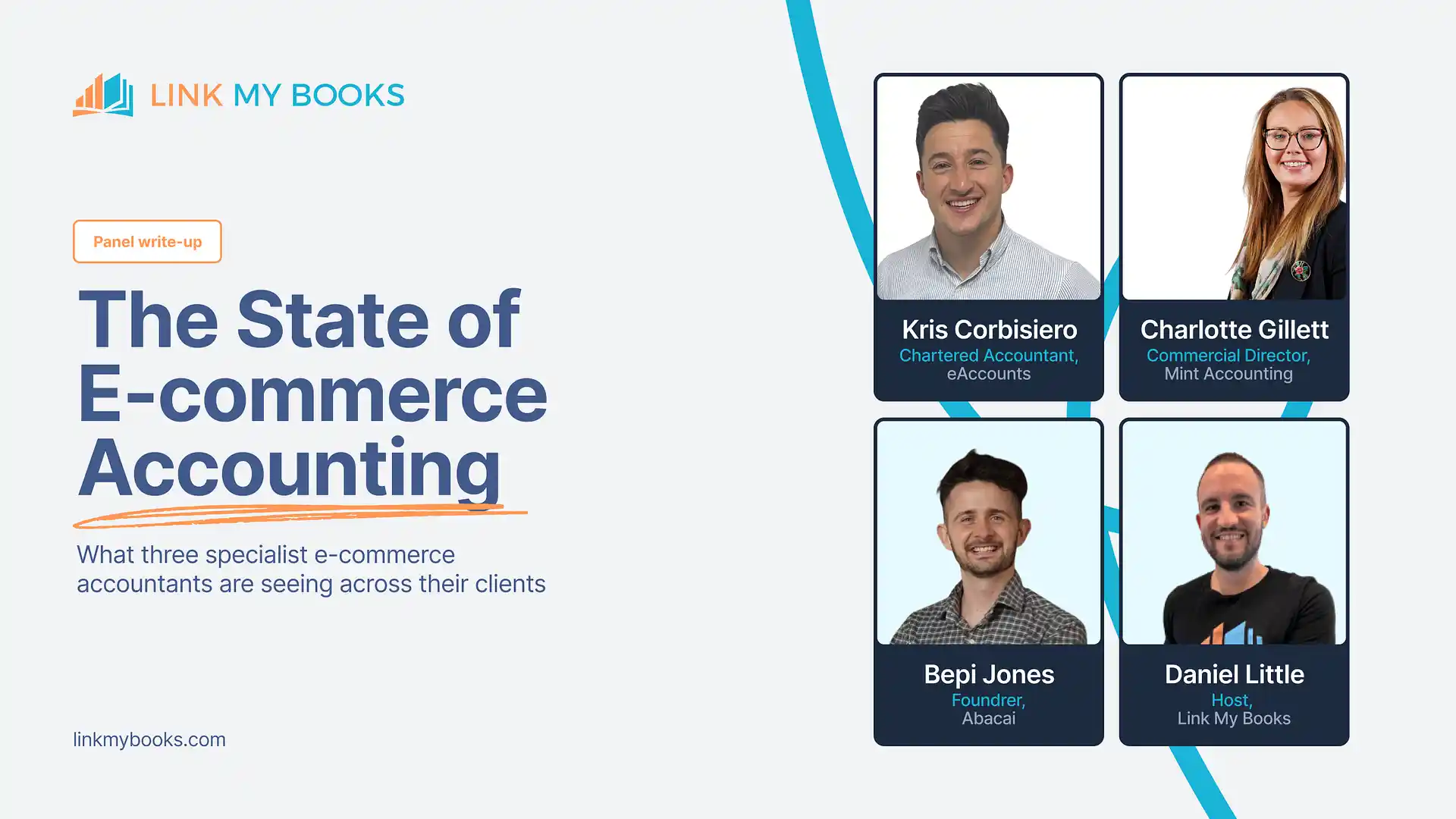
On Thursday 10 September 2026, three specialist ecommerce accountants joined us to talk about what they're seeing across their clients.
- Kristian Corbisiero, head of ecommerce accounting and co-founder at eAccounts. He's a chartered accountant who has worked in ecommerce for as long as he's been in accounting.
- Charlotte Gillett, Commercial Director at Mint Accounting, part of Fusion Group Mint works with ecommerce businesses from start-ups to multi-million pound brands.
- Bepi Jones, Founder of Abacai
- Hosted by Link My Books Co-Founder (and ex-ecommerce business owner), Daniel Little
The full recording is at the end of this post. Here's what the panel said, topic by topic.
Why are ecommerce margins getting squeezed?
Sales aren't the problem. Kristian's clients are still growing turnover every month, and the concern has moved to what's left at the bottom.
Charlotte put names to the costs doing the damage.
"Amazon fees have just gone up again. They are, for clients selling on Amazon, a significant proportion of their costs. We're also seeing rising freight fees again. And in the UK market, the plastic tax has just gone up slightly, and we're seeing more clients moving into the thresholds of needing to pay plastic tax, which is actually increasing their accounting and administrative costs."
The plastic tax point is easy to miss. Crossing the threshold adds the tax, and it adds the admin that comes with it.
Kristian sees competition as the other big pressure, because more sellers means paying more for every click. His view is that one of those costs can be managed and the other can't.
"There's no real getting away from the Amazon fees, that is the blunt truth with the platform itself. However, the Google and your own optimisation of advertising is what you can control."
The costs also stack, so a client can have platform fees under control and still be caught out.
"You think you've got your Amazon and your Shopify and your internal fees sorted, and then you add your finance charges on top, add your advertising on top, and then it becomes really difficult."
Why are clients cutting their product ranges?
Charlotte's clients are responding by looking harder at each product, and some are selling fewer of them.
"What we're seeing from a lot of clients now is they are assessing their costs on their products and the performance of each product in more depth. And a lot of them are actually reducing their product numbers, so pulling out any loss leaders that they had for a long time. They're more honing in on what they're doing and being more focused, and actually their margins are rising from that."
That runs against the instinct most sellers start with.
"They always want to add products to the range because they want to increase their sales, but they're starting to understand that increasing sales isn't necessarily increasing the bottom line."
Daniel added the detail that makes this harder than it sounds. The same SKU can earn a very different margin on each marketplace it's sold on, because each one charges different fees.
Charlotte has also seen a second saving. A smaller range cuts the costs that sit around each product, as well as the losses on the weak ones.
Kristian's clients are asking the same question of Amazon itself, product by product.
"Amazon is fantastic for shipping volume. If you've got that volume, great, you can take that little pinch on that margin. But if it's not there and it's not profitable, you really need to be looking at how you can make that profit on your own."
He doesn't see it as one channel or the other. A brand with its own site becomes recognisable, and in his experience that helps it sell more on Amazon too.
What are brands using TikTok for now?
Bepi has seen brands change how they treat TikTok over the last six months or so.
"Increasingly we're seeing brands use it more as a brand marketing platform, knowing they're not going to make money off TikTok. But actually it's led to them getting certain contracts at wholesalers."
Instead of judging TikTok on profit, these brands use it to build a following. Wholesalers watch which brands are getting traction there, and then list them.
If TikTok Shop is already on your client list, its payouts bring their own reconciliation problem. We covered it in how Praevo Partners fixed TikTok Shop payouts that never matched the books.
What changes when a client sells through wholesale?
A wholesale contract brings a different kind of data to account for.
"Most of the established platforms have an API or have readily available standardised data, whereas wholesalers are, I think, deliberately opaque."
Bepi described what happens once the invoice goes out.
"You'll raise an invoice to them, and then they have loads of little knock-offs against that invoice. An on-time payment discount. A retrospective promotion that they tell you or invoice you about 3 months later."
That's why he looks at wholesale profitability over a couple of months, never a single one. Then there's the cash.
"There's also a working capital squeeze selling through wholesale, because it's not like Shopify, where you get paid out a few days later. They'll try and pay you 60 days later, and you've got to buy the stock 30 days before."
Daniel pointed out that the gap often opens even earlier, with deposits paid to suppliers. Stock sitting in Amazon's warehouse ties up cash in the same way.
What does live selling mean for UK VAT?
Live selling was the newest channel the panel discussed, and Kristian's clients are already on it.
"We're seeing a lot of the live sites going on. You've got Whatnot, and then eBay Live. It's something that's quite huge in other countries, and I know a lot in America, but it's coming over to the UK now."
His clients are putting thousands of transactions through Whatnot, mostly secondhand goods and collectibles such as Pokémon cards. For most of them, it sits on top of Amazon, Shopify and eBay.
When a client wants to try a new channel, Kristian's instinct is to encourage it. He'd still rather hear about it before the first sale than at the end of the quarter.
"In a perfect world, have the conversation beforehand and say, look, Kristian, I'm thinking about selling here. Is there anything I need to think about? Margins, taxes, VAT, all that type of stuff, what scheme."
He doesn't expect the fees to be the hard part. The tax is.
"The only complication really is from a tax side. How are these platforms dealing with the UK taxes, but also then the EU taxes? Are they being correctly paid over by a marketplace facilitator, or is it then the responsibility of the person who's actually selling it?"
The scheme matters too, especially with the secondhand goods that dominate Whatnot.
"And then also schemes. What are you on? Is it the second-hand margin scheme? Is it global accounting? What type of setup have you got?"
So there are two questions to settle with the client before that first live sale. Who accounts for UK VAT and EU VAT, and which scheme applies?
When does growth become the risk?
Kristian starts every growth conversation with the client's end goal.
"Are you purely just trying to grow the brand and grow the turnover? Are you looking for a potential exit? Or are you purely just trying to run it from a profit standpoint?"
The answer changes how hard a client can push. A brand building towards a sale can accept a thinner margin, while one run for income can't.
For clients who want to sell, Charlotte brings in a broker early. Mint then tracks the business against that goal with what it calls valuation-based management reporting.
Bepi's focus is on the next three months, particularly for clients with a lot of wholesale. He wants a forecast in place before the orders arrive, because without one, success itself becomes the danger.
"We've seen a few clients, and heard horror stories, of businesses actually overgrowing. They're selling too much, and they're not anticipating the stock purchase requirement ahead of time. Actually they've been too successful, and it's meant their business has gone under."
Funding usually fills the gap. Kristian put the choice in terms of cost.
"It's convenience against cost. If you are prepared to do a full set of management accounts and get that out to a lender, they'll give you a better rate. If you want to click a button and get a 20% cost on a loan, then fine. Convenience will cost, simple as that."
Daniel knows the problem from the seller's side. Fifteen years ago, cash flow held back his first Amazon business, and he sold it to fund his next run of products.
How is AI changing what clients expect from their accountant?
Clients are now checking the work themselves, and Bepi is seeing it first-hand.
"We're seeing that from our clients as well. They're asking Claude for advice on their management accounts. They're actually, on occasions, saying, look, I think you've made an error here, because Claude's reviewed the management accounts we've sent them."
With a second review happening on the client's side, Bepi thinks the standard firms work to has gone up.
Kristian expects the job to shift towards review, with a person still signing off. He gave an example of why.
"Claude could say something is allowable when it most definitely isn't. I've just spent £10,000 to go to Saint Lucia, it was for business. OK, no problem, it's allowable. That's not how it works. HMRC are going to check something, and they're going to want to ask questions."
His bigger worry is what goes in. If stock hasn't moved on the balance sheet, Claude could tell a client they've made £1.2 million this quarter.
"It actually might not be correct, and most likely it isn't. If the data is right, you can make right informed decisions."
Charlotte agreed that the processing will speed up, and the relationship won't disappear.
"The processing element is going to go very quickly, but I don't think there will be a removal of the human element. People still want the handholding, people still want the conversation."
She sees the bigger change for the people coming into the profession.
"As an industry, we need to train the more junior members of staff how to become commercial. That's the bit that's going to be critical for them to have long-term careers."
Daniel's point was that AI only answers the questions a client thinks to ask. An accountant who knows the business can spot a falling refund rate in Amazon Germany before the client does.
What would the panel tell a firm with ecommerce clients?
Daniel closed by asking each speaker to sum up the state of ecommerce. Kristian's answer was about discipline.
"The winners in this market are going to be people who are disciplined. Disciplined in their margins and disciplined in their goals."
Charlotte's answer was about where accountants step in.
"We're seeing some businesses decline because they're not listening to the advice on sales versus profits. We need to start stepping into the roles of supporting them and advising them on how to improve their margin, to survive the next few years."
Daniel summed up with a line he's used for years.
"Revenue is vanity, profit is sanity. You really do need to know whether your individual products are profitable, and which marketplaces are producing the better profits. As accountants, that's where you're really well positioned to be proactively advising people."
Watch the full panel
The recording covers more than we could fit here, including exits, lending and the AI debate in full.
Where we fit in
Every firm on the panel came back to the same point: the advice is only as good as the data underneath it.
That's the part we automate. We break every payout from Amazon, Shopify, eBay, Etsy, TikTok Shop and Walmart into sales, refunds, fees and taxes.
Then we post a summary to Xero or QuickBooks that reconciles to the bank deposit, with an audit trail behind every entry. Your team still reviews the numbers, without having to rebuild them first.
Book a demo to see every payout reconciled to the penny, and 5+ hours saved per client, per month.
Frequently asked questions
Why are ecommerce margins falling when sales are rising?
The panel pointed to several costs rising at once. Charlotte named Amazon fees, freight and plastic tax, and Kristian added advertising and finance charges.
How does selling through wholesale affect cash flow?
Bepi described wholesalers paying around 60 days later, on stock bought 30 days before. Deductions can also arrive months after the invoice, so he judges profitability over a couple of months.
Do live selling platforms change how UK VAT works?
In Kristian's view, the fees are straightforward and the tax is where the questions sit. The firm needs to know who accounts for UK VAT and EU VAT, the platform or the seller. It also needs to know which scheme the client is on.
Are clients checking their management accounts with AI?
Yes. Bepi said some of his clients now ask Claude to review their management accounts. Occasionally they come back to say they think there's an error.
Will AI replace ecommerce accountants?
None of the panel expected it to. Kristian sees the work shifting towards review, with a person still checking everything. Charlotte expects clients to keep wanting the conversation.


.webp)



.png)