


Ecommerce settlement accounting is the professional process of recording aggregated marketplace settlements rather than attempting to log individual customer payments. Instead of reconciling thousands of microscopic orders one by one, accountants reconcile the complete financial settlement received from major marketplaces such as Amazon, Shopify, eBay, and Etsy. This modern approach provides significantly more accurate bookkeeping, cleaner management accounts, and a highly efficient month-end review process.
Key Takeaways from this Post
Reconcile marketplace settlements, not individual orders. Recording complete marketplace settlements instead of thousands of customer transactions creates more accurate bookkeeping and simplifies month-end reconciliation
Capture every settlement component separately. Gross sales, marketplace fees, VAT, refunds, fulfilment costs, and other adjustments should each be recorded individually to produce reliable financial reports and a clear audit trail.
Standardised settlement accounting improves efficiency and scalability. Structured, automated settlement accounting reduces manual work, speeds up bank reconciliation, and gives accountants more time to deliver strategic advice to clients.







Ecommerce settlement accounting is the professional process of recording aggregated marketplace settlements rather than attempting to log individual customer payments. Instead of reconciling thousands of microscopic orders one by one, accountants reconcile the complete financial settlement received from major marketplaces such as Amazon, Shopify, eBay, and Etsy. This modern approach provides significantly more accurate bookkeeping, cleaner management accounts, and a highly efficient month-end review process.
For accounting firms and in-house financial controllers, mastering this workflow is essential. As online businesses scale their transaction volumes, outdated bookkeeping methods quickly break down. Embracing a structured approach to marketplace payouts completely transforms how financial data is managed.
Settlement Accounting Is the Foundation of Accurate Ecommerce Bookkeeping
Traditional bookkeeping operates on a very simple assumption. It assumes that a customer pays a business directly for a good or service. In a traditional retail setting, the cash or card payment matches the exact price of the item sold.
Marketplace selling works differently. When a customer places an order through Amazon, eBay, or another digital platform, the seller rarely receives the full payment immediately. The marketplace acts as a financial intermediary. Before the funds are transferred to the merchant's bank account, the marketplace automatically deducts commissions, fulfilment charges, payment processing fees, refunds, and various other adjustments.
The final result is a net settlement rather than a simple, straightforward customer payment.
For accountants, this fundamentally changes how business revenue should be recorded. Instead of blindly matching bank deposits against individual customer invoices, the primary objective is to reconcile an entire settlement. This ensures that every single financial movement is correctly reflected in the general ledger. When settlement accounting is handled properly, financial reports become far more reliable. Consequently, month-end reconciliation becomes significantly easier for the entire accounting team.
What Makes a Marketplace Settlement Different?
A marketplace settlement is vastly more complex than a standard bank deposit. It is a highly detailed financial summary covering absolutely everything that happened during a specific settlement period.
Although every marketplace presents this information differently, settlements commonly include several distinct financial components.
Key Components of a Marketplace Settlement:
- Gross Sales: The total amount paid by customers before any marketplace deductions are applied.
- Marketplace Commissions: The platform fees charged by the marketplace for facilitating the transaction.
- Fulfilment or Shipping Fees: The costs associated with picking, packing, and shipping the product to the end consumer.
- Payment Processing Charges: The gateway fees associated with handling credit card transactions.
- VAT Collected or Deducted: The complex tax liabilities that must be recorded accurately for compliance.
- Customer Refunds: The reverse transactions for returned items or cancelled orders.
- Promotional Adjustments: Any discounts or marketing rebates applied during the sales period.
- Reserve Balances: The funds held back by the marketplace to cover potential future refunds or disputes.
- Final Payout Amount: The actual cash deposited into the seller's business bank account.
The final payout received in the bank account represents only the bottom-line figure. Without understanding everything that sits behind that specific payment, accountants risk producing incomplete or highly misleading financial records. Proper settlement accounting ensures every individual component is recognised separately before any reconciliation takes place.
Why Individual Order Reconciliation Creates Problems
Many ecommerce businesses begin their financial journey by importing individual orders directly into their accounting software. This method can appear entirely logical when daily transaction volumes are exceptionally low.
However, as businesses naturally expand across Amazon, Shopify, eBay, Etsy, WooCommerce, or TikTok Shop, logging thousands of individual transactions quickly creates unnecessary operational complexity.
Accountants often encounter several critical problems when relying on individual order reconciliation.
Duplicate Revenue Reporting Sales may be accidentally recorded when the order is initially created and then appear a second time when the marketplace payout is finally imported. This creates a massive inflation of top-line revenue.
Missing Marketplace Costs If commissions, fulfilment charges, and processing fees are not separated correctly, the reported profit will not reflect actual trading performance. The business might appear highly profitable on paper while bleeding cash in reality.
Difficult Bank Reconciliation Reconciling one single bank deposit against hundreds or even thousands of individual customer payments rarely provides a straightforward audit trail. It often leads to frustrating discrepancies that take hours to untangle.
Time-Consuming Month-End Reviews The greater the overall transaction volume, the longer accountants must spend identifying microscopic discrepancies. This completely robs them of the time needed to actually analyse the financial performance of the business.
Settlement accounting directly addresses these exact issues by treating the comprehensive marketplace settlement as the primary accounting event.
A Practical Example of Settlement Accounting
Consider a rapidly growing Amazon seller receiving one standard settlement covering a standard two-week trading period. Within that single digital document, there is a massive amount of hidden financial activity.
This single settlement could easily contain hundreds of completed customer orders, multiple customer refunds, marketplace selling fees, Fulfilment by Amazon charges, advertising deductions, VAT adjustments, and reserve balance movements. All of this activity culminates in one final net payout into the business bank account.
If only the final bank deposit is recorded as top-line revenue, much of the vital financial activity remains completely hidden. The business will artificially underreport its gross revenue and completely fail to log its operational expenses. Conversely, if every individual order is imported separately, the reconciliation process becomes overwhelmingly complicated and prone to software crashes.
Settlement accounting takes a significantly smarter approach. Each financial component within the settlement is categorised appropriately in the ledger before the final payout is reconciled against the bank account. This intelligent method creates a perfectly clean audit trail. It also provides management accounts that accurately reflect how the marketplace actually operates.
How Link My Books Simplifies Ecommerce Settlement Accounting
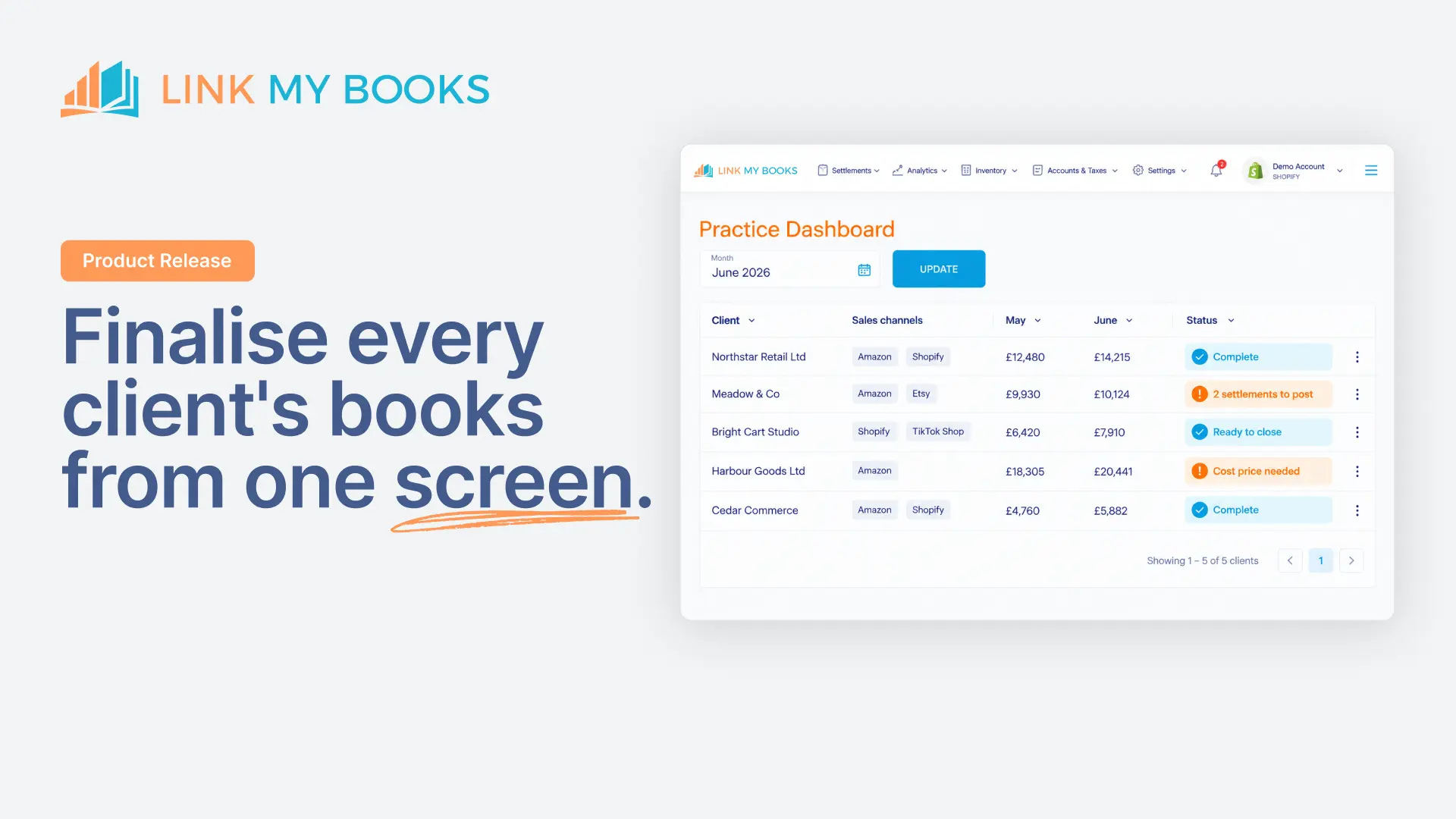
Settlement accounting becomes much more efficient when marketplace data is perfectly structured before it ever reaches Xero or QuickBooks. This is exactly where Link My Books has been specifically designed to support progressive accountants and growing ecommerce businesses.
Rather than importing raw marketplace transactions that clutter the ledger, Link My Books automatically converts complex marketplace settlement reports into structured, accountant-ready summaries.
Sales, marketplace fees, VAT liabilities, customer refunds, and settlement adjustments are completely categorised before they enter the accounting ledger. The final result is a settlement accounting workflow that is both highly repeatable and infinitely scalable.
One Methodology Across Multiple Marketplaces
Whether clients sell their products through Amazon, Shopify, eBay, Etsy, WooCommerce, or TikTok Shop, Link My Books applies the exact same structured accounting approach. This remarkable consistency drastically reduces complexity for accountants managing multiple diverse ecommerce businesses.
Cleaner Bank Reconciliation
Because settlements are perfectly organised before reaching the accounting software, month-end reconciliation becomes remarkably faster. It also requires significantly fewer manual corrections from junior staff members.
Better Financial Reporting
Separating every single component of the settlement provides much more meaningful profit and loss reporting. Business owners gain significantly clearer visibility into their true marketplace costs.
Designed specifically for Accountants
Rather than requiring highly paid accountants to rebuild settlement data manually in messy spreadsheets, Link My Books delivers financial information in a pristine format. This directly supports efficient reconciliation, reliable compliance reporting, and highly scalable bookkeeping processes.
How to Tell if Your Settlement Accounting Process Needs Improving
Proper settlement accounting should systematically reduce manual work even as daily transaction volumes increase. If the exact opposite is happening in your firm, your internal workflow desperately needs reviewing.
Common Indicators of a Broken Process:
- Bank deposits rarely reconcile to the penny without manual journal adjustments.
- Marketplace reports are regularly exported into massive spreadsheets before being posted to the general ledger.
- Different ecommerce clients require completely different reconciliation methods based on their specific sales channels.
- Accountants spend more of their billable time correcting bad transactions than reviewing strategic financial performance.
- Month-end reporting grinds to a halt every time a client grows their business or adds another marketplace.
These frustrating issues often point directly to weaknesses in the internal settlement accounting process rather than limitations of the core accounting software itself.
The Business Impact of Getting Settlement Accounting Right
Settlement accounting is often viewed merely as a tedious bookkeeping exercise, but its actual business impact reaches far beyond basic reconciliation.
When marketplace settlements are recorded accurately from day one, accountants spend far less time correcting bad data and considerably more time interpreting financial trends. Financial reports become easier for stakeholders to trust. VAT returns are fully supported by structured audit records. Crucially, conversations with clients immediately shift from explaining data discrepancies to discussing actual business performance and growth strategies.
For ecommerce businesses, this shift has massive measurable commercial value. A structured settlement accounting process can help modern firms reduce the time spent on month-end reconciliation, produce highly consistent management accounts, improve absolute confidence in tax reporting, and identify hidden marketplace costs clearly.
For forward-thinking accounting practices managing multiple marketplace sellers, true efficiency comes from having a repeatable, standardized process rather than a totally different workflow for every single client.
A Settlement Accounting Workflow That Scales
Exceptional settlement accounting should follow the exact same logical process regardless of which specific marketplace a client uses to sell their products. A truly scalable workflow typically involves four critical steps.
Step 1: Collect the Complete Settlement
Rather than relying on isolated bank deposits or raw individual orders, you must begin with the official marketplace settlement report. This comprehensive document provides the complete financial picture for the entire designated settlement period.
Step 2: Separate Every Financial Component
You must carefully identify each element within the settlement individually. This includes categorising gross sales, marketplace commissions, fulfilment charges, payment processing fees, VAT, customer refunds, and any other unique promotional adjustments. Each specific item should be recorded entirely separately instead of combining everything into one messy, unreadable journal entry.
Step 3: Post Structured Accounting Entries
Once categorised correctly, the complete settlement can be confidently posted into Xero or QuickBooks using a perfectly consistent accounting framework. This ensures that the generated financial records remain easily comparable across different marketplaces and historical reporting periods.
Step 4: Reconcile the Payout
With the detailed settlement already organised accurately in the ledger, reconciling the final cash payout against the business bank account becomes significantly simpler. The bank transaction simply becomes the final automated confirmation rather than the complicated starting point of the bookkeeping process.
Comparing Settlement Accounting Platforms
Several highly capable ecommerce accounting platforms exist to help accountants automate marketplace bookkeeping. However, they approach the concept of settlement accounting quite differently. Understanding these subtle differences is key to choosing the right tech stack.
A2X A2X is widely recognised across the industry for successfully converting marketplace settlements into accounting summaries tailored for Xero and QuickBooks. It primarily focuses on helping ecommerce businesses automate standard settlement posting and is very commonly used by accounting firms supporting large Amazon sellers. For firms looking for established settlement integrations, A2X remains a well-known software solution.
Synder Synder takes a different technological route by synchronising individual ecommerce transactions across multiple sales channels and payment platforms. It is uniquely designed to automate bookkeeping while simultaneously supporting broader financial synchronisation for varied ecommerce businesses. Its primary strength lies in seamlessly connecting multiple complex payment sources directly into accounting software through continuous automated synchronisation.
Entriwise Entriwise provides highly configurable accounting integrations alongside detailed settlement reporting. It is built for ecommerce businesses with significantly more advanced, enterprise-level bookkeeping requirements. It is very often selected by financial teams where businesses require maximum flexibility in configuring their internal accounting workflows to match legacy ERP systems.
Why Link My Books Takes an Accountant-First Approach
While A2X, Synder, and Entriwise offer robust solutions, Link My Books is built fundamentally around the principle that settlement accounting should produce completely clean financial records before any bank reconciliation even begins.
Rather than blindly importing large volumes of raw marketplace transactions, Link My Books automatically converts complex settlement reports into beautifully structured, accountant-ready summaries tailored for Xero and QuickBooks. Sales figures, marketplace fees, VAT liabilities, refunds, and settlement adjustments are automatically categorised using a remarkably consistent accounting methodology.
For busy accountants, this software architecture creates several highly practical advantages. Instead of painfully managing different bookkeeping processes for Amazon, Shopify, eBay, Etsy, WooCommerce, and TikTok Shop, accounting firms can instantly apply one strictly structured workflow across every single ecommerce client.
This strict consistency directly leads to much cleaner ledgers, incredibly fast month-end reconciliation, superior quality management accounts, drastically reduced manual corrections, and significantly more available time for lucrative client advisory work. The core focus is not simply on moving data from one place to another. The focus is entirely on ensuring that marketplace settlements arrive in the accounting software precisely organised in a pristine format that accountants can work with confidently.
Common Misconceptions About Settlement Accounting
"The payout is all that actually needs to be recorded." This is a dangerous myth. The final payout is strictly the net figure after marketplace fees, refunds, VAT, and other platform adjustments have already been forcefully applied. Recording the payout alone fundamentally distorts the profit and loss statement and absolutely fails to provide a complete, legally compliant financial record.
"Importing every single order creates better financial accuracy." While granular individual order data has immense operational value for inventory management, accountants almost always achieve cleaner financial reporting by reconciling structured settlement summaries. Importing thousands of separate transactions bogs down accounting software and drastically increases the risk of duplication errors.
"Settlement accounting only really matters for massive enterprise sellers." This is entirely incorrect. Even smaller, newly launched ecommerce businesses benefit massively from proper settlement accounting. Establishing a highly structured financial process early makes it exponentially easier to manage future growth effortlessly across additional digital marketplaces.
FAQ
What exactly is ecommerce settlement accounting?
Ecommerce settlement accounting is the specialized financial process of recording aggregated marketplace settlements rather than tracking individual customer payments. Instead of attempting to reconcile every tiny order separately, accountants reconcile the comprehensive settlement document issued by digital marketplaces such as Amazon, Shopify, or eBay. This intelligent method captures top-line sales, platform fees, tax liabilities, customer refunds, and promotional adjustments within one structured accounting journal entry. This ultimately creates pristine financial records and a radically simplified bank reconciliation workflow.
Why is settlement accounting vastly superior to recording individual orders?
Settlement accounting accurately reflects how digital marketplaces actually transfer money to sellers in the real world. Individual order imports routinely create duplicate ledger transactions, make bank reconciliation incredibly complicated, and aggressively increase monthly bookkeeping time. Settlement accounting strictly focuses on the complete financial event. This helps professional accountants produce highly reliable management accounts while systematically reducing manual administrative reconciliation.
Which specific digital marketplaces use settlement accounting methods?
Virtually all major modern ecommerce platforms issue aggregated financial settlements rather than paying businesses immediately for every individual order. Amazon, Shopify, eBay, Etsy, standard WooCommerce payment gateways, and TikTok Shop all successfully generate detailed settlement information. Accountants can leverage this specific data to produce highly structured, compliant financial records for their clients.
How does Link My Books actively improve the settlement accounting workflow?
Link My Books seamlessly converts confusing marketplace settlement reports into pristine, accountant-ready summaries tailored specifically for Xero and QuickBooks. Instead of dumping raw transactions into the ledger, the platform automatically categorises gross sales, marketplace fees, VAT, refunds, and settlement adjustments long before they ever reach the general ledger. This automated approach creates flawless reconciliation, highly consistent financial reporting, and a completely standardised accounting workflow across multiple global marketplaces.
When should accountants seriously review their internal settlement accounting process?
If monthly reconciliation is becoming increasingly manual and stressful, month-end reporting is taking noticeably longer to complete, spreadsheets remain absolutely essential to the workflow, or different marketplace clients require completely different bookkeeping methods, it is definitely time to review the process. Adopting a more structured software approach can dramatically improve firm efficiency while easily maintaining the highest quality of financial reporting.
Settlement accounting is arguably one of the most important professional disciplines in modern ecommerce bookkeeping. It perfectly reflects exactly how marketplace businesses actually receive, process, and manage their revenue in the real world.
A highly structured technological approach gives accountants much clearer financial records, radically simplifies daily bank reconciliation, and provides a much stronger foundation for both tax compliance reporting and strategic management accounts.
While A2X, Synder, and Entriwise each support ecommerce accounting in various different ways, Link My Books is explicitly designed to flawlessly transform marketplace settlements into beautifully structured, accountant-ready financial data. By successfully applying one universally consistent methodology across multiple diverse marketplaces, it actively helps accounting firms deliver highly efficient, perfectly scalable, and deeply reliable ecommerce bookkeeping services to their clients.
Book a personalised platform demo today to see exactly how Link My Books can instantly simplify ecommerce settlement accounting for your growing practice.


.webp)




.png)