


Setting up ecommerce clients on Xero requires significantly more than simply connecting a bank feed and importing raw marketplace transactions. A highly successful setup should accurately reflect gross sales, marketplace fees, customer refunds, collected taxes, and net settlements. Most importantly, it must produce reliable financial reports that remain robust as the client's business scales. Starting with the correct bookkeeping structure saves accounting firms considerable time during monthly reconciliation and year-end tax reporting.
Key Takeaways from this Post
Net payouts hide the truth—recording only the final bank deposit artificially lowers sales and ignores deductible marketplace fees. A proper setup must capture gross sales, fees, refunds, and taxes separately.
Clearing accounts and a customized chart of accounts are essential. They bridge the gap between complex marketplace settlements and actual bank deposits, making reconciliation far easier as transaction volumes grow.
Automation is non-negotiable for scalable, compliant ecommerce bookkeeping. Dedicated software eliminates manual data entry errors and ensures consistent categorization from day one.







Setting up ecommerce clients on Xero requires significantly more than simply connecting a bank feed and importing raw marketplace transactions. A highly successful setup should accurately reflect gross sales, marketplace fees, customer refunds, collected taxes, and net settlements. Most importantly, it must produce reliable financial reports that remain robust as the client's business scales. Starting with the correct bookkeeping structure saves accounting firms considerable time during monthly reconciliation and year-end tax reporting.
Key Takeaways for Accounting Firms:
- Net payouts hide the truth: Recording only the final bank deposit artificially lowers reported sales and ignores deductible marketplace fees.
- Structure dictates success: A customized chart of accounts is mandatory for modern ecommerce bookkeeping.
- Clearing accounts are essential: You must use clearing accounts to bridge the gap between marketplace settlements and actual bank deposits.
- Automation is non-negotiable: Using dedicated software to map transactions eliminates manual data entry errors and ensures strict tax compliance.
Why Ecommerce Clients Need a Different Xero Setup
Traditional businesses often generate very straightforward invoices, basic supplier bills, and simple bank transactions. Ecommerce businesses operate entirely differently.
A single ecommerce client may sell products through Amazon, Shopify, eBay, Etsy, or multiple distinct channels simultaneously. Each of these platforms produces its own complex sales reports, unique settlement schedules, and obscure marketplace deductions.
Instead of matching a simple payment to a single invoice for every sale, modern accountants must properly account for:
- Gross sales revenue: The total amount the customer actually paid at checkout.
- Marketplace fees: Platform referral fees, subscription costs, and fulfillment charges.
- Customer refunds: Money returned to buyers for canceled orders or defective products.
- Shipping adjustments: Costs related to platform-purchased shipping labels or inbound freight.
- Taxes and VAT: Sales tax or Value Added Tax collected and remitted by the marketplace.
- Settlement payments: The final net transfer that eventually clears the business bank account.
Without a bookkeeping structure specifically designed for ecommerce, Xero can quickly become an absolute nightmare to reconcile. Furthermore, the resulting financial reports may no longer provide an accurate view of true business performance.
Step 1: Understand How the Client Sells
Before connecting any software or touching the Xero dashboard, accountants should deeply understand exactly how the client's revenue flows through the business.
Crucial questions worth answering during the initial client discovery phase include:
- Which specific marketplaces and independent websites generate sales?
- Which payment gateways (like Stripe, PayPal, or Shopify Payments) are currently used?
- Does the client sell internationally or cross-border?
- Is VAT or sales tax applicable across multiple sales channels?
- How frequently are marketplace settlements actually received?
Understanding these operational processes allows you to build a bookkeeping system that genuinely reflects how the business operates. This is far more effective than trying to force high-volume ecommerce transactions into a rigid, traditional accounting workflow.
Step 2: Build the Right Accounting Structure
A strong Xero accounting setup begins with impeccably clean financial organization. The primary objective is to ensure that all marketplace activity can be categorized perfectly and consistently from the very first transaction onwards.
This process heavily involves customizing the client's Chart of Accounts. That includes establishing a structure highly capable of separating:
- Top-line sales revenue
- Marketplace commissions and advertising costs
- Payment gateway processing costs
- Customer refunds and return shipping penalties
- VAT or sales tax liabilities where applicable
- Settlement adjustments and withheld reserve balances
To achieve this, accountants must utilize clearing accounts. A clearing account acts as a temporary holding ledger. It holds the detailed breakdown of the marketplace settlement (the gross sales minus the fees) until the exact net payout actually clears the physical bank account.
Keeping these financial categories completely distinct provides much clearer reporting and makes reconciliation significantly easier as client transaction volumes increase. Rather than relying on large numbers of complex manual journal entries later, accountants can establish a brilliant bookkeeping framework that supports perfectly accurate reporting from the very outset.
Step 3: Plan for Reconciliation Before Transactions Arrive
Many severe bookkeeping problems actually originate during the software implementation phase rather than during day-to-day bookkeeping. If the reconciliation process has not been carefully considered before transactions begin flowing into Xero, accountants often spend months correcting highly avoidable issues.
An effective setup plan should confidently answer questions such as:
- Exactly how will complex marketplace settlements be recorded?
- How will customer refunds be treated on the profit and loss statement?
- How will marketplace fees be definitively separated from gross revenue?
- How will VAT compliance be reflected to satisfy tax authorities?
- How will the accounts remain perfectly consistent as sales order volumes increase?
Answering these highly technical questions during implementation creates a far more scalable and profitable bookkeeping process for your firm.
Common Setup Mistakes to Avoid
Even highly experienced accountants can encounter frustrating challenges when onboarding complex ecommerce businesses. Knowing what to avoid is half the battle.
Some of the most common setup issues include:
- Recording marketplace payouts as gross sales: This artificially deflates revenue and ignores deductible business expenses.
- Combining multiple transaction types into a single account: Lumping advertising fees, referral fees, and shipping costs into one generic "Amazon Expenses" category destroys financial visibility.
- Importing raw marketplace data without reviewing its structure: Pushing messy CSV files directly into Xero creates a tangled web of unreconciled lines.
- Waiting until month end to resolve reconciliation differences: Leaving weeks of data to pile up makes error identification nearly impossible.
- Using bookkeeping processes designed for traditional retail: Applying brick-and-mortar accounting rules to global ecommerce simply does not work.
While these lazy approaches may initially appear simpler, they always create massive additional reconciliation work. They completely reduce the overall quality of your financial reporting and expose the client to serious compliance risks.
How Link My Books Simplifies the Xero Setup Process
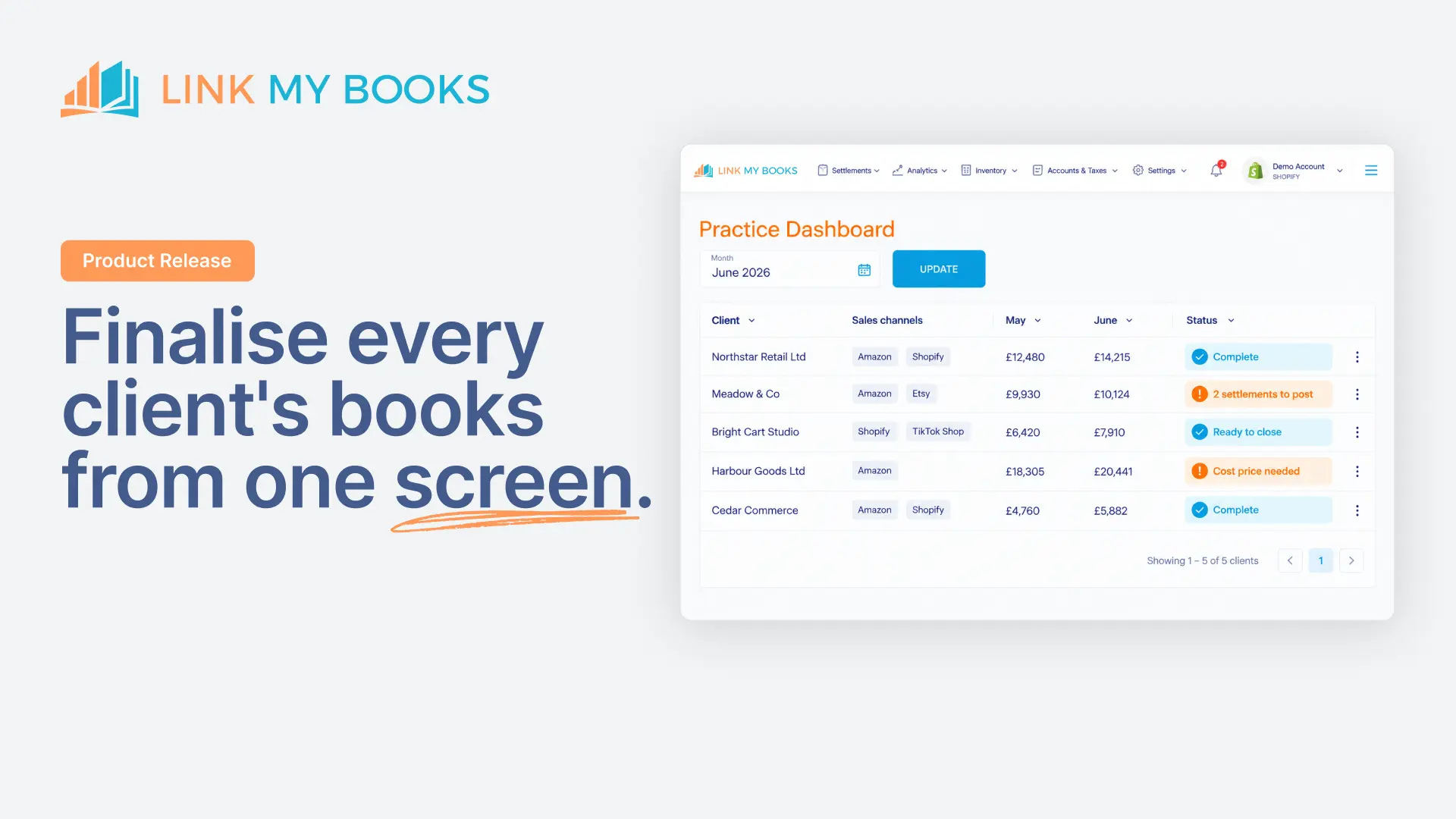
Link My Books has been designed specifically to help accountants build brilliantly clean ecommerce bookkeeping workflows entirely inside Xero.
Rather than forcing your team to manually import raw marketplace payouts as individual bank transactions, Link My Books automates your ecommerce bookkeeping. The platform seamlessly converts highly complex ecommerce activity into perfectly structured accounting summaries before it ever reaches Xero.
Gross sales, marketplace fees, collected taxes, customer refunds, and settlement adjustments are categorized automatically. This intelligent process creates flawlessly organized financial records that are incredibly easy to reconcile with a single click.
This powerful automation allows accountants to begin with a bookkeeping structure that reflects exactly how ecommerce businesses actually operate. It drastically reduces manual adjustments while providing clients with highly reliable financial reporting as they scale. For proactive accounting firms onboarding multiple ecommerce businesses, establishing this automated structure from the beginning creates a perfectly consistent process across every single client portfolio.
Best Practice After the Initial Setup
A beautifully configured Xero account is only the starting point of a successful client relationship. Maintaining accurate financial records depends entirely on having a consistent bookkeeping process as new marketplace transactions continue to flow into the system.
Accounting firms supporting ecommerce businesses should establish a strict routine that includes the following steps.
Reconcile Marketplace Settlements Regularly
Settlement reports should be reviewed consistently rather than waiting until the end of the month. Regular, weekly reconciliation makes financial discrepancies much easier to identify and aggressively prevents bookkeeping issues from accumulating over time.
Review Financial Reports Throughout the Month
Profit and loss reports, balance sheets, and draft VAT reports should be monitored regularly. Ongoing internal reviews help accountants identify unusual movements in marketplace fees, massive spikes in refunds, or rising operating costs long before official reporting deadlines arrive.
Keep Bookkeeping Processes Standardized
Applying the exact same reconciliation and categorization process across all your ecommerce clients drastically improves consistency within the practice. This uniformity makes junior staff training and senior quality control much easier to manage.
Adapt as the Client Grows
As successful businesses rapidly expand into additional marketplaces or massively increase their transaction volumes, their bookkeeping requirements naturally change. Periodically reviewing the core accounting structure helps ensure Xero continues to support highly reliable financial reporting without requiring unnecessary manual work.
Why a Better Xero Setup Delivers Commercial Value
A heavily structured ecommerce bookkeeping system benefits both the accounting firm and the ecommerce client.
For modern accounting firms, it creates a highly efficient operational workflow by completely reducing manual reconciliation and improving reporting consistency. This allows the firm to increase profit margins without increasing administrative headcount.
For clients, it provides crystal clear visibility into exactly how the business is performing. Reliable, automated bookkeeping heavily supports:
- Significantly faster month-end reporting
- Much more accurate gross and net profitability analysis
- Flawlessly clean VAT and tax reporting
- Better short-term and long-term cash flow visibility
- Highly informed commercial decision making
When foundational financial information can be trusted implicitly, accountants spend far less time correcting broken data. Instead, they spend much more billable time helping clients understand their numbers and strategize for growth.
Comparing Ecommerce Bookkeeping Solutions
Several bookkeeping software platforms actively support accountants working with complex ecommerce businesses. Each platform approaches marketplace accounting quite differently.
A2X is widely used to automate marketplace accounting summaries and is often adopted by firms with highly established, traditional ecommerce bookkeeping workflows looking for batch processing.
Entriwise provides deeply configurable integrations specifically tailored for enterprise ecommerce businesses that require heavily customized accounting processes.
Taxomate focuses primarily on basic automated marketplace bookkeeping and reducing manual transaction processing for smaller sellers.
Link My Books has been purpose-built specifically for proactive accountants who want perfectly structured, accountant-ready ecommerce bookkeeping rather than simple, messy transaction imports.
Instead of aggressively pushing raw marketplace payouts directly into the general ledger, it intelligently converts marketplace activity into highly organized accounting summaries. It meticulously separates gross sales, marketplace fees, refunds, taxes, and settlement adjustments long before they ever reach Xero. This specialist approach produces incredibly clean financial records, entirely simplifies reconciliation, and gives accountants absolute confidence that Xero reflects the client's true financial position.
Common Misconceptions About Xero Setups
"Simply connecting the Xero integration is the same thing as fully setting it up." Connecting software via an API is only one minor part of the process. A truly successful ecommerce setup requires configuring the correct accounting structure, mapping consistent categorization rules, and building an effective reconciliation workflow.
"Net marketplace payouts should just be recorded as sales." Payouts are net settlement amounts generated after marketplace fees, refunds, and other deductions have been stripped away. Recording them directly as revenue completely removes highly important financial detail and destroys your reporting accuracy.
"Once Xero is fully configured, no further review is ever needed." As dynamic ecommerce businesses grow, their bookkeeping processes must evolve with them. Regular monthly reviews help ensure financial reporting remains perfectly accurate as new global marketplaces, alternative payment methods, or higher transaction volumes are introduced.
FAQ
Why do ecommerce businesses desperately need a different Xero setup?
Ecommerce businesses generate highly complex marketplace settlements containing gross sales, hidden fees, customer refunds, collected taxes, and other obscure adjustments. A standard, traditional accounting setup often does not capture these micro-transactions accurately, making reconciliation and accurate financial reporting nearly impossible.
What should accountants explicitly configure first?
Before importing any live transactions, accountants should deeply understand exactly how the client sells, which global marketplaces they actively use, and how those specific settlements are processed. Building the customized bookkeeping structure (and chart of accounts) around these exact workflows creates a much stronger foundation for future reporting.
How does Link My Books directly improve Xero bookkeeping?
Link My Books seamlessly converts complex ecommerce marketplace activity into perfectly structured accounting summaries designed explicitly for Xero. Gross sales, marketplace fees, customer refunds, taxes, and settlement adjustments are categorized automatically. This drastically reduces manual bookkeeping while massively improving reconciliation accuracy.
Can one single bookkeeping process work for every ecommerce client?
The underlying technical principles absolutely remain consistent, but each unique client's sales channels, VAT requirements, and specific business model must be considered during implementation. A highly flexible but deeply structured approach generally delivers the absolute best long-term results for the firm.
Why is ongoing reconciliation so important after the initial setup?
Even the absolute best accounting structure relies heavily on perfectly accurate reconciliation. Regularly reviewing marketplace settlements against Xero ensures financial reports remain completely complete, highly reliable, and perfectly ready for VAT reporting or year-end accounts.
Setting up ambitious ecommerce clients on Xero is entirely about creating a robust bookkeeping system that remains flawlessly accurate as the business inevitably grows.
A strong, highly structured software implementation drastically reduces manual reconciliation work, significantly improves financial reporting, and provides proactive accountants with highly reliable information throughout the entire year rather than only at stressful reporting deadlines.
While platforms like A2X, Entriwise, and Taxomate all offer various ecommerce bookkeeping capabilities, Link My Books has been developed specifically to completely simplify marketplace accounting for modern accountants using Xero. By brilliantly transforming complex marketplace settlements into structured accounting summaries, it helps ambitious firms standardize ecommerce bookkeeping, rapidly improve reporting quality, and spend far more time delivering highly valuable advice to clients.
If you are looking to permanently streamline ecommerce bookkeeping for your clients, book a personalized demo today.



.webp)




.png)