



Running multiple Shopify entities requires more than keeping each storefront operational. Finance teams need a clear way to separate revenue, refunds, fees and taxes, reconcile payments, and make sure ecommerce activity reaches the correct accounts. When scaling across multiple storefronts, understanding the core principles of multi-entity management becomes essential for accurate financial reporting and compliance.
Key Takeaways from this Post
Separate Shopify stores from legal entities. Multiple storefronts do not necessarily mean multiple companies, so establish the correct accounting structure before automating.
Standardise ecommerce bookkeeping. Keep sales, refunds, fees, taxes and payouts consistently categorised across every Shopify operation to improve reporting and reconciliation.
Build for scalability. Automation tools such as Link My Books can reduce manual bookkeeping and create a repeatable workflow as your business adds Shopify stores, marketplaces and international sales.







Running multiple Shopify entities requires more than keeping each storefront operational. Finance teams need a clear way to separate revenue, refunds, fees and taxes, reconcile payments, and make sure ecommerce activity reaches the correct accounts. When scaling across multiple storefronts, understanding the core principles of multi-entity management becomes essential for accurate financial reporting and compliance.
The more complex the ecommerce structure becomes, the less practical it is to rely on manual exports and spreadsheets. Modern ecommerce operations often span international borders, utilize advanced setups like Shopify Plus, and process high-volume transactions across diverse payment gateways.
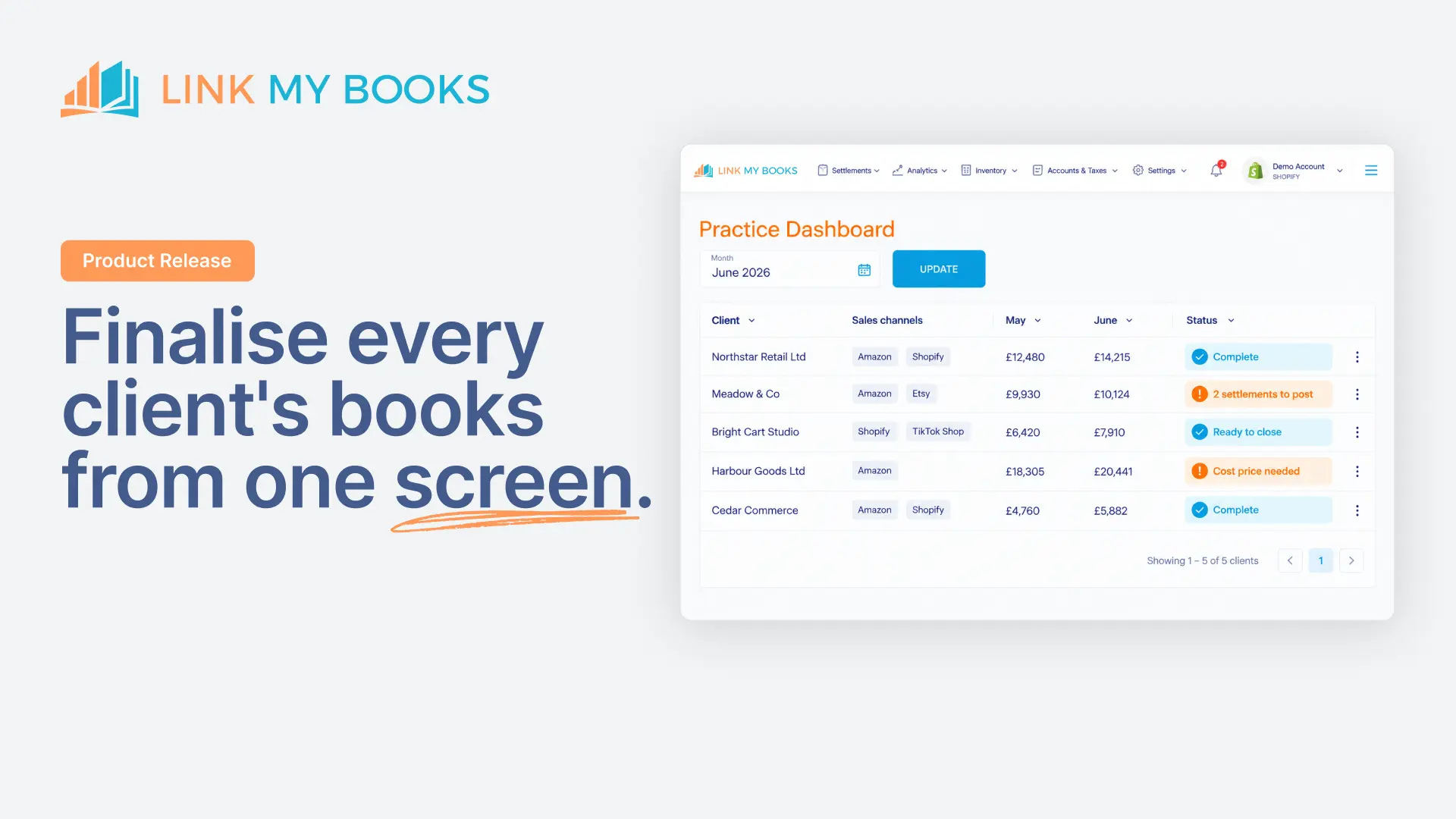
For businesses using Xero or QuickBooks Online, Link My Books automates the ecommerce bookkeeping layer by syncing sales, fees, taxes and refunds from supported platforms and creating structured accounting summaries. This gives finance teams a more consistent process for managing Shopify alongside other ecommerce channels, reducing errors and saving valuable time at month-end.
Why running multiple Shopify entities gets complicated
The challenge with running multiple Shopify entities is not necessarily Shopify itself. It is what happens to the financial data after a sale takes place.
A finance team needs to understand how money moving through the ecommerce operation should be represented in the accounts. Sales revenue needs to be distinguished from refunds, fees and tax. Payments need to reconcile correctly. Each operation also needs to be mapped to the appropriate accounting structure, ensuring that cross-border sales and regional taxes are accounted for accurately.
With one relatively simple ecommerce business, some of this can be handled manually through basic bank feeds or simple ledger entries.
That changes as the company grows and shifts towards a more intricate Shopify architecture.
Adding another storefront, sales channel or international market can introduce another source of financial data that needs to be reviewed, categorised and reconciled. For instance, dealing with Shopify Payments across different currencies introduces foreign exchange complexities that standard ledgers struggle to parse without proper pre-accounting layers.
If each expansion creates another spreadsheet or workaround, the finance process becomes harder to control, leading to compliance risks and delayed reporting.
The goal should therefore be to build a repeatable ecommerce accounting workflow rather than create a separate manual process for every new operation.
Multiple Shopify stores do not always mean multiple legal entities
Finance teams need to make an important distinction before automating anything within their systems.
Multiple Shopify stores and multiple legal entities are not necessarily the same thing. Understanding how to manage multiple Shopify stores effectively starts with mapping out your legal and corporate structure.
A company may operate several storefronts while keeping them under one legal entity, perhaps targeting different niches or regions with distinct brand fronts. Another ecommerce group may operate separate companies, each with its own distinct accounting, local tax obligations, and compliance requirements.
This distinction determines how the underlying financial activity needs to be treated in your general ledger.
Bookkeeping software should not decide the legal or accounting structure for the business. That responsibility remains with the finance team and its professional advisers.
Where automation becomes valuable is in handling the repetitive ecommerce data that sits underneath that structure, such as inventory synchronization logs, payout fees, and transaction-level tax breakdowns.
Link My Books connects supported ecommerce platforms with Xero or QuickBooks Online, categorising sales, fees, taxes and refunds before posting structured summaries into the accounting system.
This creates a clearer separation between automated ecommerce bookkeeping and professional accounting judgement.
Why a fragmented workflow makes financial reporting harder
The biggest problem with disconnected ecommerce bookkeeping is not simply the administrative workload or the time spent copying and pasting numbers.
It is the profound negative effect on financial visibility and strategic decision-making.
If one Shopify operation is reconciled manually, another relies on a custom export, and a third uses a different integration, finance teams can end up with inconsistent data across the business.
That makes relatively straightforward commercial questions surprisingly difficult to answer:
- Which specific regional operation is generating the strongest net margins?
- Are all gateway and platform fees being captured consistently across all storefronts?
- Are refunds being treated correctly against the original sales period?
- Why does the total cash received differ from reported gross sales?
- Can the VAT and international sales tax figures in the accounts be fully trusted for audit purposes?
A finance team cannot confidently analyse performance if it first has to question how the underlying numbers reached the ledger.
This is why the bookkeeping workflow matters commercially. Cleaner ecommerce accounting gives finance teams a more dependable foundation for management reporting, VAT work, international expansion, and high-level financial decision-making.
A better structure for multiple Shopify operations
The objective should be to standardise the parts of ecommerce bookkeeping that do not require manual judgement, establishing a framework that supports long-term growth.
Create consistent transaction categories
Sales, fees, refunds and taxes should follow an established accounting structure across every single storefront you operate.
The finance team should not have to determine from scratch how the same transaction type should be treated every month, especially when dealing with multi-entity management setups.
Avoid treating the payout as the sale
Cash received and revenue generated are not necessarily the same number, particularly when platform fees, reserve holds, and shipping adjustments are involved.
Ecommerce payouts can reflect various deductions and adjustments, so simply recording the bank deposit does not provide the full financial picture required for accurate profit and loss statements.
Finance teams need deep visibility into the exact activity that produced the final amount received in the bank account.
Keep the ledger usable
More ecommerce activity does not automatically mean the accounting system needs every individual order pushed into it as a separate line item.
Structured summaries can provide the financial information required for reconciliation while keeping Xero or QuickBooks Online clean, fast, and manageable.
Build for the next channel
A Shopify business today may well become a multi-channel enterprise tomorrow, selling across marketplaces and physical retail locations.
The finance workflow should be able to accommodate that growth without requiring the entire bookkeeping process to be redesigned from scratch.
Where Link My Books fits when Shopify becomes complex
Link My Books is designed specifically for ecommerce bookkeeping automation, serving as an indispensable tool within any comprehensive Finance Guide.
It connects ecommerce sales channels to Xero or QuickBooks Online and categorises sales, fees, taxes and refunds before creating structured accounting summaries.
For businesses running multiple Shopify operations, the primary benefit is consistency and control.
Rather than letting every new store or channel introduce another manual bookkeeping process, finance teams can establish a repeatable workflow for getting ecommerce data accurately into the accounting system.
Link My Books also supports platforms including Amazon, eBay, Etsy and TikTok Shop.
That matters because many businesses running multiple Shopify operations do not remain Shopify-only as they scale their brand reach.
Once Amazon or another marketplace enters the sales mix, finance teams need to manage different types of ecommerce activity without losing control of bank reconciliation.
This is where Link My Books becomes particularly useful. It provides a specialist ecommerce accounting layer rather than asking the finance team to piece together separate processes as the business expands into new markets.
For UK and international businesses, its focus on VAT and compliance makes it highly relevant to finance teams that need ecommerce automation to support, rather than complicate, their existing reporting workflow.
Choosing between Link My Books and other alternatives
The right comparison depends heavily on the specific finance problem you are trying to solve within your organisational structure.
Some platforms focus on settlement-based accounting with deep recognition among traditional enterprise accountants, making them a viable choice for businesses looking for rigid, established frameworks.
Other available tools sit within broader ecosystem suites, providing ecommerce integrations alongside wide-ranging general bookkeeping and document processing automation capabilities.
Alternative solutions take a broad integration approach, attempting to connect every conceivable payment app and sales platform directly with core accounting software.
Link My Books is positioned around making ecommerce reconciliation straightforward, transparent, and stress-free for businesses using Xero or QuickBooks Online.
Its core strengths include rapid setup times, robust UK and international VAT support, trusted guidance from accountants, and the unique flexibility to accommodate businesses operating across several distinct ecommerce channels simultaneously.
For a finance team running Shopify alongside other marketplaces, that dedicated multi-channel focus becomes exceptionally relevant.
The final software decision should not be based on which platform boasts the longest list of features. It should be based entirely on which one creates the cleanest, most reliable, and most repeatable accounting workflow for the ecommerce structure you actually operate.
What happens when the finance workflow does not scale?
Businesses often tolerate inefficient bookkeeping longer than they should because the existing process technically still works on a month-to-month basis.
However, there is a fundamental difference between a process working and a process scaling efficiently.
If adding another Shopify operation means introducing another spreadsheet, another manual journal entry, another complex reconciliation process, or another set of tedious month-end checks, then your finance workload is increasing exponentially alongside your revenue complexity.
That eventually creates a severe capacity bottleneck within the finance department.
It can also make changing or upgrading systems much more difficult later on because the business becomes increasingly dependent on accumulated, fragile workarounds.
The ideal point to introduce proper automation is well before your finance operations become an internal bottleneck.
FAQ
How should finance teams manage multiple Shopify entities?
Start by establishing which Shopify operations belong to which specific accounting entities and defining a consistent process for handling sales, fees, refunds, taxes, and payouts. The legal and accounting structure should always be determined by the finance team and its professional advisers rather than dictated by bookkeeping software.
Once that structure is clear, repetitive ecommerce reconciliation can be automated effectively. Link My Books connects supported ecommerce platforms with Xero or QuickBooks Online and creates structured accounting summaries from raw ecommerce activity. This reduces reliance on separate spreadsheets and manual processes for each operation while giving finance teams cleaner information to review. The objective is not to automate accounting judgement, but rather to automate repetitive bookkeeping so the finance team can focus entirely on high-level review, reporting, and strategic decisions.
Can Link My Books handle Shopify and other marketplaces together?
Yes. Link My Books supports both Shopify and Amazon, alongside other prominent ecommerce channels including eBay, Etsy and TikTok Shop.
This capability is extremely useful for businesses that begin on Shopify but later expand onto multi-channel marketplaces. Instead of maintaining completely separate bookkeeping workflows for each distinct sales channel, Link My Books provides a unified ecommerce accounting process connected seamlessly to Xero or QuickBooks Online.
For finance teams, the advantage is less about simply connecting more platforms and more about maintaining financial structure as channel complexity grows. Sales, fees, taxes and refunds still need to reach the accounts in a usable format regardless of where the customer completed their purchase.
Is Link My Books a strong solution for scaling Shopify brands?
Both specialised and general platforms can support ecommerce accounting, so the ideal option depends heavily on the wider operational requirements of the business.
Link My Books offers an alternative focused on straightforward setup, comprehensive VAT and tax requirements, accountant-led support, and streamlined multi-channel ecommerce bookkeeping.
The wider sales mix and future expansion plans should be considered when evaluating your options. A single-store operation may have different requirements compared to an enterprise managing multiple Shopify entities alongside global marketplaces.
Does ecommerce automation replace finance teams or accountants?
No. Ecommerce bookkeeping automation handles repetitive data processing, categorization, and reconciliation tasks. It does not replace professional accounting judgement.
Decisions regarding legal entities, complex tax treatment, VAT obligations, management reporting, and high-level financial strategy still require appropriate professional oversight.
The true value of automation is that accountants and finance teams do not need to spend countless hours rebuilding basic ecommerce transaction data before they can perform their advisory work.
Running multiple Shopify entities becomes significantly easier when the finance process is designed for complexity before complexity becomes an operational crisis.
The aim is never to eliminate proper financial oversight. It is to remove unnecessary manual work from the critical path connecting daily ecommerce activity to your core accounting system.
For businesses operating Shopify alongside other ecommerce channels, Link My Books provides a proven way to standardise that process while keeping Xero or QuickBooks Online firmly at the centre of the accounting workflow.
If your Shopify structure is already complex, or you expect to add more stores, entities or marketplaces, book a Link My Books demo to see how the workflow could fit your existing finance setup.



.webp)



.png)