


The best software for ecommerce financial reconciliation is the one that removes the need to rebuild transactions from platform payouts and delivers accounting-ready data from the start.
For an accountant or a certified public accountant, the real goal is not just a faster reconciliation process. It is eliminating regular reconciliation as a manual process altogether. In the fast-paced world of finance and accountancy, accounting professionals need tools that handle complex data sets easily to produce accurate financial records.
Key Takeaways from this Post
Ecommerce reconciliation is a data reconstruction problem
Platform payouts combine sales, fees, and adjustments, forcing accountants to rebuild transactions manually.
The best software fixes data before it enters the system
Structured, accounting-ready data removes the need for ongoing reconciliation and manual corrections.
Automation enables scalability for accounting firms
Reducing manual work allows firms to handle more clients, improve margins, and focus on higher-value advisory services.







The best software for ecommerce financial reconciliation is the one that removes the need to rebuild transactions from platform payouts and delivers accounting-ready data from the start.
For an accountant or a certified public accountant, the real goal is not just a faster reconciliation process. It is eliminating regular reconciliation as a manual process altogether. In the fast-paced world of finance and accountancy, accounting professionals need tools that handle complex data sets easily to produce accurate financial records.
Why ecommerce reconciliation is different for accountants
Standard workflows assume clean data
Traditional financial reconciliation relies on:
- Bank feeds and bank statements
- Invoices and properly maintained records
- Clearly categorised transactions
These inputs are already structured and easy to match against the general ledger. Most accountants and internal auditors are used to this standard accounting process, where two different data sets are compared to catch errors and prevent fraudulent activity or outright fraud.
Ecommerce data breaks that assumption
Ecommerce platforms provide:
- Settlement reports
- Net payouts
- Combined transaction data
These include sales, fees, refunds, and tax adjustments in one flow. When this money enters accounting systems, it does not align with standard bank reconciliation workflows typically performed by an accounting team.
Reconciliation becomes reconstruction
Instead of matching transactions to verify accuracy, public accountants must:
- Break down payouts
- Identify missing components
- Rebuild financial activity over a specific time period
This turns reconciliation into a manual, time-intensive process rather than a quick check to ensure properly verified accounts.
What accountants actually need from reconciliation software
Most tools claim to automate the process. In practice, accountants need something more specific to produce reliable financial statements.
Usable data at entry point
If financial information is correct when it enters the system, financial reconciliation becomes minimal. If it is not, it becomes ongoing work that eats into time meant for advisory services.
Consistency across clients
Ecommerce clients operate across different platforms. Whether dealing with management accounting, tax accounting, or financial planning, accountants need a system that handles this consistently across various organizations and business models.
Scalability
Manual reconciliation limits how many clients a firm can manage. Automation must reduce workload, not just shift it. You shouldn't need a team where everyone holds a master's degree or extensive public accounting experience just to untangle payout reports.
Reliability
Financial records must be trusted without constant checking. This is critical for financial reporting, risk management, and ensuring compliance with government agencies, tax law, and regulatory compliance bodies like the securities and exchange commission.
Commercial implications for accounting firms
Margin pressure
Time spent on reconciliation reduces profitability per client. Even though the median annual wage for an accountant is strong, ecommerce clients can become resource-heavy and erode margins if handled manually.
Limited growth capacity
Manual workflows restrict how many clients CPA firms can take on. This impacts scalability, especially for firms working with fast-growing public companies.
Team inefficiency
Highly skilled staff, including those who have passed the rigorous CPA exam to become a certified public, spend time fixing historical data instead of analyzing it. You want your rising star management accountants to analyze data and inform business decisions, not do basic data entry.
Client expectations
Ecommerce clients expect:
- Accurate reporting for current and potential investors
- Fast turnaround on tax returns
- Clear visibility into all types of financial metrics
Workflows must support this level of service.
How different tools approach ecommerce reconciliation
A2X
A2X is widely adopted and often driven by accountant recommendation. It is considered a standard tool in many ecommerce workflows.
Dext Commerce
Dext focuses on capturing and organising financial data. It supports general bookkeeping but is not designed specifically for complex intercompany reconciliation or dedicated ecommerce workflows.
Synder
Synder connects multiple platforms to accounting systems. It focuses on integration across channels for various accounting platforms.
The key difference
Most tools focus on bringing data into accounting systems. The real challenge is ensuring that data is ready to use when it arrives, especially when dealing with strict compliance and business law.
How Link My Books Changes Reconciliation for Accountants
Link My Books removes the need to rebuild ecommerce data inside your workflow by changing what your team starts with.
Instead of receiving combined payouts that need to be broken apart and interpreted, your accounting system is populated with accurate financial records that already reflect what actually happened across sales, costs, and adjustments.
This shifts the role of your team. You are no longer:
- Breaking down settlements
- Correcting incomplete or unclear entries
- Spending time resolving mismatches
You are working with data that is already structured, consistent, and aligned with accounting requirements. That means:
- Transactions can be reviewed instead of reconstructed
- Client work follows the same repeatable process
- Your workflow runs without ongoing correction
Reconciliation stops being a manual task and becomes the natural result of having the right data in place from the beginning.
Practical use cases
Firms managing multiple ecommerce clients
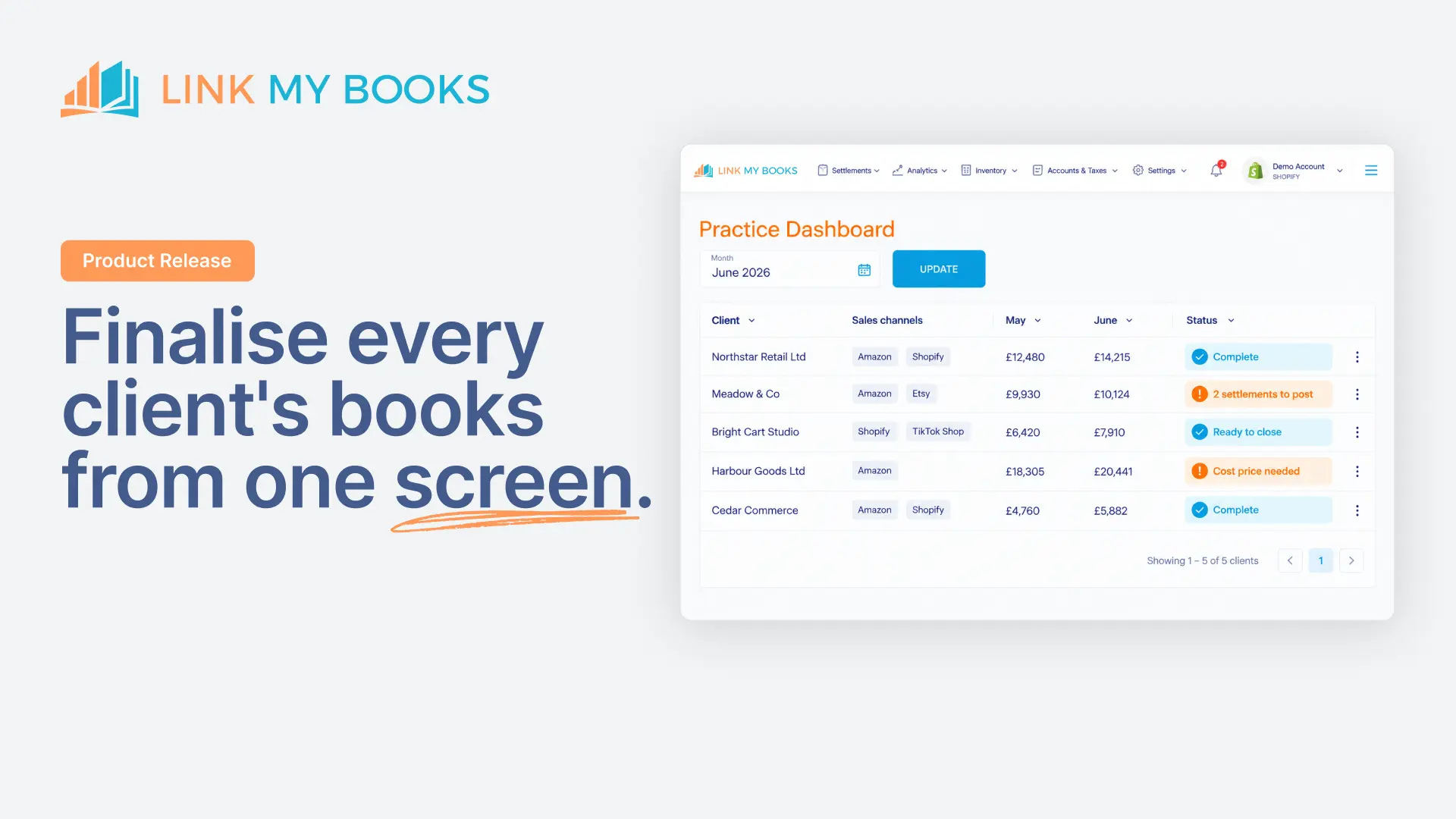
Structured data allows consistent workflows across all clients, helping teams generate accurate statements faster.
High-volume client portfolios
Automation removes the need to scale headcount alongside client growth. Even the largest employers of accounting professionals rely heavily on scalable software.
Practices specialising in ecommerce
Efficient reconciliation becomes a competitive advantage that can attract potential investors to your clients' businesses.
Accountants focused on advisory
Reducing manual work allows more time for higher-value services, giving accountants the chance to use their communication skills to provide strategic guidance.
Risks and misconceptions
“Reconciliation software removes all work”
Some tools reduce effort. Few eliminate the need for data correction. Even with automation, basic internal auditing is still required to catch anomalies.
“Integration equals automation”
Data can flow between systems without being usable for auditing or tax compliance.
“Manual processes can scale with better systems”
Manual steps remain a bottleneck regardless of tooling.
“All ecommerce tools solve reconciliation”
Different tools address different parts of the workflow. For example, some might be better suited for deep forensic accounting investigations, while others simply do not address data quality at entry.
FAQ
What is ecommerce financial reconciliation for accountants?
Ecommerce financial reconciliation involves matching platform data, such as sales, fees, and payouts, with accounting records. Unlike traditional reconciliation, ecommerce requires interpreting settlement reports and aggregated data. This makes the process more complex and time-consuming. The goal is to ensure that financial statements accurately reflect business activity. Tools like Link My Books simplify this by providing accounting-ready data, reducing the need for manual reconciliation.
Why is ecommerce reconciliation more difficult than traditional bookkeeping?
Ecommerce reconciliation is more complex because platforms provide aggregated data rather than individual transactions. Settlement reports combine multiple elements, which must be separated and categorised correctly. Traditional accounting relies on clean inputs, while ecommerce requires additional processing. This increases workload and introduces more opportunities for error.
How can accountants automate ecommerce reconciliation?
Automation requires more than connecting platforms to accounting systems. It involves ensuring that data is usable when it enters the system. Tools like Link My Books convert platform data into structured financial records, allowing accountants and auditors to work with accurate information from the start. This reduces manual work and improves efficiency.
Can reconciliation be fully automated for ecommerce clients?
Reconciliation can be significantly reduced or effectively eliminated as a manual process when data is structured correctly. While some level of review is always necessary to maintain tax compliance, the need for rebuilding transactions from scratch can be entirely removed.
How does Link My Books help accounting firms scale?
Link My Books helps firms scale by reducing the time spent on reconciliation. It provides consistent, reliable data across clients, allowing workflows to operate efficiently. This means firms can manage more clients without increasing workload, improving profitability and enabling growth.
Turn Reconciliation Into a Scalable Process
Reconciliation should not be the core workload in ecommerce accounting. If your team is rebuilding transactions, your workflow is working against the structure of the data.
Link My Books removes that constraint. It ensures that the data entering your system is already aligned with strict accounting requirements.
That allows your firm to scale ecommerce clients without increasing manual effort, while maintaining total accuracy and control over your clients' financial future.


.webp)



.png)