


Managing Shopify, Amazon, and Etsy accounting becomes difficult when each platform is handled separately. The solution is to apply one consistent structure across all channels so that sales, fees, refunds, and tax are recorded the same way before reaching your accounting system.
Key Takeaways from this Post
Use one unified structure across Shopify, Amazon, and Etsy to eliminate data inconsistencies and simplify accounting
Standardize all transactions into sales, fees, refunds, and tax for accurate reporting and comparison
Replace manual, platform-by-platform workflows with a single scalable system to reduce errors and save time







Managing Shopify, Amazon, and Etsy accounting becomes difficult when each platform is handled separately. The solution is to apply one consistent structure across all channels so that sales, fees, refunds, and tax are recorded the same way before reaching your accounting system.
Why Multi-Channel Accounting Feels Unmanageable
Most businesses do not struggle because of transaction volume. They struggle because of fragmentation. Each platform behaves differently based on its own definition of a transaction:
- Shopify is order-based.
- Amazon is settlement-based.
- Etsy sits somewhere in between.
This leads to different payout timings, unique fee structures, and varied reporting formats that don't easily communicate with each other. When each channel is handled in isolation, data cannot be compared, reconciliation becomes repetitive, and errors naturally increase over the length of time you operate.
The feeling of chaos is a clear sign that your current setup is failing. It is a direct result of inconsistent systems. In other words, the pressure doesn't come from accounting itself; it comes from trying to manage multiple versions of the truth.
The Hidden Problem Behind the Stress
For many startups and small e-commerce sellers, the early days require immense energy and focus to find product-market fit and start increasing revenue. But as an influx of orders arrives, founders often realize they are flying blind.
Each platform shows its own version of revenue, its own version of costs, and unique reporting logic. Meanwhile, your account ledger expects one consistent version of the truth. Without alignment, reports do not match, margins are unclear, and precious time is lost investigating discrepancies.
This is where most businesses get stuck. They try to out-work a structural problem rather than fixing the underlying infrastructure.
What a Scalable Multi-Channel System Looks Like
The shift toward successful scaling is not about working harder. It is about removing variation and leveraging technology to accelerate your workflows.
One Structure Across All Platforms
To properly execute multi-channel accounting, all channels should be translated into a standardized format:
- Sales
- Fees
- Refunds
- Tax
This removes platform-specific differences. While accounting is not always an exact science when APIs act up, applying a rigid structure ensures your numbers make sense.
One Set of Categorization Rules
It is a best practice to establish rules where every transaction follows the same account mapping and tax treatment, whether the user bought it on Shopify, Amazon, or Etsy.
One Reconciliation Process
Instead of reconciling each platform separately, everything flows into a single, efficient process. This reduces duplication of effort.
One Source of Truth
Your accounting system should reflect a unified view of the business, not three separate systems combined manually.
Why Manual Processes Break Under Multi-Channel Growth
Manual workflows rely on managers and employees reviewing each platform, adjusting entries, and trying to maintain consistency.
As complexity increases, platform differences multiply, and manual tasks become a massive burden. The costs of this inefficiency are high: you spend more on administrative expenses and less on actual business growth. Manual systems do not scale. They simply amplify stress and drain resources.
How Link My Books Simplifies Multi-Channel Accounting
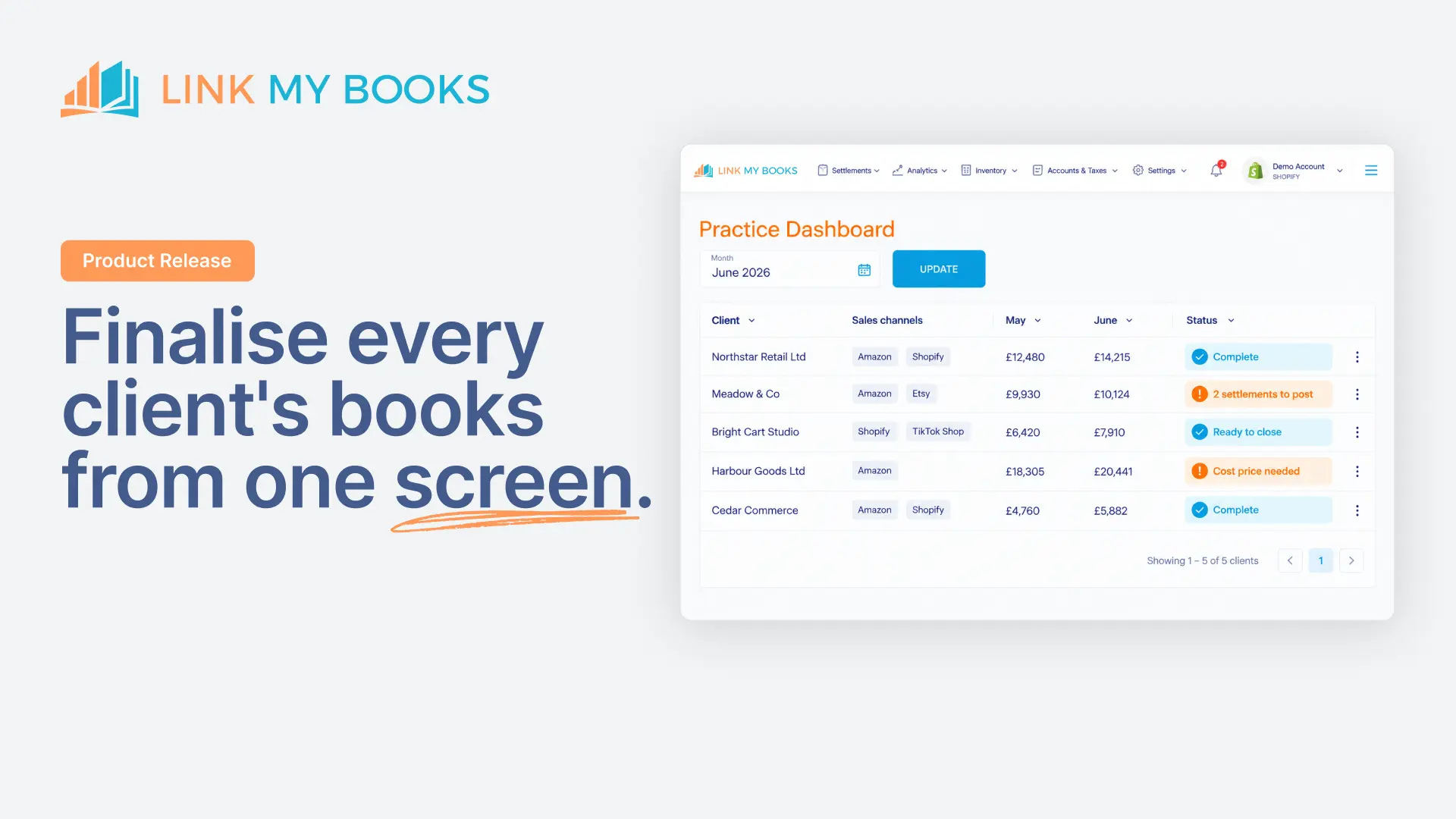
Link My Books removes the need to manage each platform separately. It applies one structure across all channels before data ever reaches your accounts, offering immediate benefits to your company.
Standardized Transaction Structure
Shopify, Amazon, and Etsy data are all processed into sales, fees, refunds, and tax. This ensures that the services you use automatically categorize transactions using predefined rules, providing reliable outputs with reduced manual intervention.
Unified Data in Xero or QuickBooks
Instead of separate platform entries, structured summaries are posted. This creates clean reconciliation and allows you to clearly watch your financial performance.
Designed for Scaling Businesses
As new channels are added to your network, the exact same system applies. No new processes or features are required, giving you the ability to expand seamlessly.
Comparison: Managing vs. Structuring
Link My Books
Unifies all platforms into one structure, removes platform-level differences, and utilizes advanced tools to reduce operational complexity.
A2X
Strong for marketplace reconciliation, but often utilizes Amazon-focused workflows.
Synder
Offers broad integrations but requires significant configuration to deliver consistency.
Booke AI
Focuses on general automation but is less focused on e-commerce data structure.
What matters is not how many platforms you connect, but whether they are handled the same way once connected.
Commercial Impact of Fixing This
Multi-channel accounting directly affects your bottom line and how your team operates. If you look ahead to where you want to be in three years, getting this right is non-negotiable.
Clear Performance Across Channels
When data is consistent, your leaders can accurately compare Shopify, Amazon, and Etsy. This helps leadership decide where to direct future investment.
Faster Reporting and Reduced Costs
One system replaces multiple reconciliation processes. This means less money spent on bookkeeping cleanup, leaving more capital available for marketing and inventory.
Scalable Operations and Talent Retention
New channels do not increase complexity. When your accounting is automated, your hiring strategy can prioritize top talent in sales and marketing rather than hiring extra admin staff to manually crunch numbers in back offices.
Practical Scenarios for Growing Brands
- Expanding into New Markets: Moving from just Shopify to exploring Amazon and Etsy introduces entirely different data models. A unified system removes this hurdle, making expanding much easier.
- Multi-Channel Brands and Customers: Operating across multiple platforms requires one consistent reporting structure. Without it, you cannot accurately track how much it costs to acquire and serve your customers.
- High-Growth Businesses: As transaction volume surges and you experience rapid growth, manual processes inevitably fail. Don't put the cart before the horse—you must define and build your financial foundation before you try to scale your marketing.
- Accountant-Managed Setups: Accountants and financial advisors benefit from standardized data and repeatable workflows. This improves efficiency across all their clients and ensures they can offer high-level strategic support.
Risks and Misconceptions
❌ "Each platform needs its own process."
Reality: No, this simply creates fragmentation and double work.
❌ "More tools will fix the problem."
Reality: Tools without a unified structure actually increase complexity.
❌ "Automation alone is enough."
Reality: Automation without consistency creates fast, but unreliable outputs.
❌ "This is just part of scaling."
Reality: The problem is not scaling itself; it is the lack of system design. In the long run, true scale requires structure.
FAQ Section
Why is managing Shopify, Amazon, and Etsy accounting so difficult?
Each platform uses a different data structure, payout model, and reporting format. Without a unified system, this creates inconsistencies that make reconciliation incredibly difficult.
What is the best way to manage multi-channel accounting?
The most effective approach is to standardize all platforms into the same structure, separating transactions into distinct categories: sales, fees, refunds, and tax.
Can I manage multi-channel accounting manually?
Manual processes can work at very low volumes but become highly inefficient as complexity increases. The sheer volume of data makes it impossible to maintain consistency without automation.
How does Link My Books help with multiple platforms?
Link My Books standardizes data from Shopify, Amazon, and Etsy before it reaches your accounting system, ensuring all platforms follow the exact same structure.
Does this apply outside the UK?
Yes. Multi-channel accounting challenges exist globally, including the US, Canada, and Australia.
Turning Three Systems into One
Shopify, Amazon, and Etsy are not natively designed to work together. Trying to manage them separately creates ongoing friction that goes against your core business goals.
The key to multi-channel accounting is to stop thinking in platforms and start thinking in structure. When all channels follow the same rules, you can accurately track your revenue, differences become manageable, and you finally achieve financial clarity. That is what allows you to operate confidently without the constant effort of fixing your numbers.



.webp)



.png)