


%20(1).webp)
Multi-channel ecommerce bookkeeping becomes exponentially difficult to manage manually when sales, fees, VAT, refunds, and payouts are spread across multiple platforms. Sellers operating across Amazon, Shopify, eBay, Etsy, and various payment processors often struggle with fragmented reconciliation workflows and inconsistent reporting visibility. Without a structured data approach, cloud-based accounting platforms like Xero and QuickBooks quickly become overwhelmed by disorganised data.
Link My Books helps automate multi-channel ecommerce bookkeeping by organising complex settlement activity into structured accounting workflows that drastically reduce manual finance correction work. By standardising the data before it ever reaches your accounting software, businesses can regain financial control and scale their operations confidently.
Key Takeaways from this Post
Multi-channel ecommerce bookkeeping becomes difficult when platforms handle settlements differently
Amazon, Shopify, eBay, and payment processors all structure payouts, fees, and VAT independently.
Settlement-based automation reduces reconciliation friction and bookkeeping clutter
Structured summaries improve payout matching, reduce duplicate entries, and simplify month-end finance reviews.
Strong automation improves operational scalability across multiple sales channels
Standardised bookkeeping workflows help businesses manage VAT, refunds, and reporting consistently as they grow.







Multi-channel ecommerce bookkeeping becomes exponentially difficult to manage manually when sales, fees, VAT, refunds, and payouts are spread across multiple platforms. Sellers operating across Amazon, Shopify, eBay, Etsy, and various payment processors often struggle with fragmented reconciliation workflows and inconsistent reporting visibility. Without a structured data approach, cloud-based accounting platforms like Xero and QuickBooks quickly become overwhelmed by disorganised data.
Link My Books helps automate multi-channel ecommerce bookkeeping by organising complex settlement activity into structured accounting workflows that drastically reduce manual finance correction work. By standardising the data before it ever reaches your accounting software, businesses can regain financial control and scale their operations confidently.
Why Multi-Channel Bookkeeping Becomes Operationally Complex
Every ecommerce platform handles financial activity differently, resulting in severe data fragmentation. What works for a single-channel storefront completely breaks down when applied to a multi-channel environment.
- Amazon uses settlement payouts, heavily grouping various charges and fees into net deposits.
- Shopify separates payment processing from direct store activity, creating multiple layers of reconciliation.
- eBay applies marketplace deductions independently, often calculating fees at the point of sale.
- Payment Processors (like Stripe or PayPal) introduce additional reconciliation layers, deducting merchant fees before the cash ever reaches the bank account.
Operationally, this creates disconnected finance workflows across the business. A single month of ecommerce activity may involve untangling:
- Marketplace sales (Gross revenue)
- Refund deductions (Including partial refunds and tax rollbacks)
- VAT adjustments (Cross-border tax and domestic GST liabilities)
- Platform fees (Listing fees, advertising costs, and fulfillment charges)
- Payment processor charges (Gateway transaction fees)
- Reserve balances (Rolling funds held by platforms to cover chargebacks)
- Currency conversions (Fluctuations from international sales)
- Shipping revenue (Amounts collected specifically for logistics)
When these systems are managed manually via raw data exports, bookkeeping workflows become significantly harder to maintain accurately. The operational issue rapidly compounds as sellers expand into additional sales channels.
Signs That Bookkeeping Workflows Are No Longer Scalable
Many ecommerce businesses continue using spreadsheet-heavy workflows and manual bank reconciliation long after the process has become operationally unstable. Relying on manual data entry introduces human error and obscures the true financial health of the business.
Common warning signs include:
- Slow month-end reconciliation: Finance teams spend days downloading CSVs and rebuilding payout reports manually just to close the books.
- Duplicate transaction activity: Disconnected or poorly configured app integrations create overlapping bookkeeping entries, falsely inflating revenue.
- VAT reporting inconsistencies: Tax visibility becomes harder to maintain across marketplaces, increasing the risk of compliance failures or overpaying sales tax.
- Weak profitability visibility: Operational costs and accurate Cost of Goods Sold (COGS) become difficult to interpret, meaning businesses do not know their true profit margins.
- Reconciliation mismatches: Bank deposits stop aligning clearly against marketplace settlement records, leaving unexplained discrepancies on the balance sheet.
When these symptoms appear, the operational workload often increases faster than revenue growth itself, forcing businesses to hire more administrative staff simply to manage the data.
What Automation Should Actually Improve Operationally
Many ecommerce sellers mistakenly assume automation simply means pushing raw transactions into the accounting platform as fast as possible. However, moving disorganised data quickly just creates a faster mess.
Operationally, highly effective bookkeeping automation should improve:
- Settlement visibility: Payouts should reconcile clearly and instantly against accounting records, matching the exact net deposits in the bank feed.
- Workflow consistency: Bookkeeping structures must remain stable across all marketplaces. Whether a sale happens on Etsy or WooCommerce, it should follow the same categorical logic.
- Finance review efficiency: Month-end bookkeeping should require significantly less manual correction work, freeing up accountants to provide strategic advisory.
- Multi-platform management: The accounting workflow should remain completely manageable as channel complexity grows.
- VAT and tax handling: Tax reporting should stay operationally structured across regions, ensuring compliance with frameworks like Making Tax Digital (MTD).
True automation becomes commercially valuable only when it reduces operational bookkeeping pressure after the settlement data reaches the accounting environment.
Why Transaction-Heavy Imports Create Bookkeeping Friction
Some legacy ecommerce integrations focus heavily on importing every single customer order into the accounting system. At first glance, this level of granularity appears detailed and thorough.
However, as transaction volume increases, these transaction-level workflows inevitably create:
- Bookkeeping clutter: Thousands of individual receipts overwhelm Xero or QuickBooks, causing the software to slow down.
- Reconciliation delays: Matching 5,000 individual gross sales against a single net bank deposit is nearly impossible without hours of manual cross-referencing.
- Slower reporting workflows: Generating a profit and loss statement becomes a sluggish process due to system bloat.
- Duplicate activity: Overlapping data streams from payment gateways and storefronts lead to double-counted sales.
- Larger finance correction workloads operationally: Fixing a systemic error requires deleting and re-syncing thousands of individual lines.
For multi-channel ecommerce sellers, fragmented transaction imports usually become harder to manage over time. That is precisely why settlement-based reconciliation workflows are operationally more scalable, reliable, and secure.
How Link My Books Automates Multi-Channel Ecommerce Bookkeeping
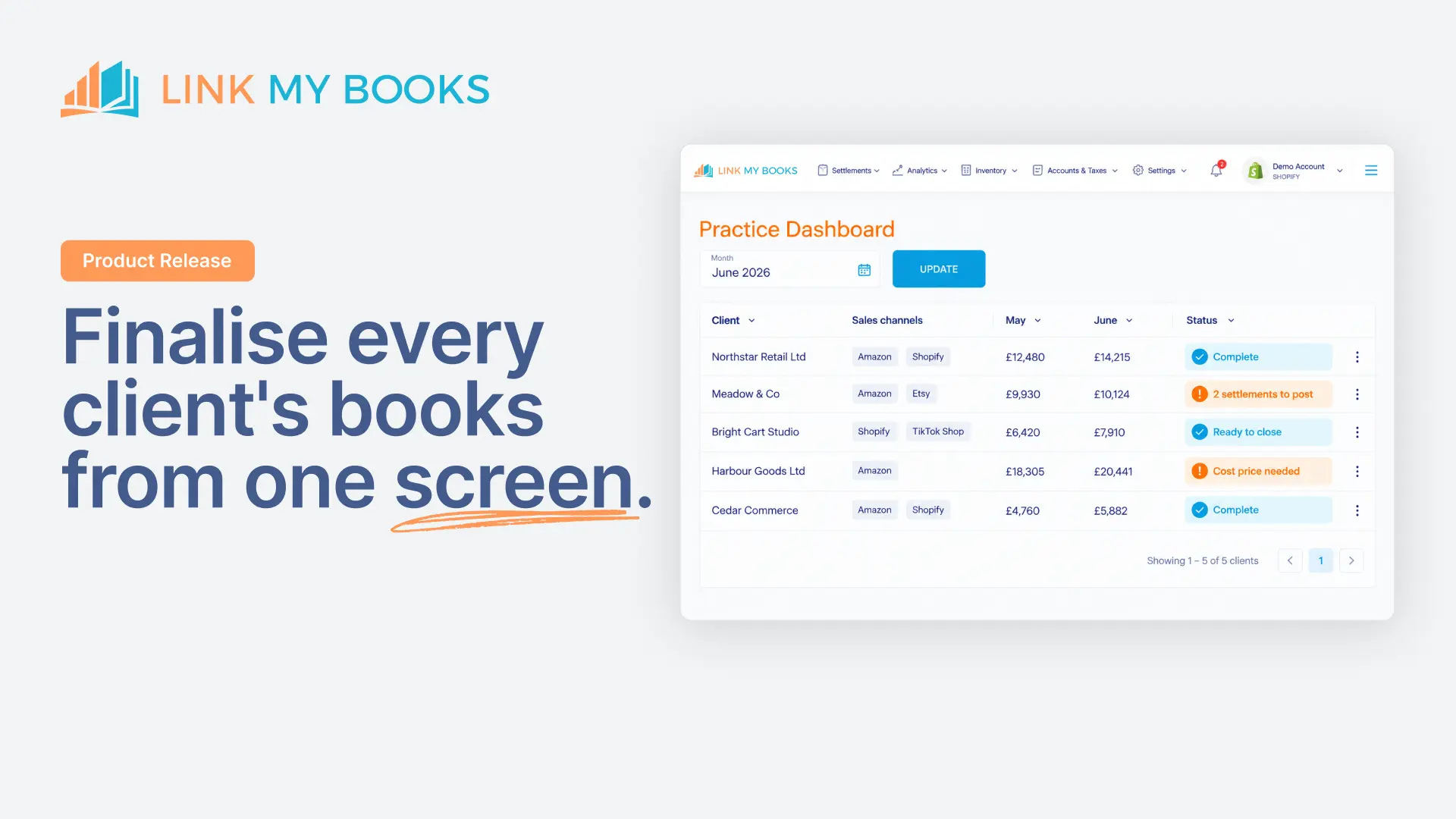
Link My Books approaches the problem differently by focusing on organising settlement activity into cleaner bookkeeping structures rather than pushing fragmented transaction-level imports into the accounting platform.
The workflow begins by seamlessly connecting ecommerce channels directly into Link My Books. This natively includes:
- Amazon
- Shopify
- eBay
- Etsy
- Payment processors (Stripe, PayPal, Square)
Once connected, the platform intelligently structures the raw data into:
- Marketplace payouts
- Fees and deductions
- Refund activity
- VAT-related transactions
- Reserve balances
- Settlement summaries
After securely connecting the accounting platform, the refined settlement activity flows into a much more organised reconciliation environment designed entirely around operational finance review.
This helps ecommerce sellers to:
- Reconcile payouts faster with one-click bank matching.
- Reduce spreadsheet dependency completely.
- Improve VAT visibility for strictly compliant tax returns.
- Simplify multi-channel bookkeeping workflows through standardisation.
- Maintain cleaner finance reporting structures operationally.
Instead of manually rebuilding settlement logic for each new platform, finance teams can review highly standardised bookkeeping summaries across the entire business. Using a dedicated multi-channel e-commerce software ensures that financial accuracy scales alongside sales.
To see exactly how this structured approach transforms your workflows, you can Book a demo here.
How Multi-Channel Bookkeeping Platforms Compare Operationally
When assessing your tech stack, it is crucial to understand how different integrations handle data architecture. Here is how three major competitors approach multi-channel environments:
Webgility
Webgility focuses heavily on broad ecommerce automation and multi-channel connectivity, often bridging the gap between inventory systems and accounting software.
- Operationally, it supports: Deep ecommerce platform integrations, complex inventory and accounting workflows, and multi-channel synchronisation for large-scale operations.
- Operational friction may increase when: Transaction environments become difficult to review operationally, settlement visibility weakens across diverse marketplaces, and finance teams require more granular reconciliation oversight.
Synder
Synder focuses heavily on direct transaction syncing and immediate ecommerce automation workflows.
- Operationally, it supports: Multi-platform ecommerce connectivity, automated transaction imports, and direct payment processor integrations.
- Operational complexity may increase when: Transaction-heavy bookkeeping environments become fragmented and bloated, month-end review workflows require additional reconciliation work to untangle net deposits, and overall finance visibility depends heavily on the initial setup quality.
Amaka
Amaka focuses on providing essential ecommerce integrations and baseline accounting synchronisation.
- Operationally, it supports: Standard marketplace connectivity, direct ecommerce transaction imports, and core accounting platform integration workflows.
- Additional operational review may be required when: Multi-channel settlement complexity increases, advanced VAT reporting workflows become harder to standardise, and reconciliation visibility weakens operationally across international marketplaces.
The strongest multichannel ecommerce accounting systems are usually the ones improving operational finance visibility rather than simply increasing bookkeeping complexity.
Practical Use Cases for Multi-Channel Sellers
Applying structured automation solves distinct challenges depending on a business's operational footprint:
Ecommerce Businesses Selling Across Amazon and Shopify
- The Need: Standardised settlement workflows and faster reconciliation visibility operationally. These brands must translate Amazon's complex fee structures and Shopify's gateway payouts into identical accounting summaries.
International Ecommerce Operations
- The Need: More stable VAT and currency reporting workflows. Selling into the EU or Australia requires stringent cross-border tax mapping that cannot be left to manual interpretation.
Businesses Scaling Into Additional Marketplaces
- The Need: Accounting systems that remain manageable operationally across channels. Adding TikTok Shop or Walmart to the sales mix shouldn't require hiring an additional bookkeeper to handle the data load.
High-Volume Ecommerce Sellers
- The Need: Reduced finance correction work and cleaner payout visibility across platforms. When processing thousands of orders daily, settlement-based structures are the only way to maintain a clean general ledger.
Risks and Misconceptions
When navigating ecommerce accounting, sellers often fall victim to several damaging industry myths:
“More integrations automatically improve bookkeeping.”
Disconnected, overlapping workflows often create much larger reconciliation problems operationally. Every app syncing data into Xero must follow the exact same structural rules.
“Importing every order improves accounting accuracy.”
Too much fragmented activity usually weakens operational bookkeeping visibility, cluttering the bank feed and obscuring true cash flow.
“Manual spreadsheets are sufficient for scaling ecommerce businesses.”
Spreadsheet-heavy workflows inevitably become unstable as settlement complexity and transaction volumes grow.
“All ecommerce platforms structure financial activity similarly.”
Each marketplace processes settlements, tax withholding, and fees differently operationally. Assuming uniformity leads to catastrophic reporting errors.
FAQ
What is multi-channel ecommerce bookkeeping?
Multi-channel ecommerce bookkeeping involves managing financial activity across multiple marketplaces (like Amazon and eBay), payment processors, and distinct ecommerce platforms (like Shopify) inside a singular, structured accounting workflow.
Why is multi-channel reconciliation difficult operationally?
Each marketplace handles net payouts, merchant fees, VAT collection, refunds, and rolling reserves completely differently. When this data enters an accounting system raw, it creates disconnected, chaotic settlement workflows that are nearly impossible to reconcile manually.
How does Link My Books automate ecommerce bookkeeping?
Link My Books extracts data from your sales channels and structures the raw settlement activity into organised, consolidated bookkeeping summaries. This matches your bank deposits exactly, improving reconciliation visibility and drastically reducing manual finance correction work.
Why do fragmented transaction imports create bookkeeping problems?
Pushing large volumes of disconnected, individual transaction activity into an accounting system creates severe reconciliation clutter. It bloats the software, slows down reporting, and becomes increasingly difficult to manage operationally as ecommerce businesses scale.
Is Webgility suitable for multi-channel ecommerce workflows?
Yes, Webgility is highly capable of supporting multi-channel ecommerce automation and accounting connectivity. However, depending on your setup, operational review complexity may still increase in larger, transaction-heavy environments if settlement-based workflows are not properly leveraged.
Creating Bookkeeping Systems That Support Multi-Channel Growth
Multi-channel ecommerce bookkeeping becomes infinitely harder to manage when each new platform introduces completely different payout structures, fee models, tax handling rules, and reconciliation workflows.
The ultimate challenge is not simply moving data into your accounting software faster. The real challenge is maintaining pristine operational clarity as your sales channels expand globally.
Strong, settlement-based bookkeeping automation provides finance teams with cleaner settlement visibility, highly consistent reconciliation workflows, and reporting structures that remain manageable even as marketplace complexity increases across the entire business.


.webp)




.png)