


If your store takes payment through Shopify Payments, Klarna, PayPal and maybe a card terminal too, you have several settlement cycles landing in your bank account at different times, each with fees calculated differently. Reconciling this in a spreadsheet means manually splitting every deposit by provider, chasing fee data some gateways never pass through, and hoping nothing gets missed before your VAT return is due. There is a repeatable process that fixes this, and it does not require becoming a spreadsheet expert.
Key Takeaways from this Post
Separate each payment provider by treating Shopify Payments, Klarna and PayPal as separate ledgers with their own settlement cycles and fee structures.
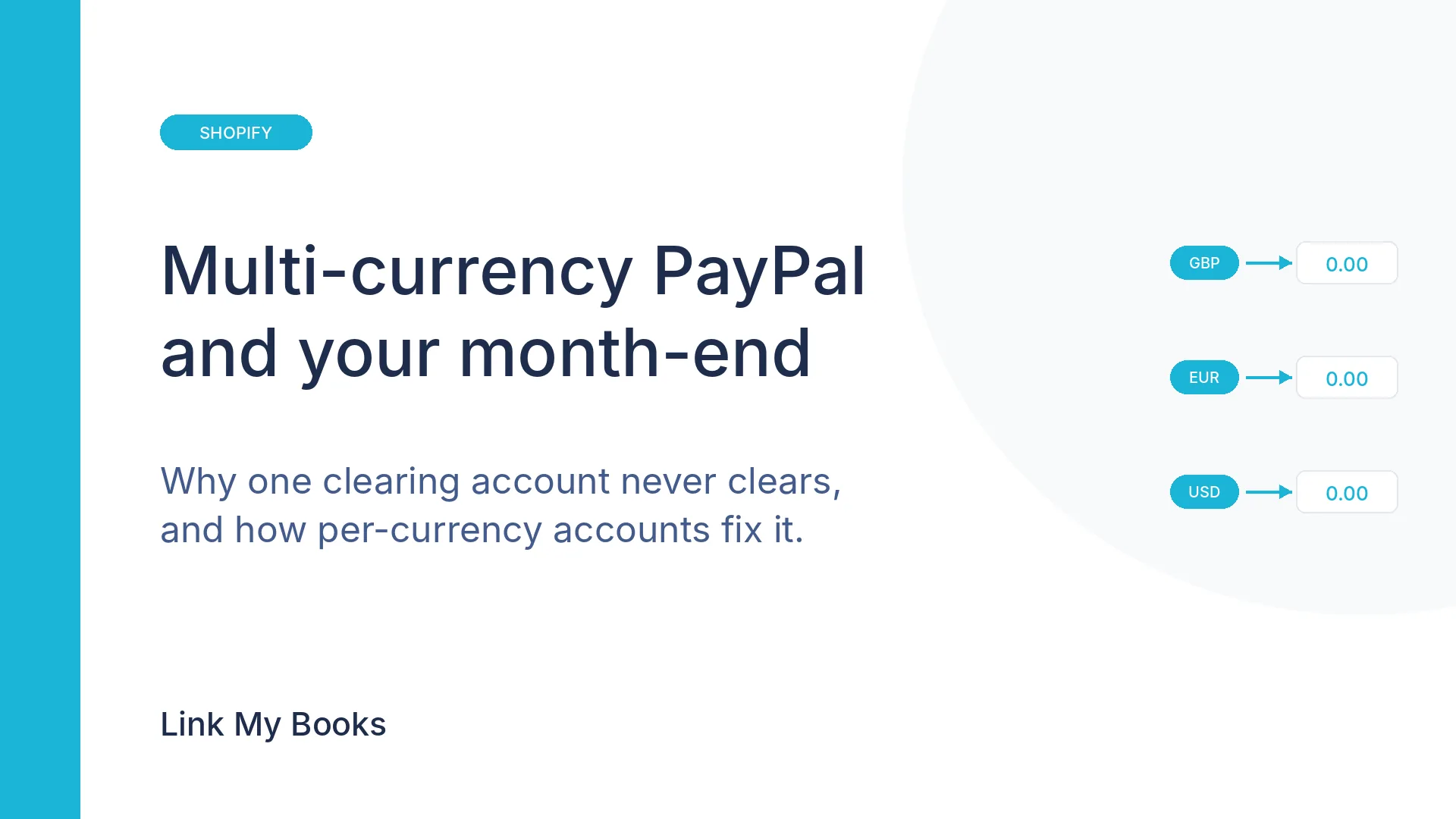
Use gateway specific clearing accounts to match deposits, track fees and resolve timing differences without spreadsheet chaos.
Reconcile regularly to protect VAT accuracy by keeping balances under control and ensuring VAT returns are based on accurate sales data.







If your store takes payment through Shopify Payments, Klarna, PayPal and maybe a card terminal too, you have several settlement cycles landing in your bank account at different times, each with fees calculated differently. Reconciling this in a spreadsheet means manually splitting every deposit by provider, chasing fee data some gateways never pass through, and hoping nothing gets missed before your VAT return is due. There is a repeatable process that fixes this, and it does not require becoming a spreadsheet expert.
Why Spreadsheets Break Down With Multiple Payment Providers
A single payment provider is manageable by hand. Shopify Payments deducts its fees before the payout hits your bank, so the deposit roughly matches what you expect. Add Klarna and PayPal and the picture changes. Klarna settles sales on a monthly cycle but pays out weekly, then invoices its fee separately through a merchant portal, entirely outside the Shopify payout. PayPal does not pass any fee data to Shopify at all, and its settlement summary usually appears by the 3rd of the following month, with the actual bank deposit landing several days later still.
Each of these creates a timing gap between when a sale happens, when it settles, and when cash reaches your bank. A spreadsheet has no way to hold that gap open safely. Sellers either force-match deposits to sales totals that do not agree, or give up and post round-sum journal entries that bury the fee and VAT detail. Both approaches leave your books wrong, and wrong books mean wrong VAT returns.
When dealing with multiple payment providers, traditional bookkeeping methods frequently fall short due to the complexity of multi-gateway transaction flows. Without dedicated reconciliation software, tracking individual payment settlement cycles across Stripe PayPal Adyen and alternative methods becomes an administrative burden.
The Step by Step Process for Reconciling Mixed Providers
The fix is to treat each payment provider as its own mini ledger inside your accounting system, rather than one blended cash pile. Effective payment reconciliation relies on systematic transaction matching and rigorous fee validation to maintain absolute financial accuracy.
- Separate settlement data by provider. Pull the settlement report from each gateway, Shopify Payments, Klarna, PayPal, Square, whichever applies, and keep them as distinct data sets rather than merging them into one sales total. This is crucial for clean gateway settlement tracking.
- Open a clearing account per gateway. Set up a dedicated balance sheet clearing account for each provider, where settlements, deposits and fees pass through before hitting your bank feed. This acts as an interim holding phase for transaction data.
- Post the settlement summary first. Record the gross sale, then the fee, into the relevant clearing account as soon as the provider confirms it, even if the cash has not arrived yet. This ensures swift discrepancy resolution before anomalies compound.
- Match the deposit when it lands. When the bank deposit clears, match it against the clearing account balance rather than the original sale. This is what absorbs the timing gap between Klarna's monthly settlement and weekly payouts, or PayPal's delayed transfer through automated automated matching protocols.
- Record fees as they become known. For providers like PayPal that do not pass fee data through Shopify, pull the fee separately from the provider's own reporting so it is not left sitting in undeducted gross sales. This level of granular control is essential for advanced ecommerce payment reconciliation.
- Expect a small leftover balance. A clearing account rarely hits exactly zero on any given day because of the gap between sale, settlement and deposit. What matters is that the balance trends toward zero over time.
- Tie the total back to VAT. Once fees and sales are correctly split by gateway, reconcile the net figures against your VAT return so the VAT declared reflects real taxable sales, not gross figures inflated by unrecorded fees. Seamless ERP integration or specialized channel connectors can simplify this final reporting stage.
Doing this monthly, rather than catching up at year end, keeps the clearing accounts manageable and the gaps small enough to spot quickly. For businesses scaling up their operations across different sales channels, streamlining multi channel bookkeeping is the ultimate key to sustainable growth.
Common Misconceptions
A common assumption is that if the bank deposit matches the sales report, the reconciliation is correct. It often is not, because fees deducted at different points, or not deducted at all in PayPal's case, can offset each other and hide errors that surface later.
Another misconception is that a nonzero clearing balance means something is broken. A small, shrinking balance is normal given how Klarna and PayPal settle. The problem is a balance that keeps growing or never moves.
Some sellers also assume VAT only needs attention at filing time. Fee timing differences can distort taxable sales figures for months before anyone notices, which is how one seller ended up overpaying HMRC before catching the error during a full review.
How Link My Books Solves This
Link My Books automates the clearing account logic described above, creating a dedicated "Shopify Gateway Clearing" account for each payment provider and posting the settlement summary, deposit, and fee in the correct order. For Klarna and PayPal specifically, it has documented, tested workflows covering how to reconcile Shopify sales paid via Klarna and how to reconcile Shopify sales paid via PayPal, so timing gaps and separately billed fees are handled without manual journal entries.
Beyond the clearing accounts, it also handles VAT product grouping, automated bank deposit matching, and deferred payment reconciliation across every channel it connects, Amazon, Shopify, eBay, Etsy, TikTok Shop, WooCommerce, Walmart and Square, into Xero or QuickBooks Online. A2X remains a solid, well trusted option for a similar approach, particularly through accountants who already know it. Taxomate covers similar ground but focuses mainly on Amazon, so it is less useful once Klarna and PayPal enter the mix. Booke AI is newer and AI-native but has limited presence among UK sellers so far.
One customer recovered £8,829 in overpaid VAT from HMRC after fixing this kind of reconciliation gap, and case study data shows sellers saving over 70 hours a month once automated.
FAQ
Why does my bank deposit never match my sales report exactly?
Deposits and sales rarely settle on the same day or in the same grouping. Shopify Payments is close to a match since fees come off before payout, but Klarna pays weekly against a monthly settlement cycle, and PayPal's summary appears around the 3rd of the following month with the deposit arriving days after that. A direct one-to-one match between a sale and a deposit is the exception once more than one provider is involved. This is why a clearing account exists, it holds the difference until the timing catches up rather than forcing an inaccurate match on the day.
Do I need a separate clearing account for every payment provider?
Yes, ideally. Blending Klarna, PayPal and Shopify Payments into one account makes it impossible to see which provider's fees or timing gaps are causing a discrepancy. A separate clearing account per gateway means any leftover balance immediately points to a specific provider, so tracking down an issue takes minutes rather than hours tracing through a combined spreadsheet.
How does this affect my VAT return?
If gross sales are recorded without correctly separated fees, taxable sales figures can be overstated or understated depending on how fees were handled. Since the £90,000 VAT registration threshold applies to taxable turnover, getting this wrong can affect registration timing as well as the return itself. Reconciling by provider before filing keeps VAT figures accurate and reduces the risk of an overpayment being caught later.
Is a nonzero clearing account balance a sign of an error?
Not necessarily. A small balance is expected because of the gap between when a sale settles and when cash lands, especially with Klarna and PayPal. The balance should trend toward zero over weeks, not stay flat or keep climbing. A balance that grows steadily or never reduces is the actual warning sign worth investigating.
Mixed payment providers do not have to mean messy books. Once each gateway has its own clearing account and a consistent monthly process for posting settlements, deposits and fees in order, VAT figures stay accurate and reconciliation stops eating hours every month. For sellers who would rather not build that process manually, Link My Books automates it across every major payment provider and sales channel, with a 14 day free trial and no card required.


.webp)



.png)