


If your bookkeeping depends on someone manually checking marketplace settlement reports at month end, that is already a scaling problem, not a growth problem. Sellers doing a few hundred orders a month can usually get away with spreadsheets and manual VAT coding. Past that point, especially once you are selling across more than one channel, the same process starts costing hours, then days, then the confidence to make decisions off your own numbers.
Key Takeaways from this Post
Manual finance processes do not scale because reconciliation, VAT coding and month end adjustments become increasingly time consuming as order volumes grow.
Channel level visibility is essential because blended reporting can hide unprofitable sales channels and make important financial decisions harder to justify.
Automation improves accuracy and control by keeping VAT, COGS, settlements and financial reporting up to date across multiple ecommerce channels.







If your bookkeeping depends on someone manually checking marketplace settlement reports at month end, that is already a scaling problem, not a growth problem. Sellers doing a few hundred orders a month can usually get away with spreadsheets and manual VAT coding. Past that point, especially once you are selling across more than one channel, the same process starts costing hours, then days, then the confidence to make decisions off your own numbers.
As digital storefronts expand, building a resilient ecommerce finance stack becomes the bedrock of sustainable growth. Without a robust financial infrastructure, expanding into new territories or adding sales channels introduces operational friction that can quickly stall a growing business.
The Seven Signs
1. Manual reconciliation is eating more hours every month
Every extra hundred orders adds more settlement lines, more fee types, and more refunds to trace back to the right invoice. What took an afternoon at 200 orders a month can take days once you cross into four figures across two or three channels. As a general pattern, this is where manual reconciliation stops being manageable for most sellers, though the exact tipping point depends on how many channels you are running. Implementing automated reconciliation is the primary method modern merchants use to eliminate this administrative drag.
2. No visibility into profit by sales channel
You know total revenue, but not whether Amazon, Shopify, or TikTok Shop is actually the more profitable channel once fees, ad spend, and returns are factored in. Without a profit and loss broken out by channel, decisions about where to invest marketing budget or list new products are guesswork dressed up as strategy. True scalability requires granular insights into unit economics across every platform you operate on.
3. VAT is being categorised product by product by hand
Someone is manually deciding which line items are zero-rated, standard-rated, or outside the scope of UK VAT, transaction by transaction. This is slow, and it is where errors creep in, particularly around marketplace facilitator rules and B2C versus B2B sales across borders. For growing businesses, handling VAT reconciliation ecommerce sellers face requires automated rule engines rather than human memory to maintain compliance across complex tax jurisdictions.
4. COGS updates lag weeks behind actual stock movement
If cost of goods sold is only updated when someone remembers to open a spreadsheet, your margins are always describing last month, not this one. Stale COGS means your P&L looks fine right up until the moment a supplier price rise or a slow-moving SKU quietly wipes out your margin. Keeping inventory valuation synchronised with real-time sales data prevents sudden cash flow surprises.
5. Recurring manual adjustments at month end just to make the books balance
If your bookkeeper or accountant needs a list of journal entries every single month to force the accounts to tie out with what actually happened on the marketplaces, that is not a one-off tidy-up. It is a sign the underlying process is not capturing fees, refunds, and taxes correctly in the first place. This symptom often points to an outdated setup that lacks proper ERP integration or native multi-channel mapping.
6. Revenue figures don't match across reports
Your accounting software says one number, the channel dashboard says another, and the bank statement shows a third. Settlement payouts bundle sales, fees, refunds, and tax together, so without proper reconciliation these figures will keep drifting apart as volume grows, and reconciling them after the fact gets harder every month. Managing cross-border payments and multi-currency payouts compounds this issue if your ledger does not ingest settlement data transparently.
7. Nobody can explain why profit moved month to month
When margin swings and the answer is "not sure, might be fees" rather than a specific, traceable cause, the finance stack has stopped doing its job. At low volume this is a minor irritation. At scale it means real decisions, pricing, ad spend, and stock orders are being made without reliable information. Optimising your broader cash flow management framework relies entirely on explaining these variances with absolute precision.
What This Actually Costs You
These signs compound. One seller who fixed their reconciliation process found they had overpaid HMRC and recovered £8,829 in VAT that had been miscategorised for months. Another case saved more than 70 hours a month once manual reconciliation was automated, time that had been going into spreadsheet work rather than the business. Multiply either of those across a full year, or across an accountant billing hourly to untangle messy books, and the cost of ignoring these signs is rarely small once you actually add it up.
As businesses mature, many evaluate enterprise tools like NetSuite or transition towards a modern composable architecture that allows specialized microservices to plug directly into core ledgers. However, achieving true financial automation does not always require an enterprise overhaul; often, it requires streamlining the transactional data flow between marketplaces and accounting platforms.
How Link My Books Solves This
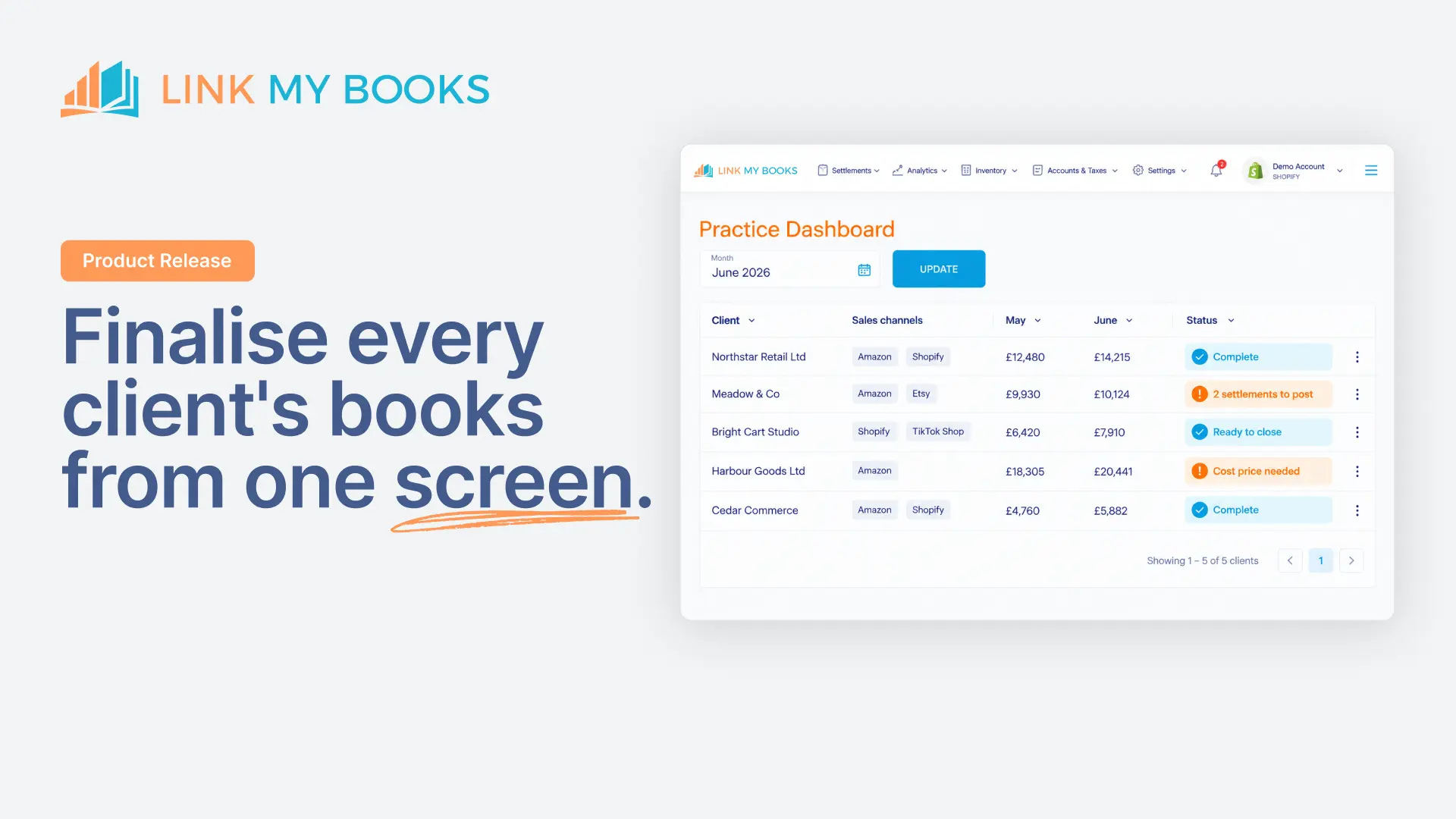
Link My Books connects Amazon, Shopify, eBay, Etsy, TikTok Shop, WooCommerce, Walmart, and Square directly to Xero or QuickBooks Online, and addresses each of these signs directly rather than patching around them. Automated payout reconciliation matches every settlement to sales, fees, refunds, and tax so the manual hours in sign one disappear. P&L by sales channel gives the visibility that sign two is missing, so you can see which channel actually makes money once real costs are included.
VAT product grouping handles the categorisation in sign three automatically, applying the right tax treatment across channels instead of relying on someone coding each line by hand. Built-in COGS and inventory tracking keeps margins current rather than weeks behind, fixing sign four, and because sales, fees, and tax are broken out correctly at the point of sync, the recurring adjustments in sign five and the mismatched figures in sign six largely stop happening. Financial analytics and benchmarking give the traceability that sign seven needs, so profit movements have a specific, explainable cause.
Compared to leading alternatives on the market, Link My Books excels by providing robust multi channel accounting UK capabilities tailored specifically to domestic and cross-border compliance. While some platforms offer general ledger syncing, specialized tools streamline complex tax workflows much faster.
FAQ
At what order volume should I stop reconciling manually?
There is no fixed cutoff, but the pattern shows up consistently once sellers pass roughly 1,000 orders a month across multiple channels. Below that, a careful person with a spreadsheet can usually keep up. Above it, the number of settlement lines, fee types, and refund cases grows faster than the time available to check them, and errors start slipping through unnoticed until VAT returns or year-end accounts surface them.
How does UK VAT registration affect my finance stack?
Once taxable turnover passes the £90,000 threshold, VAT registration for online sellers becomes mandatory, and every sale needs correct tax treatment from that point forward. Manual coding becomes riskier at this stage because VAT errors compound across every order rather than showing up once. Automating VAT categorisation before you register, not after, avoids a backlog of transactions that need re-checking.
Can Link My Books replace my bookkeeper or accountant?
No, and it is not designed to. It automates the reconciliation and categorisation work that otherwise takes up an accountant's time, so the numbers they receive are accurate and ready for review rather than needing correction first. Most accountants prefer working with clients whose books are already reconciled, since it reduces the manual clean-up before VAT returns or annual accounts.
Does this work if I sell on more than one marketplace?
Yes, that is the specific case it is built for. Amazon, Shopify, eBay, Etsy, TikTok Shop, WooCommerce, Walmart, and Square all sync into the same Xero or QuickBooks Online setup, with channel-level P&L so you can compare performance across marketplaces rather than seeing one blended number.
If any of these seven signs sound familiar, the fix is not more spreadsheet discipline, it is removing the manual step entirely. A 14-day free trial with no card required is enough time to see whether automated reconciliation changes the picture for your own numbers, and Link My Books is built specifically for sellers running multiple ecommerce channels into Xero or QuickBooks Online.


.webp)



.png)