


Synder is a capable accounting automation platform, but many ecommerce sellers start looking elsewhere when pricing scales up, Basic plan limits kick in, or they want a tool built more specifically for payout reconciliation, VAT handling, and multi-channel ecommerce bookkeeping.
The best Synder alternative is usually the one that gives you clean payout reconciliation, accurate tax handling, and pricing that still makes sense when your order count grows. That is where a more ecommerce-specific tool often wins.
Key Takeaways from this Post
Synder gets expensive as complexity grows: It can work well for broad transaction syncing, but many ecommerce sellers start looking for alternatives when pricing rises with volume, integration limits kick in, or they still need too much manual cleanup at month-end.
The best alternative depends on what you actually need: Taxomate is stronger for budget-conscious sellers, Webgility fits QuickBooks-heavy operations, and ConnectBooks is a solid option for SKU-level profit visibility, but each comes with its own tradeoffs.
Link My Books is the best overall fit for ecommerce sellers: It gives you cleaner payout reconciliation, stronger VAT and sales tax handling, better multi-channel visibility, and direct sync with Xero or QuickBooks, which saves time and reduces bookkeeping errors.







Best Synder Alternatives at a Glance
The shortlist below focuses on tools that solve the real problem behind this search: getting sales, fees, refunds, taxes, and payouts into Xero or QuickBooks accurately without wasting hours on cleanup at month-end. Pricing below reflects public starting prices visible on official sites at the time of review.
Link My Books: Best overall for ecommerce accounting

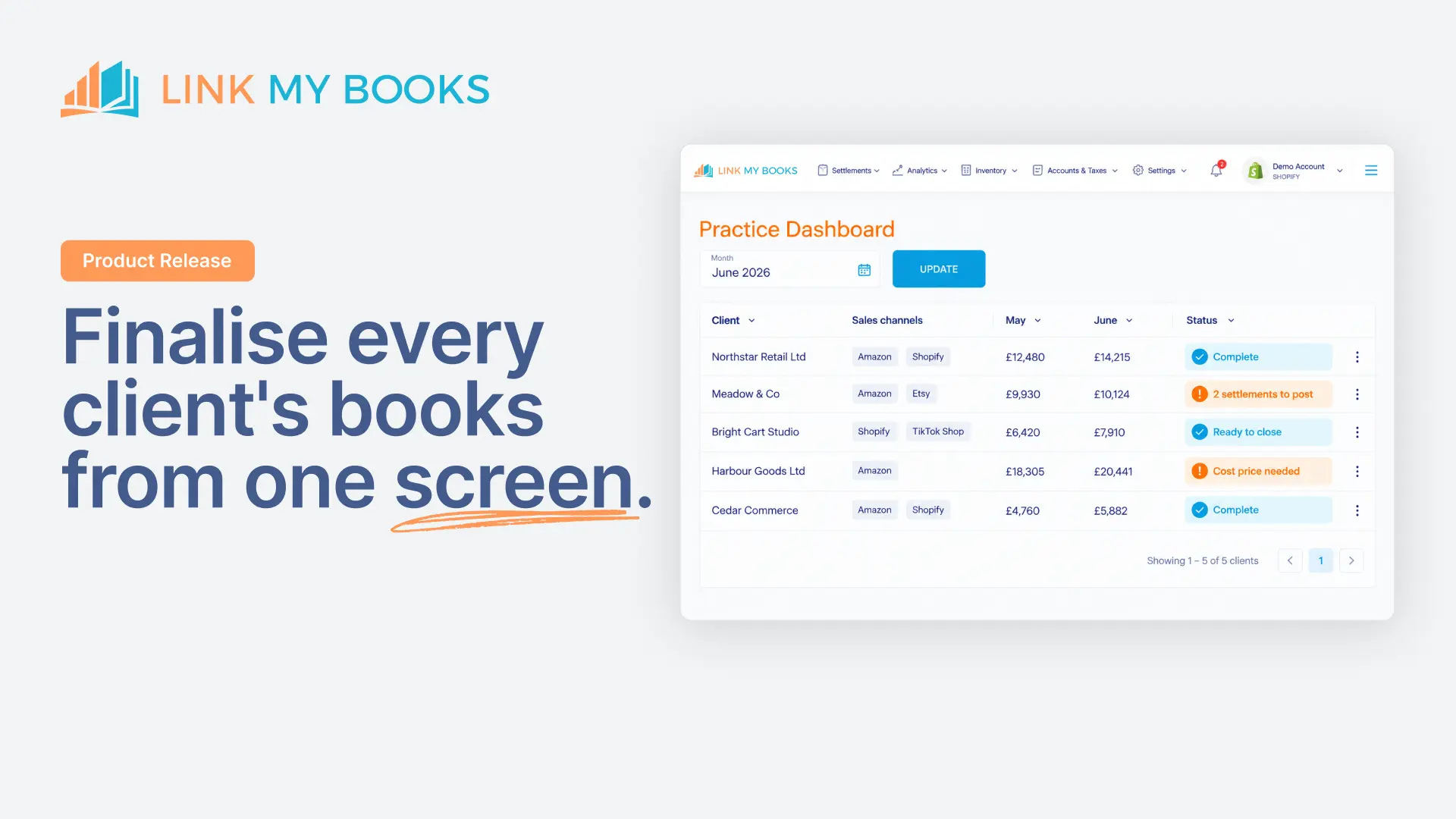
Link My Books is the strongest Synder alternative for ecommerce sellers who want accurate payout reconciliation, better VAT and tax handling, and cleaner month-end books in Xero or QuickBooks. It is purpose-built for ecommerce, which shows up in the feature set: payout reconciliation, financial analytics, COGS tracking, VAT product grouping, P&L by channel, and benchmarking.
Features
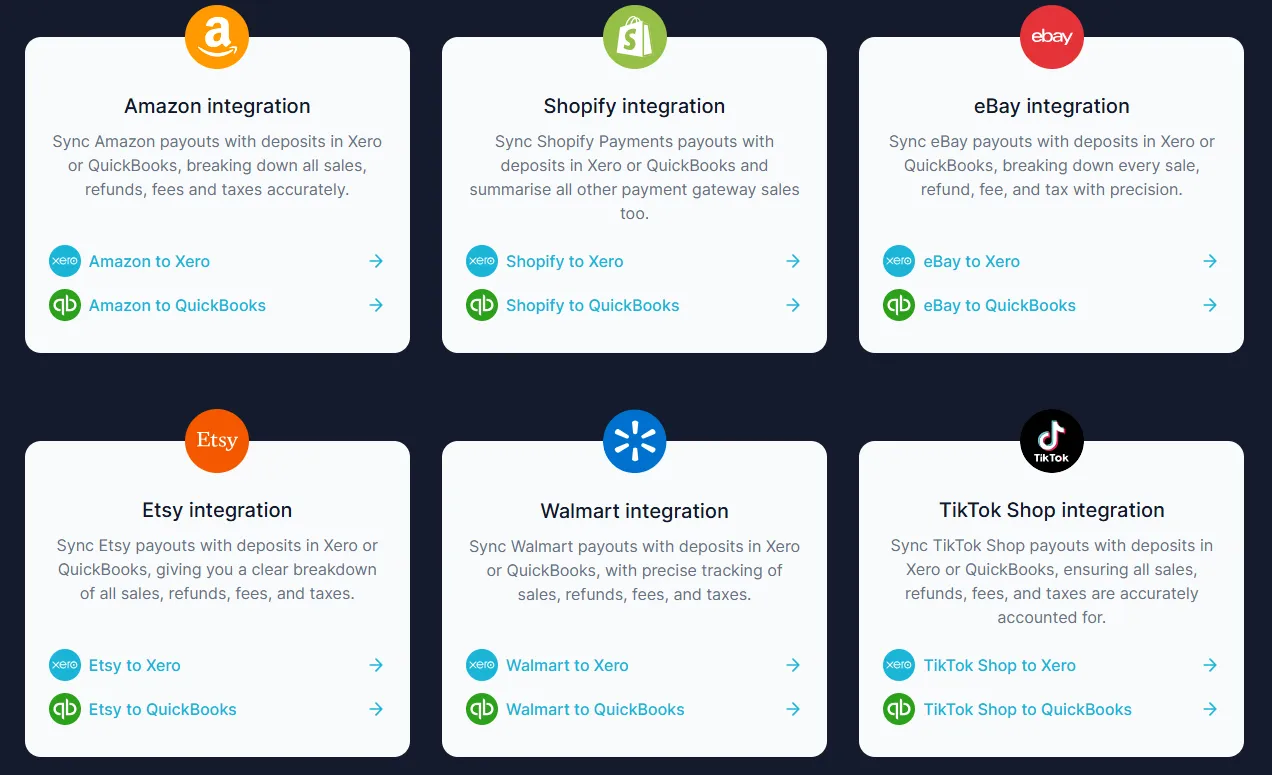
- Payout reconciliation: Sync sales, refunds, fees, and tax data from your sales channels into Xero or QuickBooks.
- VAT product grouping: Apply different tax rules to standard, reduced, and zero-rated goods.
- COGS tracking: Track cost of goods sold as inventory moves.
- Financial analytics and P&L by channel: See cross-channel performance in one place.
- Benchmarking: Compare your performance against industry averages.
- Accountant-led onboarding and support: Plans include email, chat, and one-to-one onboarding support.
👉If you decide to try out Link My Books, here’s what you can expect:
Cleaner Reconciliation
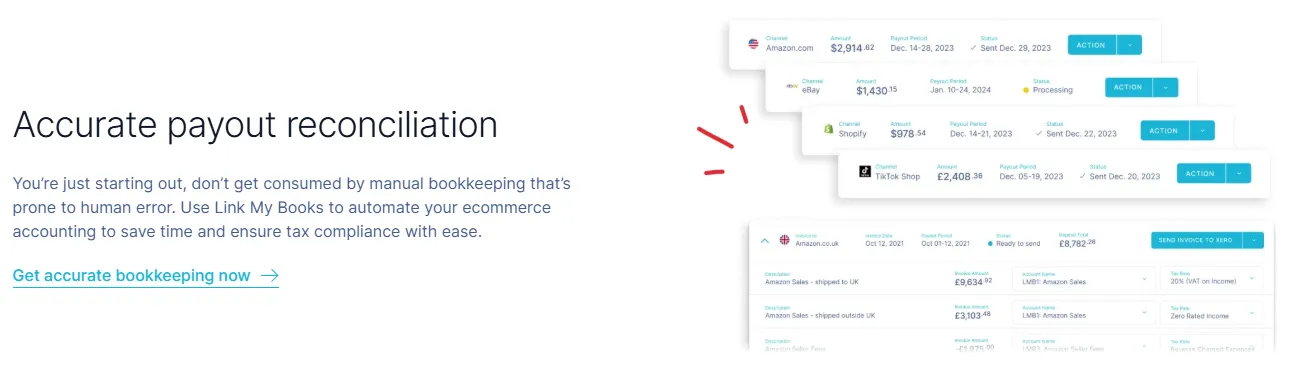
This is where Link My Books pulls ahead for most ecommerce sellers. It is built around the reality that your bank deposit is not the same thing as your revenue. You need sales, refunds, fees, and taxes separated properly so the entry matches the payout and reconciles cleanly. That removes one of the biggest sources of bookkeeping errors for online sellers.
Better VAT and Sales Tax Accuracy
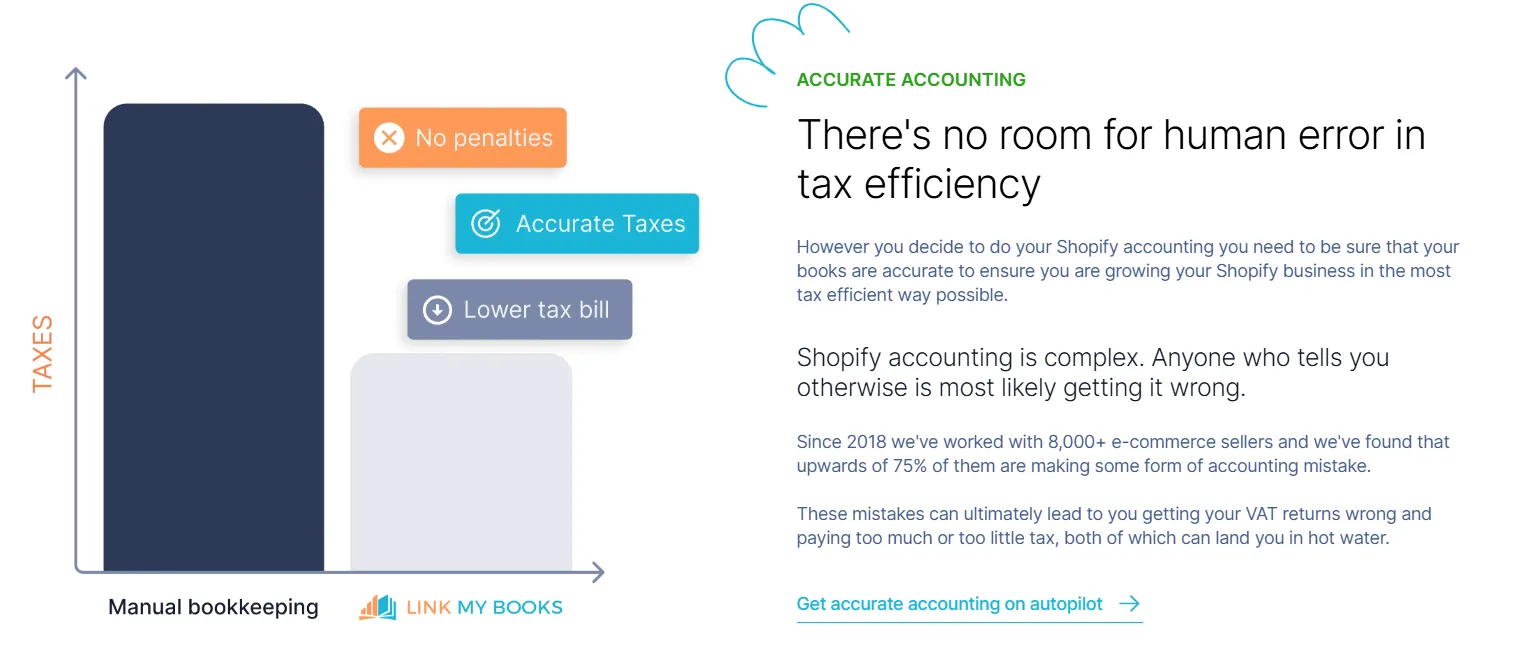
If you sell across borders or carry products with mixed tax treatment, manual bookkeeping creates risk fast. Link My Books addresses that with a guided tax wizard, VAT product grouping, support for multiple VAT registrations, and product grouping for standard, reduced, and zero-rated goods. That is especially useful for UK and EU sellers that need tighter VAT control.
Better Visibility Across Channels
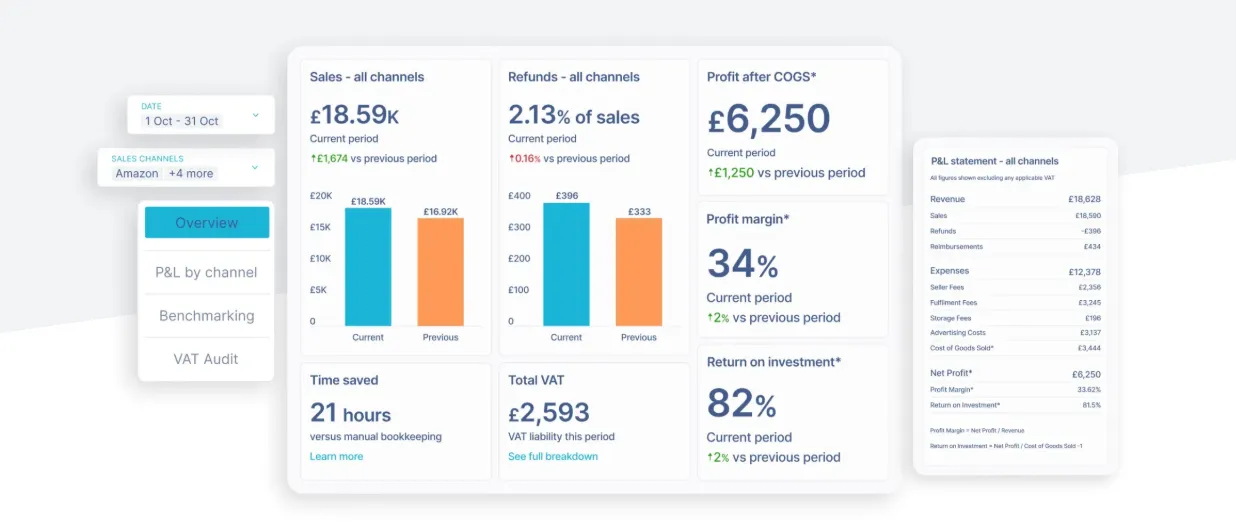
Link My Books does more than push data into the ledger. It also gives you financial analytics, P&L by channel, and benchmarking. That matters when you want to understand which platform is actually profitable after fees and taxes, not just which one looks strong on gross revenue.
Link My Books Pricing

Link My Books offers flexible pricing that scales with your business based on two factors:
- Monthly order volume: whether you process 200 orders or 250,000 orders, you only pay for what you use.
- Number of connected sales channels: one Shopify store, or multiple stores across Amazon, Etsy, TikTok Shop, and eBay.
Check out our price calculator to see where you would land.
[insert shortcode for pricing]
Every subscription includes:
- Unlimited users (ideal for accountants or teams)
- Free onboarding with a qualified accountant
- Built-in VAT and OSS automation
- SKU-level COGS tracking
- Industry benchmarking and profitability insights
- A 14-day free trial with no credit card required
Where It Shines
Link My Books is the best fit if you sell on ecommerce channels and care about payout reconciliation, VAT accuracy, multi-channel reporting, and keeping Xero or QuickBooks clean. It also works well for accountants who manage ecommerce clients and need a repeatable workflow instead of spreadsheets and one-off fixes.
Where It Falls Short
The setup can still feel detailed if you have no accounting knowledge at all. Link My Books helps with onboarding, but it does not replace tax advice. Sellers with unusual tax setups still benefit from involving their accountant during implementation.
A2X: Best for established sellers who want a well-known payout summary workflow
A2X is mature, well-known, and purpose-built for ecommerce accounting. If you want payout-summary accounting and already know you prefer A2X’s workflow, it is a strong option.
A2X Features
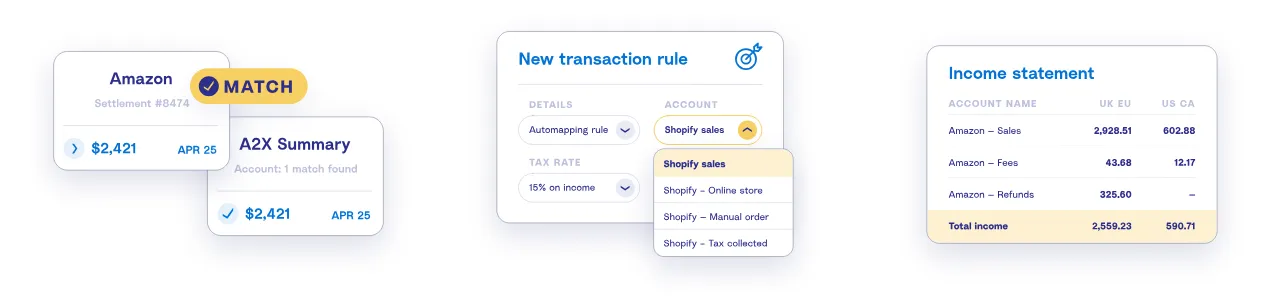
- Payout summaries: Converts marketplace payout data into organized summaries that reconcile in your accounting software.
- Multi-platform accounting sync: Connects ecommerce channels to QuickBooks Online, Xero, Sage, or NetSuite.
- COGS support: Helps sellers match product costs to payouts for clearer margin reporting.
- Ecommerce-focused bookkeeping: Built specifically for sellers who need structured marketplace accounting.
A2X Pricing
A2X is solid, but the price climbs much faster once sellers add channels and volume.
Where It Shines
A2X is a good fit for sellers who want a proven payout-summary workflow and do not mind paying more as channel count and order volume rise. It is especially strong for established Amazon and Shopify businesses.
Where It Falls Short
The cost curve is the main issue. A2X gets expensive faster than many sellers expect once they move into multi-channel territory.
Taxomate: Best for budget-conscious sellers who want low-cost bookkeeping automation

If you are looking for a cheap Synder alternative, Taxomate deserves a close look. It supports QuickBooks, Xero, and Wave. The Multi-channel plan removes the one-channel cap and includes unlimited sales channels, unlimited historical data, COGS tracking, one-click auto-sync, and unlimited users.
Taxomate is attractive for smaller sellers because the entry price is low and the feature set is practical. It supports Amazon, eBay, Shopify, Walmart, and Etsy, and it gives you a lighter path into ecommerce bookkeeping automation without enterprise-style pricing.
Taxomate Features
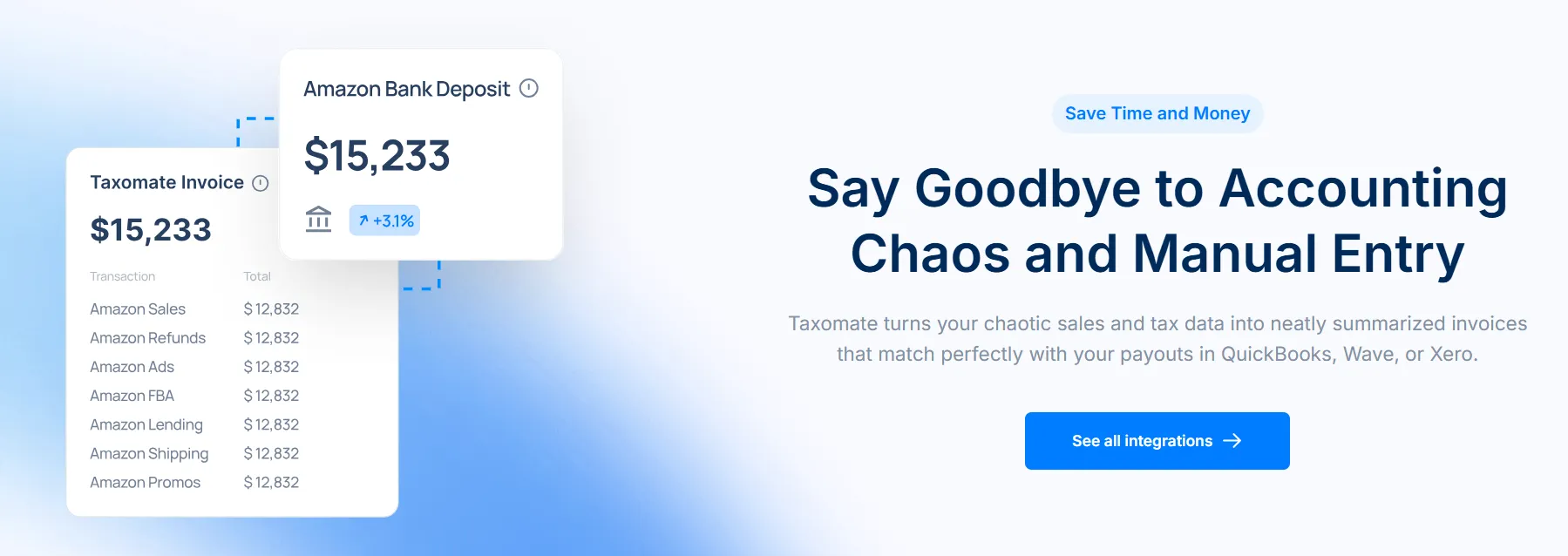
- Automated payout posting: Pulls marketplace data and creates summarized invoices that match payouts.
- Broad accounting support: Syncs with QuickBooks, Xero, and Wave.
- COGS tracking: Supports cost of goods sold workflows for cleaner profitability reporting.
- Multi-channel automation: Supports marketplaces like Amazon, Shopify, eBay, Walmart, and Etsy.
Taxomate Pricing

The pricing plans are flexible, and the price will change based on whether you sync your sales channel inventory to QuickBooks.
Taxomate includes a 14-day free trial and supports QuickBooks Online, Xero, and Wave.
Where It Shines
This is one of the best Synder accounting alternatives if your main goal is to save money and stop doing bookkeeping manually. It is also one of the few options here that publicly supports Wave in addition to Xero and QuickBooks.
Where It Falls Short
Taxomate is compelling on price, but it does not feel as full-stack as Link My Books or Webgility. If you want deeper analytics, stronger VAT-specific positioning, or more premium onboarding, you may still outgrow it.
Webgility: Best for QuickBooks-heavy businesses

Webgility sits in a slightly different category. It is not just an accounting connector. It leans into broader ecommerce operations, including inventory, order workflows, and QuickBooks-heavy automation.
It supports QuickBooks Online, QuickBooks Desktop, and Xero, and is leaning into inventory sync, assemblies, kits, refund logic, payout reconciliation, and real-time ecommerce accounting automation. That makes it attractive for operators who want a more operational system around the books.
Webgility Features
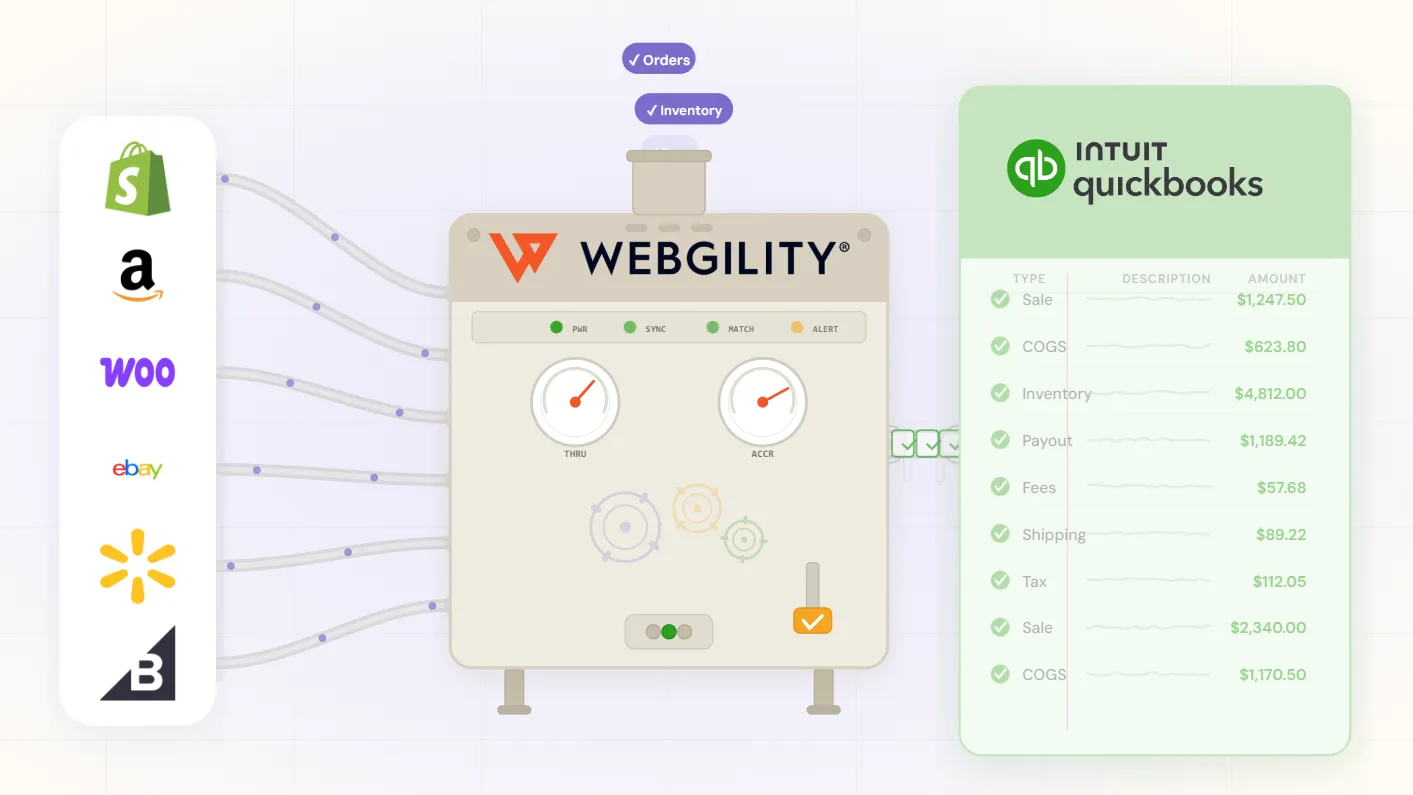
- Ecommerce accounting automation: Connects online stores with QuickBooks for automated bookkeeping and reconciliation.
- Inventory management: Supports inventory sync, assemblies, and kits.
- Order and refund handling: Includes channel-level refund logic and real-time transaction syncing.
- Operational depth: Goes beyond bookkeeping with broader workflows for multichannel sellers.
Webgility Pricing

Webgility’s pricing is customizable, so actual cost changes with order volume, channels, and add-ons. The page also shows extra fees in some setups, including a one-time historical data input fee and onboarding fees on some plans.
Where It Shines
Webgility is a strong Synder alternative for QuickBooks-heavy businesses, especially those that also want inventory automation or QuickBooks Desktop support. If you are trying to manage accounting and operations in one workflow, it offers more breadth than most pure reconciliation tools.
Where It Falls Short
The tradeoff is complexity. Pricing is less straightforward than Taxomate or Parex, and optional modules can push the real cost up. If you only want clean ecommerce reconciliation, Webgility can feel bigger than necessary.
ConnectBooks: Best for sellers who want SKU-level profit visibility and deeper margin insights
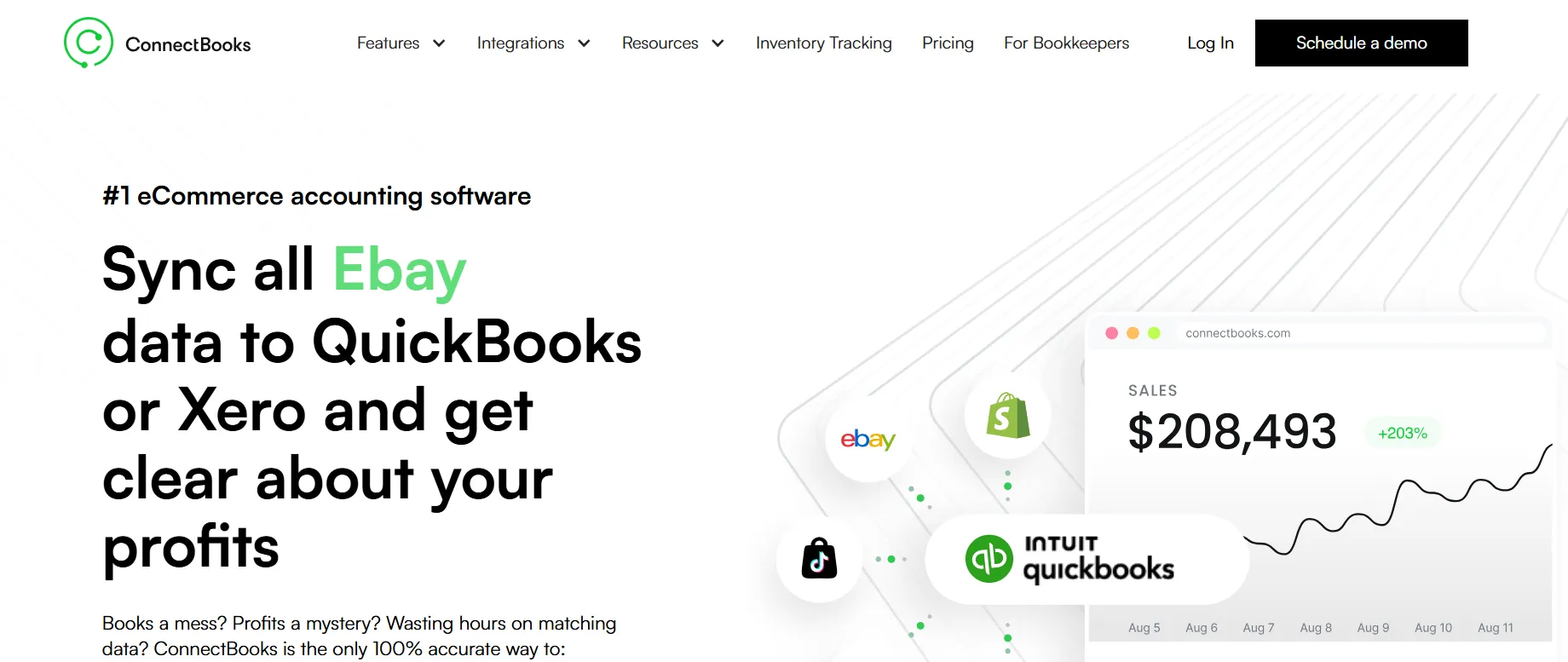
ConnectBooks is a strong pick if your biggest frustration is not just bad bookkeeping, but poor margin visibility. Its site positions the tool around transaction sync, profitability analytics, and SKU-level reporting.
It supports QuickBooks Desktop, QuickBooks Online, QuickBooks Enterprise, and Xero. It also emphasizes profit analytics, transaction-by-ID tracking, reconciliation of fees and returns, and inventory-aware visibility. That makes it a solid option for sellers who care about profit-by-product rather than just getting month-end entries posted.
ConnectBooks Features

- Automated accounting sync: Sends accurate ecommerce data into QuickBooks or Xero.
- Real-time profit visibility: Tracks sales, fees, COGS, and profit calculations daily.
- SKU-level insights: Helps sellers see net profits and COGS per SKU.
- Dashboard reporting: Includes live sales and profitability views for easier decision-making.
ConnectBooks Pricing

ConnectBooks uses a custom pricing calculator tied to monthly orders and marketplaces, so pricing shifts by usage tier.
They also offer a free trial that you can use for up to thirty days.
Where It Shines
This is one of the better Synder alternatives for operators who want SKU-level clarity and want their accounting tool to help with buying decisions, landed costs, and profitability analysis, not just sync data to the ledger.
Where It Falls Short
Pricing is more layered and plan logic depends on how much detail you want in QuickBooks or Xero. That can make the buying process less intuitive than it looks at first glance.
Parex Bridge: Best for sellers who want a cheaper connector with flexible sync options
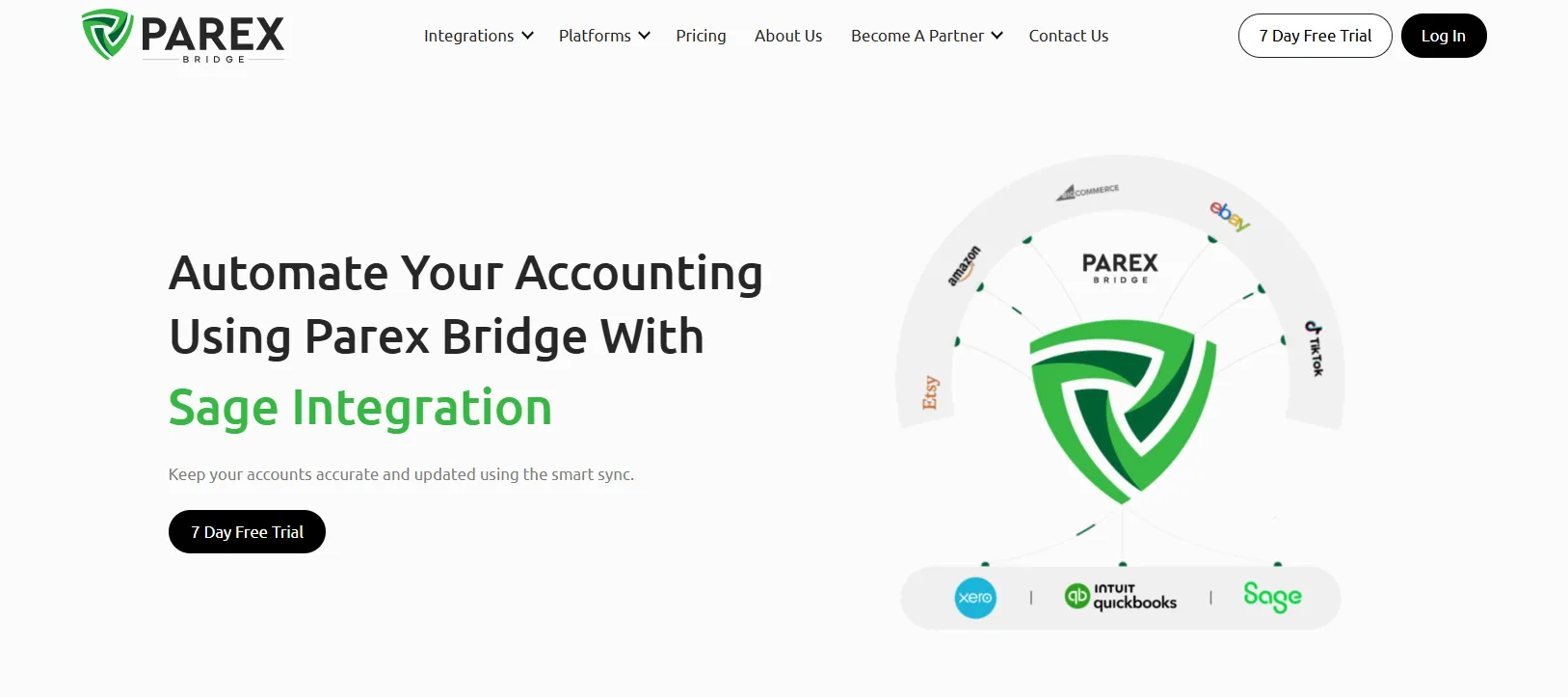
Parex Bridge is a lower-cost connector option that supports QuickBooks, Xero, and Sage, offers both individual sync and summary sync, and includes payout sync for easier reconciliation.
Parex Bridge Features
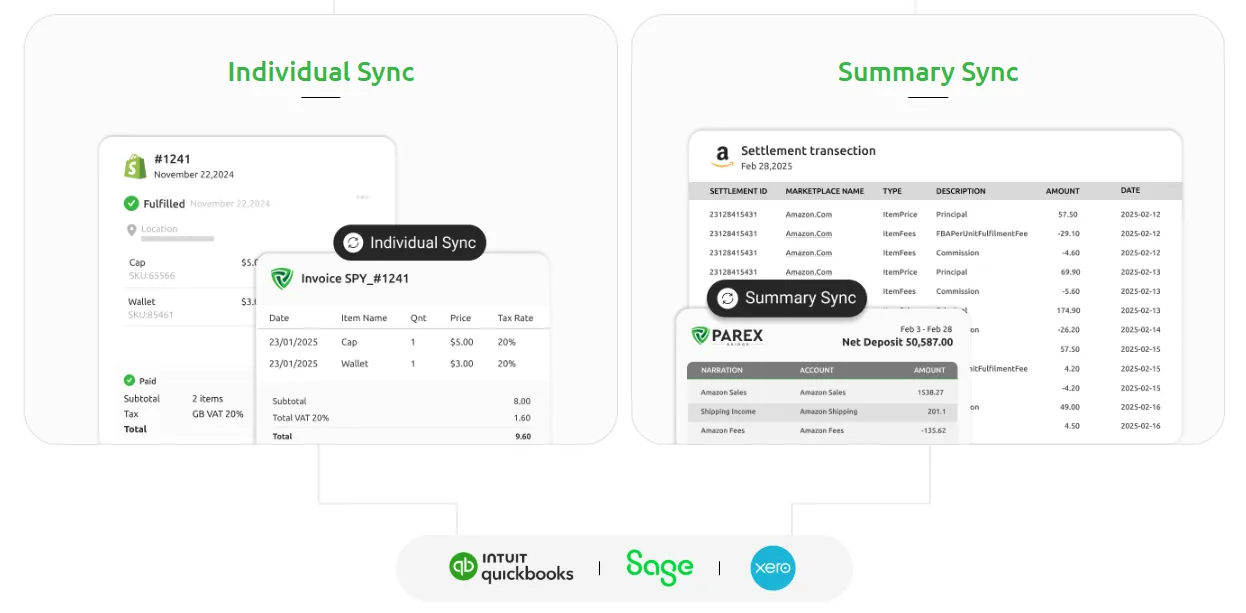
- Summary and individual sync: Lets sellers choose between summarized posting and line-level syncing.
- Order data sync: Syncs items, fees, taxes, discounts, payments, and refunds.
- Flexible reconciliation workflow: Includes payout and settlement-related syncing for cleaner bookkeeping.
- Multiple accounting integrations: Connects ecommerce stores with QuickBooks, Xero, and Sage.
Parex Bridge Pricing
Parex also lists overage pricing on the main page and notes that plan availability can change by integration. It is one of the cheaper connector-style options, but it does not bring the same ecommerce accounting depth as Link My Books.
Different payment plans are included for the integration with QuickBooks Desktop.
Where It Shines
If your priority is a lower monthly bill and a connector that can handle the basics well, Parex is a credible cheap alternative to Synder. It is also useful if you want both individual and summarized sync options.
Where It Falls Short
Parex is more connector-style than insight-style. You do not get the same analytics and seller-focused financial visibility that make Link My Books or ConnectBooks more strategic tools. Support also appears to be email-only on public plan pages.
How to Choose a Synder Alternative
If you want to choose the right Synder alternative fast, focus on five things.
Check whether the product is built for ecommerce accounting or for general transaction syncing. That distinction matters. General sync tools can push data into your books, but ecommerce sellers usually need payout-level clarity, fee breakdowns, refund handling, and marketplace tax treatment that match what actually hit the bank. That is the core of good ecommerce accounting.
Review tax and reconciliation depth. If you deal with VAT, mixed-rate products, marketplace-collected tax, or multi-country sales, you need more than a basic connector. You need a tool that helps separate what the marketplace collected from what you still owe, and then posts it cleanly into Xero or QuickBooks.
Check channel coverage and support. Synder connects 30+ sales channels and supports QuickBooks Online, Xero, Sage Intacct, NetSuite, and Intuit Enterprise Suite. That breadth is useful. But if you are an ecommerce seller who mainly wants accurate books from Amazon, Shopify, eBay, Etsy, or Walmart, a more specialized tool can be a better fit.
Look at what happens after setup. The real test is not whether the software connects. The real test is whether your first bank deposit reconciles cleanly, your tax settings hold up, and your accountant can review the output without fixing it manually.
What Is the Best Synder Alternative?
Here is the clearest answer.
Link My Books wins overall because it combines the features most ecommerce sellers actually need in one place: payout reconciliation, VAT-aware tax handling, analytics, benchmarking, accountant-friendly support, and pricing that starts lower than Synder’s public entry tier.
How to Switch From Synder to Another Tool
Switching is not hard if you do it in the right order.
- Export your historical reports from Synder: Keep a copy of prior synced periods and tax settings.
- Audit your chart-of-accounts mappings: Check sales, refunds, fees, tax, and payout accounts before you connect a new tool.
- Connect one sales channel first: Do not migrate everything at once if you can avoid it.
- Run one parallel period: Compare the new tool’s output against your Synder records for one payout period.
- Reconcile the first bank deposit: This is the real pass-fail test.
- Invite your accountant or bookkeeper: Most of these tools support collaborative review, and Link My Books includes free additional users.
- Lock the workflow and stop double posting: Once the new tool is verified, turn off the old sync to avoid duplicates.
Frequently Asked Questions
What Is the Cheapest Synder Alternative?
On public pricing, Taxomate is the cheapest mainstream option in this list at $12 per month billed annually, while Parex Bridge starts at $15 per month. Link My Books also stays very competitive at £13 or $17 on Lite plans.
What Is the Best Synder Alternative for Ecommerce Sellers?
For most ecommerce sellers, Link My Books is the best overall fit because it is built around payout reconciliation, tax handling, and multi-channel ecommerce bookkeeping in Xero or QuickBooks.
Which Synder Alternatives Support Both Xero and QuickBooks?
Link My Books, A2X, Taxomate, Webgility, ConnectBooks, and Parex Bridge all publicly support both Xero and QuickBooks in some form. A2X also extends to Sage and NetSuite, while Synder supports QuickBooks Online, Xero, Sage Intacct, NetSuite, and Intuit Enterprise Suite.
Which Synder Alternative Is Best for VAT or Sales Tax?
Link My Books stands out here because it has stronger public positioning around VAT product grouping, mixed tax-rate products, guided tax setup, and cross-border ecommerce bookkeeping.
Is Synder Still a Good Tool?
Yes. Synder is still a strong platform if you want broad integrations, automated categorization, summary or transaction-level posting, and support for multiple ledgers and ERPs. It just is not always the best value or the best ecommerce-specific fit for every seller.
Can I Switch Without Losing Historical Data?
Usually yes, but each platform handles history differently. Link My Books says paid plans can go back up to 24 months depending on plan, and A2X and other competitors also vary history by tier. Check historical-import limits before you migrate.
Automate Your E-commerce Accounting with Link My Books
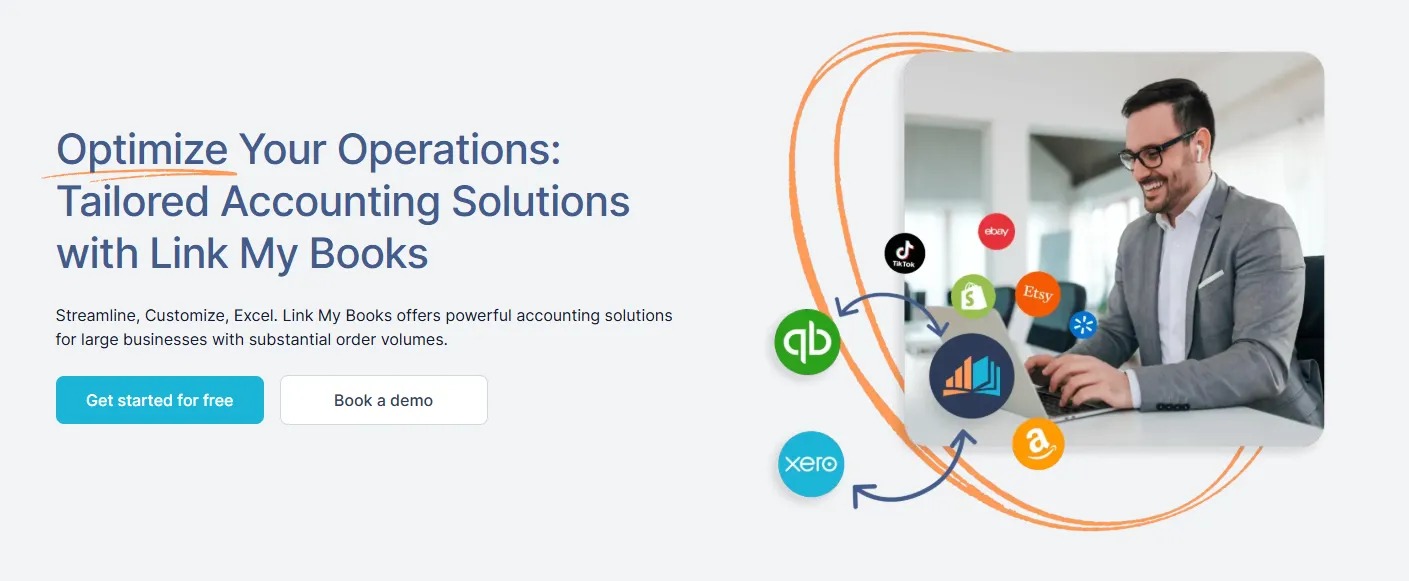
Link My Books automates e-commerce accounting by connecting your sales channels to Xero or QuickBooks and turning each payout into a clean summary that breaks out sales, refunds, fees, and taxes accurately.
It is built to make payout summaries match the deposits that hit your bank, which cuts down month-end cleanup and makes the books easier for both sellers and accountants to review.
It also adds financial analytics, including P&L by channel, so you get more than a basic sync tool.
👉Start automating your e-commerce accounting with Link My Books today and experience the difference!



.webp)



.png)