


An ecommerce month-end close checklist needs to do more than confirm the bank balance matches the ledger. Because marketplace settlements bundle gross sales, fees, refunds, taxes and adjustments into one payout, closing the books means reconciling that activity channel by channel, tagging it to the right VAT rate, and reporting it in a way that shows which channels and products are actually profitable. Below is a four-stage checklist built for that reality, covering Amazon, Shopify, eBay, Etsy, TikTok Shop, WooCommerce, Walmart and Square sellers running on Xero or QuickBooks Online.
Key Takeaways from this Post
Reconcile each marketplace settlement to separate sales, fees, refunds, VAT and bank payouts.
Track VAT, COGS and attributable costs accurately across channels without forcing shared costs into false categories.
Review channel-level profitability and significant variances before signing off the month-end close.







An ecommerce month-end close checklist needs to do more than confirm the bank balance matches the ledger. Because marketplace settlements bundle gross sales, fees, refunds, taxes and adjustments into one payout, closing the books means reconciling that activity channel by channel, tagging it to the right VAT rate, and reporting it in a way that shows which channels and products are actually profitable. Below is a four-stage checklist built for that reality, covering Amazon, Shopify, eBay, Etsy, TikTok Shop, WooCommerce, Walmart and Square sellers running on Xero or QuickBooks Online.
Why This Close Is Harder Than a Standard Business Close
A typical business closes against invoices it raised itself. An ecommerce seller closes against settlement reports written by someone else, on someone else's schedule, using someone else's fee structure. One Amazon payout might cover three weeks of sales, dozens of refunds, storage fees, advertising spend and VAT, all netted into a single bank deposit. Without a structured process, finance teams either post that deposit as one lump sum, losing visibility into what happened, or spend days pulling it apart manually every month.
Stage 1: Reconcile Ecommerce Activity Channel by Channel
Before anything else, confirm every channel's activity is accounted for on its own terms through rigorous account reconciliation and payment processor match techniques.
- Pull the settlement report for each connected channel (Amazon, Shopify, eBay, Etsy, TikTok Shop, WooCommerce, Walmart, Square) for the period being closed.
- Confirm gross sales per channel match what the sales channel itself reports, before fees and refunds are deducted.
- Break each settlement into its components: gross sales, marketplace fees, commissions, refunds, and VAT or sales tax withheld.
- Match each settlement's net payout to the corresponding bank deposit, flagging any payout that hasn't landed yet.
- Check for deferred or delayed payments, where a settlement period doesn't align with a bank deposit date, and confirm they're held correctly until cash arrives.
- Investigate any settlement needing manual adjustment and note why, rather than plugging a balancing figure and moving on.
Stage 2: Define the Reporting Dimensions That Matter
A close that produces one blended revenue number hides more than it reveals, especially when executing a thorough ecommerce CFO close process.
- Decide which dimensions matter for this business: channel, brand, market, or a combination.
- Confirm sales, fees and refunds are tagged consistently to those dimensions, not just to a generic revenue account.
- Check that VAT product grouping is applied correctly, so sales post at the right rate by product type and market, rather than lumped under one rate.
- Reconcile VAT collected against VAT reported to HMRC for the period, checking for overpayments or underpayments before filing to ensure seamless sales tax compliance.
- Cross-check that revenue reported by dimension sums back to the total confirmed in Stage 1. If it doesn't, find the gap before closing further.
Stage 3: Add Attributable Costs Where the Data Supports It
Costs should only be allocated where there's a defensible basis for doing so within your broader bookkeeping checklist.
- Close COGS for the period, matched to units actually sold, not units purchased, focusing heavily on accurate inventory accounting.
- Reconcile inventory movements (received, sold, returned, written off) against the inventory management data feeding COGS adjustments and inventory valuation metrics.
- Allocate department or channel-specific costs, such as advertising spend tied to a specific channel, where the allocation is based on real data.
- Leave shared costs (rent, salaries, general admin) unallocated at the channel level unless there's a reliable driver for splitting them. Forcing every cost into a channel bucket produces a number that looks precise but isn't.
Stage 4: Review Contribution and Trends
The close isn't finished once the numbers balance. It's finished once someone has looked at them through structured financial reporting and a comprehensive balance sheet review.
- Review gross margin and contribution by channel, brand or market against the prior period.
- Compare this period's figures against industry benchmarks where available, not just against last month.
- Ask what changed and why for any material movement, rather than only checking whether the top-line number went up or down.
- Document the explanation for each significant variance so next month's reviewer doesn't have to re-investigate the same thing from scratch.
- Sign off the close only once channel-level P&L, VAT position and COGS all tie back to Stage 1's reconciled figures.
Warning Signs the Close Process Is Breaking Down
A few patterns tend to show up before a close process fully falls apart, and they're worth checking for every month:
- The finance team spends more time maintaining spreadsheets and reports than analysing what they show.
- Settlements still need manual investigation every single month, rather than the exceptions being rare.
- Different reports produce conflicting revenue figures for the same period.
- Spreadsheet adjustments have become a routine, expected part of every close rather than an occasional fix.
If two or more of these are true most months, the underlying reconciliation process needs fixing, not just the current close.
How Link My Books Solves This
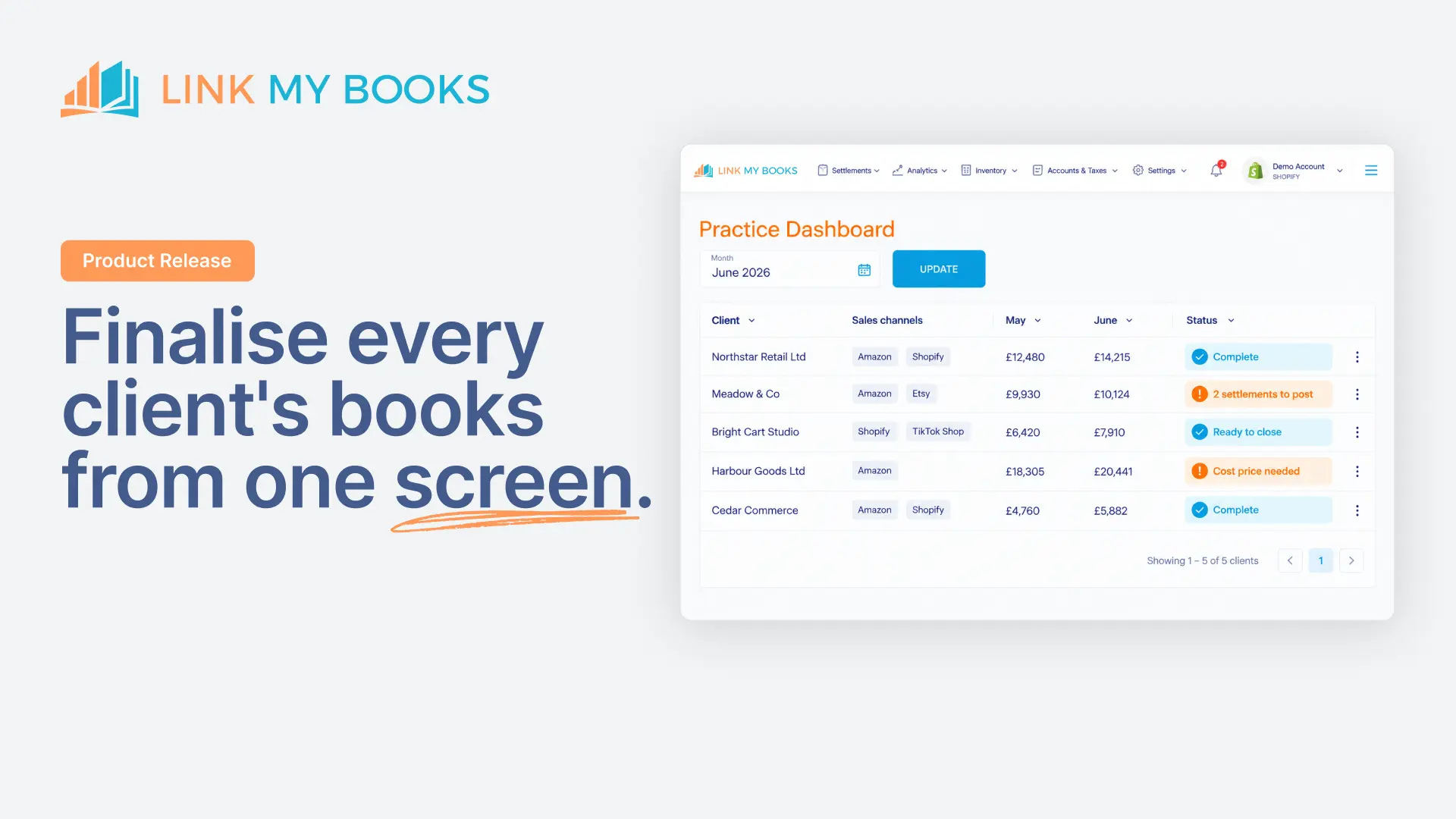
Link My Books addresses Stage 1 directly by pulling settlement data from Amazon, Shopify, eBay, Etsy, TikTok Shop, WooCommerce, Walmart and Square and posting an itemised breakdown of every settlement into gross sales, fees, refunds, commissions and VAT, rather than one lump net figure. Automated payout reconciliation and automated bank deposit matching close the gap between settlement and bank deposit without manual checking, and deferred payment reconciliation handles payouts that don't land in the same period they were earned.
For Stage 2, VAT product grouping posts sales at the correct VAT rate automatically by product and market, which is the step most sellers get wrong when posting settlements by hand (see the biggest accounting mistakes ecommerce sellers make). One customer recovered £8,829 in overpaid VAT from HMRC after fixing their reconciliation this way.
For Stage 3, COGS tracking with inventory management ties cost of goods sold to units actually sold, and a well-structured ecommerce chart of accounts keeps channel and cost data separated cleanly enough to allocate costs without guesswork.
For Stage 4, profit and loss reporting by sales channel and financial analytics benchmarked against industry averages give the review stage something concrete to work from. One case study documented over 70 hours saved per month once the reconciliation stopped being manual. Compared with alternative solutions in the market, the difference for a UK seller on Xero or QuickBooks Online comes down to how granular that settlement breakdown and VAT handling are out of the box.
FAQ
What's the difference between a standard month-end close and an ecommerce month-end close?
A standard close reconciles invoices a business raised itself against its own bank account. An ecommerce close reconciles marketplace settlements that bundle gross sales, fees, refunds, commissions and VAT into a single payout, often on a delayed schedule. Stage 1 of an ecommerce close has to unpack each settlement into its components before anything else can be reconciled, a step a standard close doesn't need.
Why does VAT keep going wrong in ecommerce accounting?
VAT errors usually come from posting settlements as one net figure instead of grouping sales by VAT rate at product and market level. Different products can carry different VAT rates, and cross-border sales add further complexity. Getting VAT product grouping right at the point of posting, rather than correcting it later, is what prevents both overpayments and underpayments to HMRC.
Should every cost be allocated to a specific channel?
No. Costs with a reliable allocation basis, such as channel-specific advertising spend, should be attributed at the channel level. Shared costs like rent or general admin usually don't have a defensible allocation driver, and forcing them into a channel bucket produces a number that looks precise without being accurate. Stage 3 of this checklist exists to draw that line.
What are the clearest signs a close process needs to change?
Watch for settlements needing manual investigation every month, conflicting revenue figures across reports, spreadsheet adjustments becoming routine, and the finance team spending more time maintaining reports than reviewing them. Two or more of these together usually means the reconciliation process itself is the problem, not the people running it.
Running this checklist consistently turns month-end from a reconstruction exercise into a review exercise, which is the point of closing the books. For UK ecommerce sellers on Xero or QuickBooks Online managing multiple channels, Link My Books is built to handle Stage 1 and Stage 2 automatically, so the finance team's time goes into Stage 4.


.webp)



.png)