


The best white label bookkeeping software helps ambitious accounting firms deliver efficient, consistent bookkeeping services while securely maintaining their own client relationships and brand identity. In 2026, accountants must prioritize software that aggressively automates repetitive bookkeeping tasks, integrates flawlessly with major ecommerce platforms, and produces highly reliable financial records that scale as client portfolios grow.
Key Takeaways from this Post
White label software lets firms use enterprise tech while keeping their own brand, and automation frees senior staff for higher-margin advisory work.
Ecommerce needs specialist tools—deep API integrations that automatically separate sales, fees, refunds, and taxes into clean data for Xero or QuickBooks.
Scalability drives profit: onboard more clients without proportionally increasing headcount through multi-client dashboards and automated reconciliation.







The best white label bookkeeping software helps ambitious accounting firms deliver efficient, consistent bookkeeping services while securely maintaining their own client relationships and brand identity. In 2026, accountants must prioritize software that aggressively automates repetitive bookkeeping tasks, integrates flawlessly with major ecommerce platforms, and produces highly reliable financial records that scale as client portfolios grow.
Key Takeaways for Accounting Firms:
- Brand preservation is critical: White label solutions allow you to leverage enterprise technology while keeping your firm at the forefront of the client relationship.
- Automation solves the talent shortage: Using software to handle repetitive data entry frees up your senior staff to focus on highly profitable advisory services.
- Ecommerce requires specialization: Standard bank feeds are no longer sufficient for decoding complex marketplace settlements.
- Scalability dictates profit: The right platform allows you to onboard dozens of new clients without needing to proportionally increase your administrative headcount.
What Is White Label Bookkeeping Software?
White label bookkeeping software allows accountants and bookkeeping firms to provide cutting edge, technology driven services without carrying the massive financial burden of building the software themselves.
Rather than developing their own proprietary bookkeeping platform from scratch, firms use specialist software working silently behind the scenes. This allows the practice to present a seamless, high quality service to their clients. For practices working heavily with ecommerce businesses, this strategy is particularly valuable because marketplace bookkeeping involves massive volumes of micro transactions that are entirely too difficult to manage manually.
Instead of spending billable hours trying to reconcile complex settlements and categorize messy marketplace activity, firms can automate the vast majority of the process. They continue to deliver a highly professional service under their own trusted brand, ultimately increasing client retention and satisfaction.
Why More Accounting Firms Are Investing in Automation in 2026
The baseline expectations of modern ecommerce clients have changed significantly over the last few years. Businesses selling on Amazon, Shopify, eBay, and Etsy generate hundreds or thousands of complex transactions every single month.
Today, clients no longer expect their accountants to simply prepare historical year end accounts. They expect a proactive financial partnership.
Clients now consistently demand:
- Timely, real time financial reporting
- Flawlessly accurate month end reconciliation
- Reliable Value Added Tax (VAT) records for compliance
- Significantly faster month end bookkeeping turnarounds
- Better commercial insight regarding their profit margins
Meeting these heightened expectations using manual data entry becomes increasingly difficult as your client portfolios expand. Automation allows modern firms to spend far less time processing raw transactions. Instead, they can spend more time proactively advising clients on growth strategies, gross profitability, and overall financial performance.
Core Features Accountants Must Look For
Not every financial software platform is designed with professional accountants in mind. When evaluating white label bookkeeping software in 2026, firms should focus strictly on features that dramatically improve operational efficiency without ever compromising data accuracy.
Key capabilities to evaluate include:
Deep Ecommerce Marketplace Integrations
The software must connect flawlessly via API with major ecommerce platforms such as Amazon, Shopify, eBay, and Etsy. It must accurately capture complex marketplace activity, including historical data, without requiring manual CSV uploads.
Xero and QuickBooks Compatibility
Most leading UK accounting firms already use industry standard cloud software. Choosing an ecommerce bookkeeping solution that integrates seamlessly with Xero and QuickBooks reduces administrative duplication and massively improves your workflow efficiency.
Fully Automated Reconciliation
Marketplace settlements are notoriously messy. They often contain gross sales, platform fees, customer refunds, collected taxes, and other obscure adjustments hidden within a single net payout. Automation should perfectly organize these distinct transactions into the correct ledger accounts before they ever reach the primary accounting system.
Consistent Financial Reporting
The objective is not simply to import raw, unstructured data. The software must produce structured, highly reliable bookkeeping that accountants can review confidently and sign off on quickly.
Practice Scalability and Multi-Client Management
As firms onboard more ecommerce clients, their bookkeeping processes must remain highly efficient. The software should offer multi-client dashboards, allowing a single accountant to manage dozens of accounts without requiring a proportional increase in manual administrative work.
Why Ecommerce Clients Require Specialist Bookkeeping
Traditional bookkeeping methods often struggle immensely to cope with modern marketplace selling. Standard rules that work for brick and mortar businesses completely fall apart when applied to global ecommerce operations.
A single Amazon or eBay payout may represent hundreds of individual transactions. These payouts include marketplace referral fees, customer refunds, shipping adjustments, advertising costs, and complex tax movements. Recording only the final net bank deposit completely removes much of the crucial financial detail that accountants desperately need to prepare compliant tax returns.
Specialist ecommerce bookkeeping helps perfectly preserve this information. It separates marketplace activity into highly meaningful accounting categories before the data ever reaches the general ledger. This precise separation produces much cleaner financial reports while making month end reconciliation significantly more efficient for your team.
How Link My Books Supports Modern Accounting Firms
Link My Books has been built specifically for proactive accountants and bookkeepers working directly with high volume ecommerce businesses.
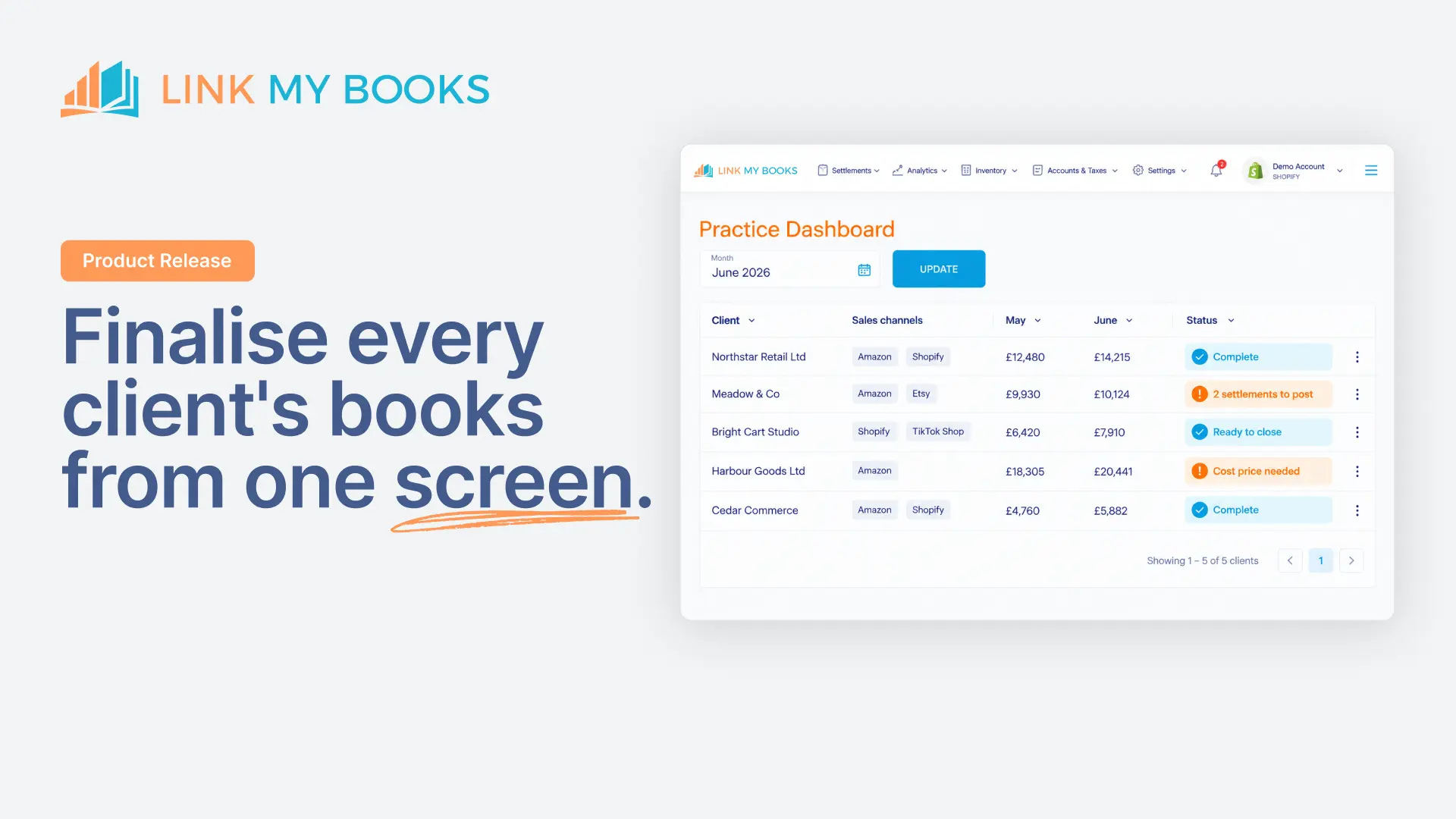
Instead of requiring your firm to manually interpret confusing marketplace settlements, our platform automatically converts raw ecommerce activity into perfectly structured accounting summaries designed for Xero and QuickBooks.
Gross sales, marketplace fees, taxes, refunds, and settlement adjustments are categorized flawlessly before entering the accounting system. This gives your firm incredibly clean financial records while drastically reducing manual bookkeeping hours.
For practices managing multiple ecommerce clients, this creates a highly consistent bookkeeping process that scales perfectly as the client base grows. By joining an accountant partner program, firms can access dedicated support and advanced practice management tools. Rather than replacing the accountant, Link My Books entirely removes repetitive reconciliation work. This ensures your firm can spend more time delivering strategic advisory services and strengthening valuable client relationships.
Commercial Considerations When Choosing a Platform
Selecting the right white label bookkeeping software is about much more than just reducing manual data entry. The right software platform should actively strengthen your firm's ability to serve ecommerce clients consistently while supporting your future financial growth.
When evaluating software for your practice, consider whether it directly helps your team:
- Standardize complex bookkeeping across multiple diverse clients
- Drastically reduce manual reconciliation time
- Produce highly consistent, board ready financial reports
- Scale revenue without increasing your administrative payroll
- Improve seamless collaboration between junior bookkeepers and senior accountants
The core objective is not simply to process transactions faster. The goal is to create perfectly reliable financial data that allows your team to spend more time advising clients on their business and less time correcting broken bookkeeping entries.
Practical Use Cases for Accounting Firms
White label bookkeeping software can strongly support firms of completely different sizes and specialisms.
Firms Specializing in Ecommerce
Practices working primarily with Amazon, Shopify, eBay, or Etsy sellers often deal with highly complex marketplace settlements every single month. Automating the strict categorization of marketplace transactions reduces manual processing while massively improving reporting consistency across the entire client base.
Growing Bookkeeping Practices
As total client numbers increase, maintaining strict quality control becomes much more challenging. Standardized bookkeeping workflows utilizing automation help firms onboard new ecommerce clients quickly without significantly increasing their administrative overhead.
Multi-Client Accounting Teams
In larger firms where multiple staff members work on the exact same client accounts, having a consistent bookkeeping process is vital. Software automation improves internal collaboration and completely reduces data entry inconsistencies between different team members.
Advisory-Focused Firms
Reliable, automated bookkeeping creates much better financial reports. This allows accountants to spend more billable time discussing profitability, cash flow forecasting, and strategic growth rather than investigating frustrating reconciliation discrepancies.
Comparing Leading Ecommerce Bookkeeping Platforms
Several software platforms exist to support accountants working with complex ecommerce businesses. Each tool offers a slightly different approach to solving the marketplace data problem.
A2X is widely recognized for automating marketplace accounting summaries. It is frequently used by traditional firms supporting ecommerce sellers who require standard, reliable batch posting to their general ledger.
Dext Commerce focuses heavily on collecting and organizing broad ecommerce transaction data while integrating with various accounting software. It is often preferred by firms dealing with a very wide variety of smaller sales channels.
Taxomate automates marketplace bookkeeping by importing raw settlement data directly into accounting systems. It focuses on reducing manual processing for firms looking for simple data synchronization.
Link My Books has been purpose built for modern accountants who want perfectly structured, accountant ready ecommerce bookkeeping. Rather than simply transferring raw marketplace data into Xero or QuickBooks, it converts complex transactions into highly organized accounting summaries. It flawlessly separates gross sales, marketplace fees, taxes, refunds, and settlement adjustments. This specialist approach creates much cleaner financial records, completely simplifies reconciliation, and allows accounting firms to manage growing ecommerce client portfolios with maximum efficiency.
Common Misconceptions About Accounting Automation
"White label software eventually replaces human accountants." Automation absolutely removes repetitive bookkeeping tasks, but professional judgment, strategic financial advice, and complex tax expertise remain completely essential. The software strongly supports accountants rather than replacing them.
"Any basic bookkeeping integration is good enough." General API integrations may move basic transaction data between systems, but they do not necessarily structure marketplace activity in a way that supports highly accurate, compliant ecommerce bookkeeping.
"Automation only really benefits large, enterprise firms." Practices of all sizes benefit immensely from reducing manual administration. Smaller firms often gain even greater efficiency because automation allows them to serve significantly more clients without proportionally increasing their workload or their payroll.
FAQ
What is white label bookkeeping software?
White label bookkeeping software allows accounting firms to deliver highly efficient bookkeeping services using specialist technology while maintaining their own client relationships and unique service offering. It helps automate highly repetitive bookkeeping processes without requiring firms to develop their own proprietary software.
Why do ecommerce accountants need specialist bookkeeping software?
Marketplace transactions often contain gross sales, hidden fees, customer refunds, taxes, and complex settlement adjustments bundled within a single net payout. Specialist software meticulously organizes these distinct transactions into structured accounting data, making reconciliation and formal financial reporting significantly more accurate.
What should accountants prioritize when choosing software?
Accountants should explicitly look for strong ecommerce integrations, deep compatibility with Xero and QuickBooks, fully automated reconciliation features, consistent financial reporting, and the ability to scale efficiently as their client portfolios rapidly grow.
How does Link My Books support growing accounting firms?
Link My Books automates complex ecommerce bookkeeping by converting raw marketplace activity into perfectly structured accounting summaries for Xero and QuickBooks. This drastically reduces manual reconciliation, improves reporting consistency, and allows firms to deliver incredibly reliable bookkeeping for all their ecommerce clients.
Is white label bookkeeping software suitable for smaller practices?
Yes. Smaller firms often benefit considerably because automation completely removes repetitive bookkeeping tasks. This helps small teams confidently manage more clients while maintaining consistent service quality and perfectly accurate financial reporting.
As the global ecommerce sector continues to grow rapidly, accounting firms desperately need bookkeeping processes that can keep pace with increasingly complex marketplace transactions.
White label bookkeeping software must do much more than simply automate basic data entry. It should produce highly reliable financial information that improves firm efficiency, deeply supports accountants, and significantly strengthens client relationships over the long term.
While platforms like A2X, Dext Commerce, and Taxomate each provide valuable ecommerce bookkeeping capabilities, Link My Books has been designed specifically for proactive accountants who want perfectly clean, structured bookkeeping for Xero and QuickBooks. By fully automating marketplace reconciliation and producing accountant ready financial records, it helps modern firms scale their ecommerce advisory services without ever compromising accuracy or quality.
If you are looking to permanently streamline ecommerce bookkeeping for your clients and boost your firm margins, book a personalized demo today.



.webp)



.png)