


Choosing an accounting integration for Shopify often comes down to one question: how much will it actually cost as your store grows. A2X positions itself as a specialist tool that posts summarized Shopify transactions into Xero or QuickBooks, with pricing based primarily on monthly order volume. That pricing model matters, because Shopify sellers rarely stay at a fixed order count for long.
A2X publishes clear entry-level pricing tiers for Shopify users, but those tiers come with defined order limits, store assumptions, and data-history allowances. When sellers exceed those limits, they must move to higher plans that increase monthly costs. None of this is unusual for accounting automation software, but it does mean that the headline price is not always the price you pay long term.
This article breaks down A2X Shopify pricing exactly as it is published, explains how the order-based model works, and highlights where costs can change as volume increases. We will also compare that structure to Link My Books, an alternative Shopify accounting integration that uses a different pricing and reconciliation approach.
Key Takeaways from this Post
A2X’s costs scale on two levers: your combined monthly order or transaction volume and the number of connected stores or sales channels.
As you move up tiers, A2X quickly rises. But you also get larger allowances for history access and premium 1:1 support and onboarding on higher plans.
For multi-channel and VAT-registered sellers, Link My Books is the smarter long-term choice: It supports more platforms under one plan, applies VAT and OSS rules automatically, and costs less than A2X’s per-channel.







A2X Pricing Plans Overview for Shopify Sellers
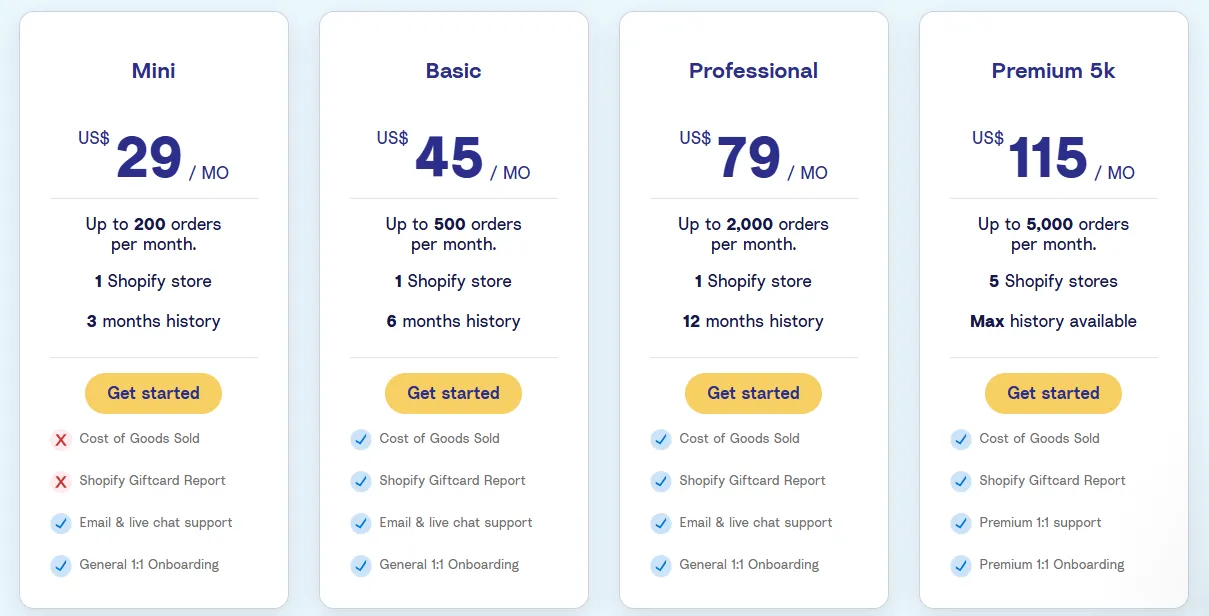
A2X prices its Shopify integration based on monthly order volume, not revenue. Each plan includes a defined order cap and a fixed amount of historical data. When your Shopify store exceeds those limits, you must move to a higher tier.
A2X Shopify Pricing
Each plan explicitly lists:
- A maximum monthly order count.
- The number of Shopify stores included.
- The amount of historical data available.
The Premium 5k plan is the only tier that:
- Includes more than one Shopify store.
- States “max history available.”
Feature Differences Shown by Plan
- Mini:
- Does not include Cost of Goods Sold reporting.
- Does not include the Shopify Giftcard Report.
- Includes email and live chat support and general 1:1 onboarding.
- Basic, Professional, and Premium 5k:
- Include Cost of Goods Sold reporting.
- Include the Shopify Giftcard Report.
- Include email and live chat support.
- Include general 1:1 onboarding.
- Premium 5k only:
- Includes premium 1:1 support.
- Includes premium 1:1 onboarding.
Important clarifications:
- A2X defines pricing by order count, not payouts or revenue.
- Historical data access is capped by plan and matters during migrations or audits.
- Pricing above 5,000 orders moves into premium pricing, and is capped at 100.000 orders per month.
This structure is transparent at entry level, but it does mean your monthly cost increases as order volume grows. Shopify sellers with seasonal spikes, promotions, or rapid growth often move through tiers faster than expected.
A2X Multi Plans for Sellers Using Multiple Sales Channels
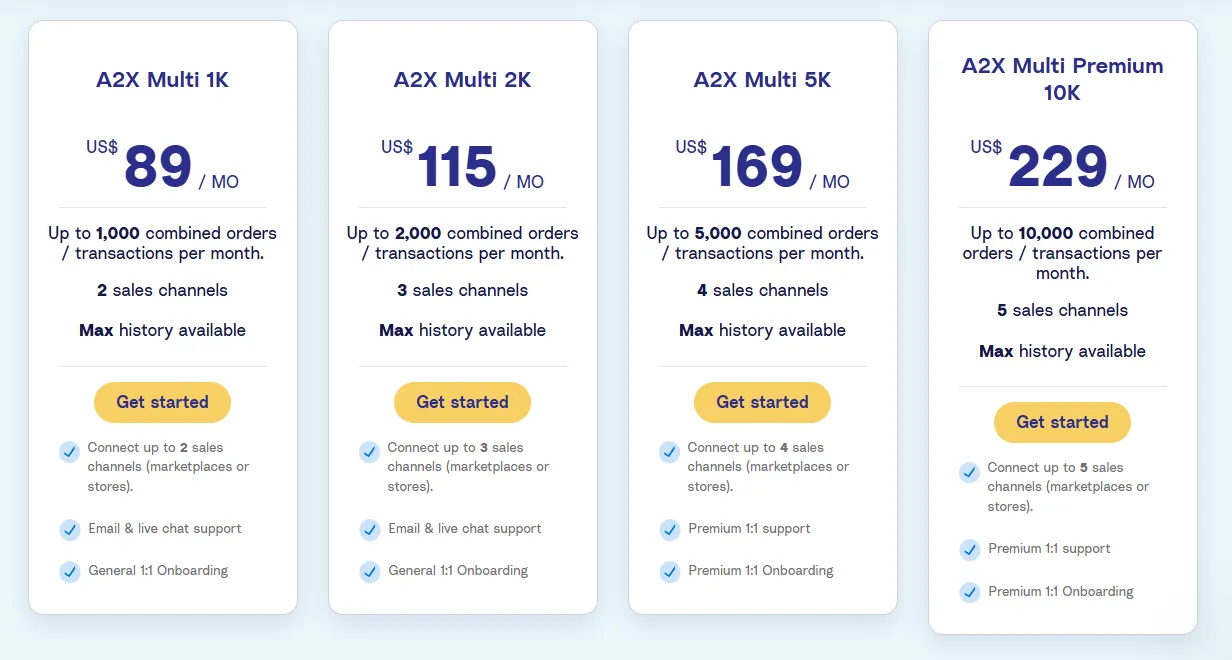
A2X offers a separate set of Multi plans designed for sellers who operate across more than one sales channel. These plans are explicitly labeled to support combined orders or transactions across multiple channels, rather than a single Shopify store.
Each tier increases in three ways:
- The number of combined monthly orders or transactions
- The number of sales channels you can connect
- The level of support and onboarding
A2X Multi Pricing
Sales Channels Explained
Each plan lists the maximum number of sales channels (marketplaces or stores) you can connect:
- Multi 1K: Connect up to 2 sales channels
- Multi 2K: Connect up to 3 sales channels
- Multi 5K: Connect up to 4 sales channels
- Multi Premium 10K: Connect up to 5 sales channels
Support and Onboarding Differences
Based on the icons and labels shown:
- Multi 1K and Multi 2K include:
- Email and live chat support
- General 1:1 onboarding
- Multi 5K and Multi Premium 10K include:
- Premium 1:1 support
- Premium 1:1 onboarding
These Multi plans are intended for sellers who:
- Sell on more than one marketplace or store
- Want all orders or transactions counted together
- Need access to maximum historical data
- Require higher channel limits as their operation grows
How A2X Pricing Scales as You Add Channels and Volume
A2X’s pricing interface scales based on two variables shown on its pricing pages: combined monthly order volume and either Shopify stores (Shopify plans) or sales channels (Multi plans).
- Combined monthly volume: A2X asks sellers to estimate “combined monthly orders” across channels and displays plan tiers with specific monthly caps. In Multi plans, A2X uses “combined orders / transactions per month” on the pricing cards.
- Channels or stores: Shopify tiers display a fixed number of Shopify stores per plan, while Multi tiers display a fixed number of sales channels (marketplaces or stores) per plan.
- History and support: Plan cards display differences in history availability (for example: some tiers show a specific number of months, while others state “max history available” or “history available”) and support labels (for example: email and live chat support vs premium 1:1 support).
- What A2X does not specify on pricing pages: The pricing pages and the multi-channel pricing explainer do not define how A2X calculates an “order” or a “transaction” for pricing purposes beyond showing volume caps.
Costs and Limits That Change What You Pay on A2X
A2X’s pricing interface looks straightforward at first glance, but your monthly cost can change quickly when you cross a plan limit. On the Shopify pricing page, A2X ties pricing to order volume, then layers on store limits, history access, and feature availability by tier.
What Changes Between Shopify Tiers
The Tax Note Sellers Miss
A2X states its pricing is shown in USD and excludes any applicable Canadian GST, PST, or HST. If those taxes apply to you, they can increase the total cost beyond the plan price shown on the page.
If You Sell on Multiple Channels, A2X Uses a Different Set of Tiers
A2X publishes separate Multi-channel plans that price by “combined orders / transactions per month” and cap the number of sales channels you can connect. The Multi-channel pricing page shows fixed tiers and Premium tiers beyond the entry levels.
Why choose Link My Books over A2X for your Shopify accounting
Both A2X and Link My Books aim to simplify your Shopify bookkeeping, but the way they handle tax automation, reconciliation, reporting, and pricing can be very different. Below we break down the core features side by side so you can see where each tool shines, and where one falls short.
A2X vs Link My Books: Tax Automation
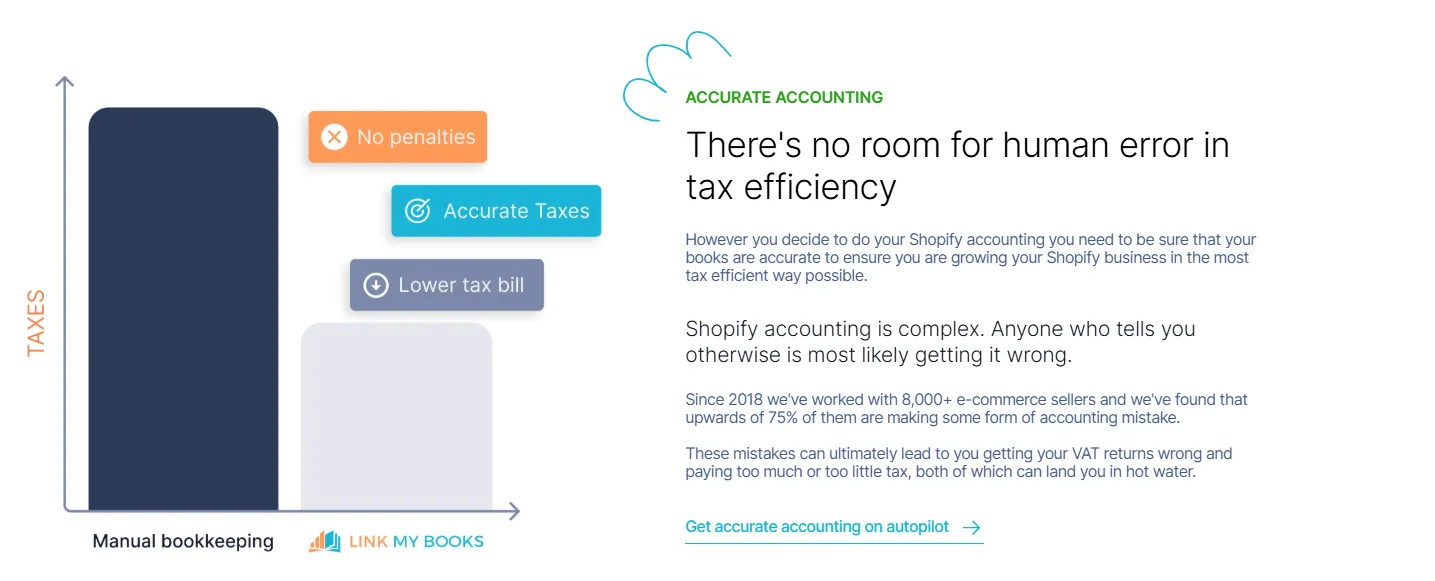
Link My Books
- Built for UK/EU sellers where VAT rules are complex.
- Automatically applies VAT codes and OSS logic, separating standard-rated, reduced-rated, and zero-rated sales.
- Prevents common errors that lead to VAT overpayments.
A2X
- Supports VAT, GST, and sales tax mapping across jurisdictions.
- Shopify Payments tax is included in payout summaries, but advanced mapping may require an accountant to configure correctly.
- Marketplace Facilitator Taxes (MFV) are identified, but sellers remain responsible for assigning the correct tax codes in Xero.
💡 Bottom line: Link My Books is plug-and-play for VAT; A2X offers global tax support but requires more manual setup.
A2X vs Link My Books: Reconciliation & Gateways
Link My Books
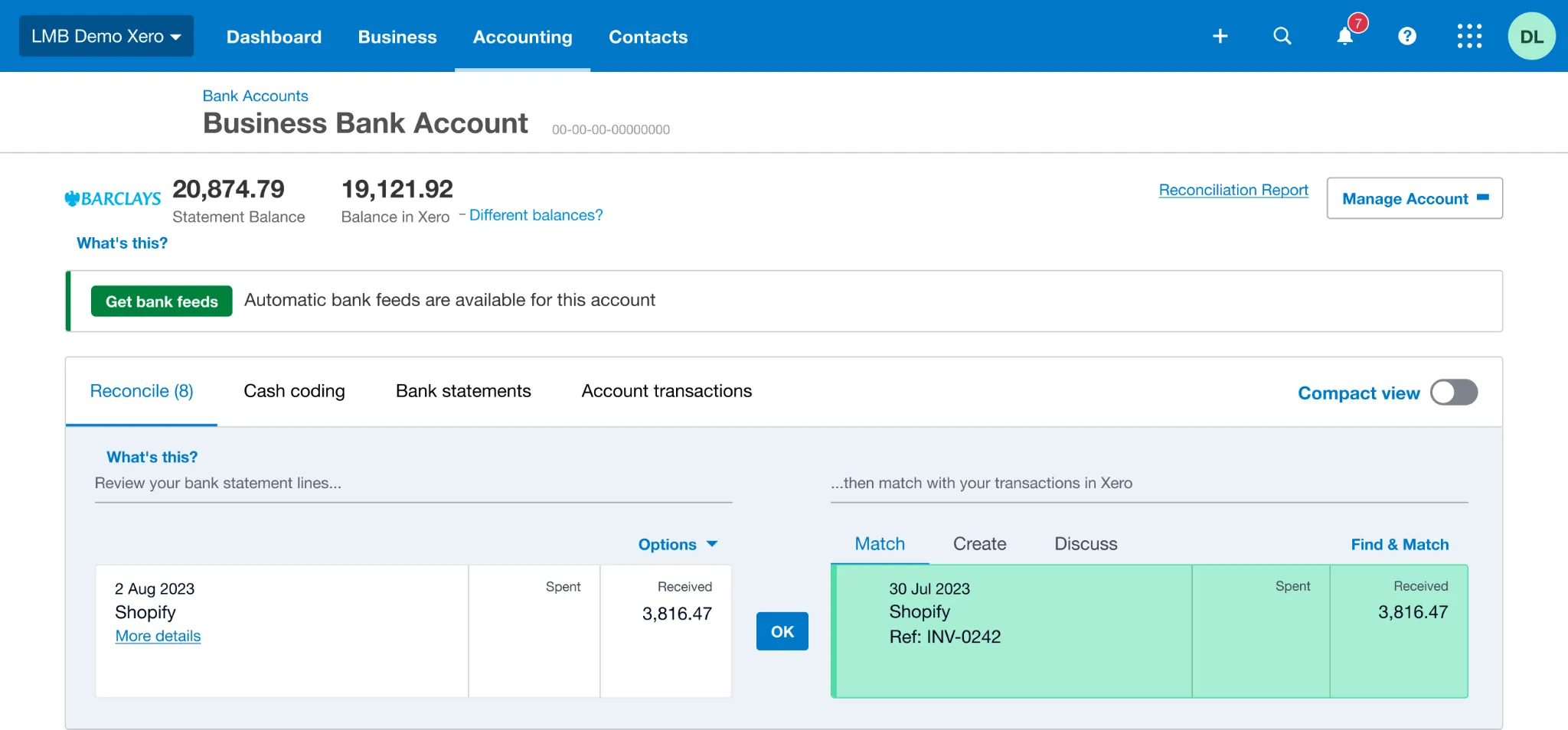
- Payout summaries from Shopify and all gateways (PayPal, Stripe, etc.) are imported and matched directly to Xero bank feeds.
- No clearing accounts needed. You can reconcile your Shopify payments in one click.
A2X
- For Shopify Payments, you can also reconcile in one click.
- For PayPal or Stripe, A2X posts to gateway clearing accounts. These balances must then be cleared manually when deposits hit the bank.
A2X vs Link My Books: COGS Tracking
Link My Books
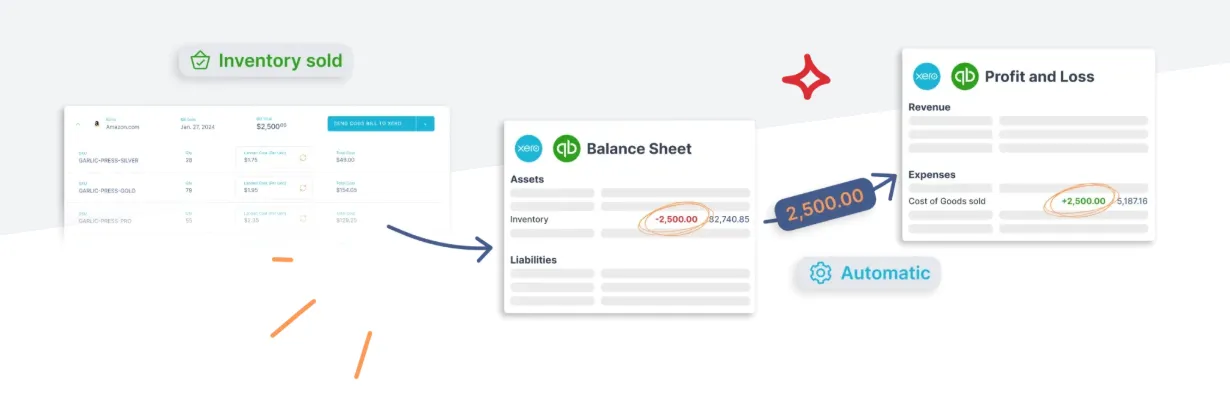
- Automatically calculates COGS at the SKU level, included in all plans.
- Provides gross profit visibility without extra setup.
A2X
- Offers SKU-level COGS, but only if product SKUs and cost data are correctly maintained in Shopify.
- Posts COGS as monthly journals, not per payout.
- 💡 Bottom line: both tools can track COGS, but Link My Books includes it by default and aligns it with payout reconciliation.
A2X vs Link My Books: Reporting & Insights
Link My Books
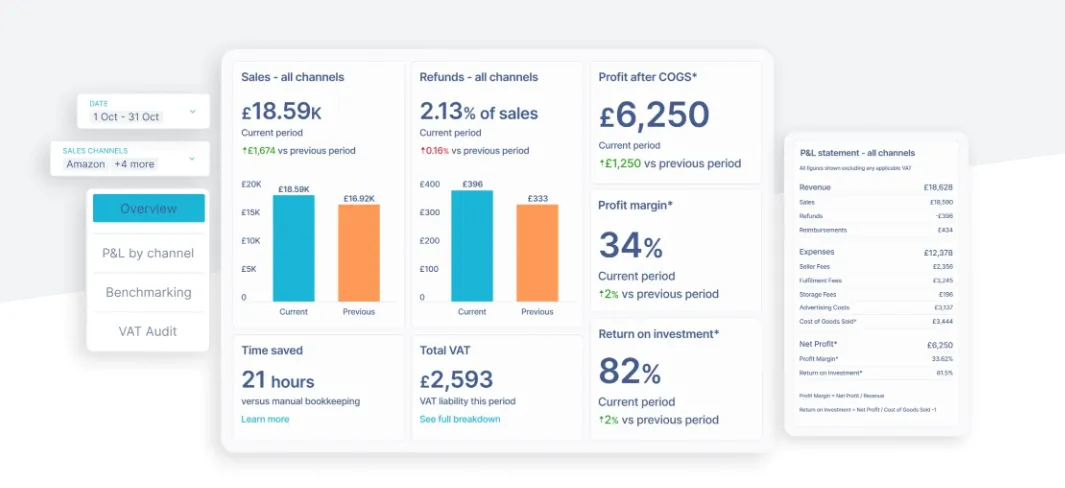
- Built-in performance analytics and industry benchmarking for e-commerce sellers.
- Lets you compare sales and margins against industry averages.
A2X
- Focused on payout summaries and accounting accuracy.
- Does not provide benchmarking or financial performance dashboards.
💡 Bottom line: Link My Books adds analytics beyond bookkeeping. A2X sticks to clean accounting summaries.
A2X vs Link My Books: Integrations
A2X
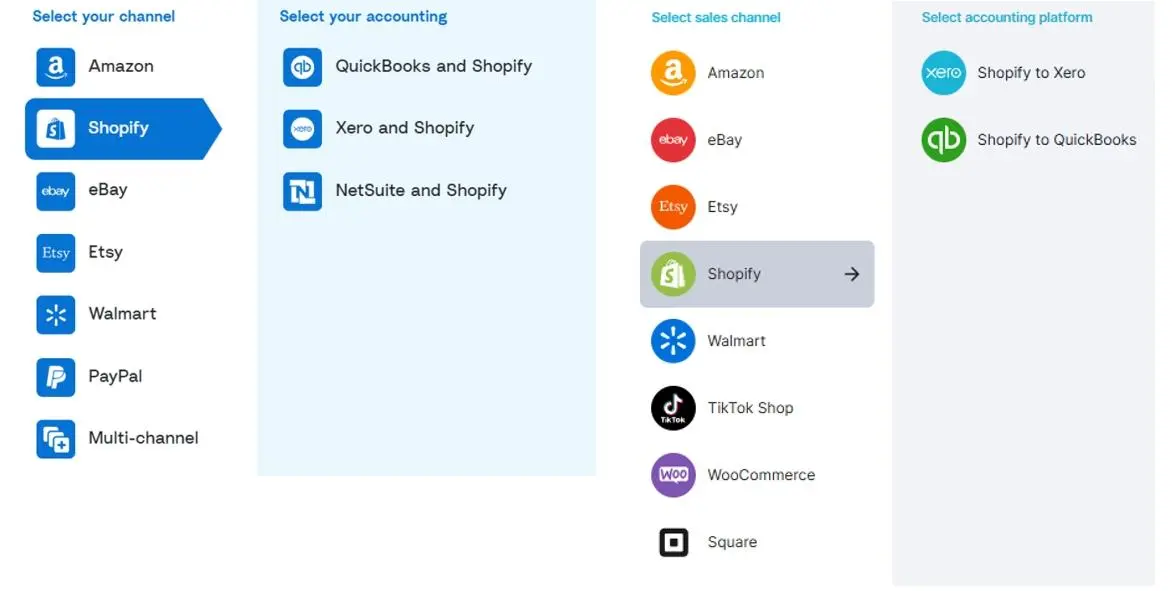
- Supports accounting integrations with Xero, QuickBooks Online, Sage, and NetSuite.
- Connects to major e-commerce platforms: Shopify, Amazon, Etsy, eBay, Walmart, and BigCommerce.
- Payment processor coverage includes Shopify Payments, PayPal, and others.
Link My Books
- Connects with Xero and QuickBooks Online, covering the two dominant choices for Shopify sellers.
- E-commerce integrations include Shopify, Amazon, eBay, Etsy, TikTok Shop, Walmart, Square, and WooCommerce.
- Also integrates with key payment processors like PayPal and Klarna.
Where Link My Books excels: broader e-commerce coverage, including TikTok Shop, which is rapidly expanding as a marketplace.
Where A2X excels: a wider range of accounting software, supporting Sage and NetSuite.
Link My Books overview
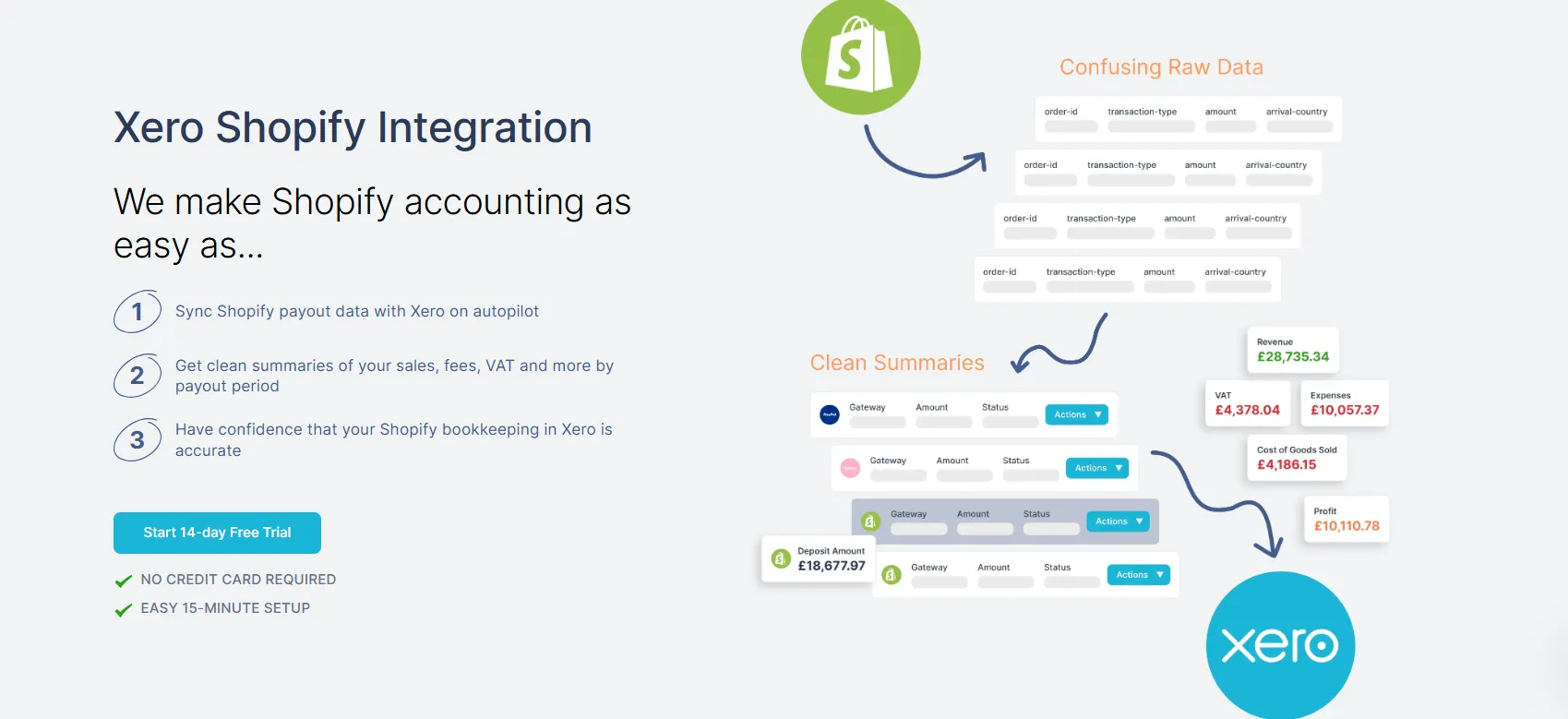
Link My Books was built specifically for e-commerce sellers who use Shopify with Xero or QuickBooks. Instead of forcing you to untangle CSVs and tax codes manually, it automates the entire bookkeeping process.
From VAT handling to SKU-level COGS, it posts clean payout summaries that match your bank deposits every time. Because pricing is based on order volume rather than channels, it’s also one of the most affordable tools for multi-channel sellers who want scalability without hidden costs.
Here’s what to expect:
Automated Payout Reconciliation
Link My Books imports Shopify payouts directly, breaking them down into sales, refunds, fees, shipping, and tax. It then creates summary invoices in Xero that match your bank deposits line for line. This eliminates manual CSV uploads and ensures reconciliations are accurate every month.
Built-in VAT Handling
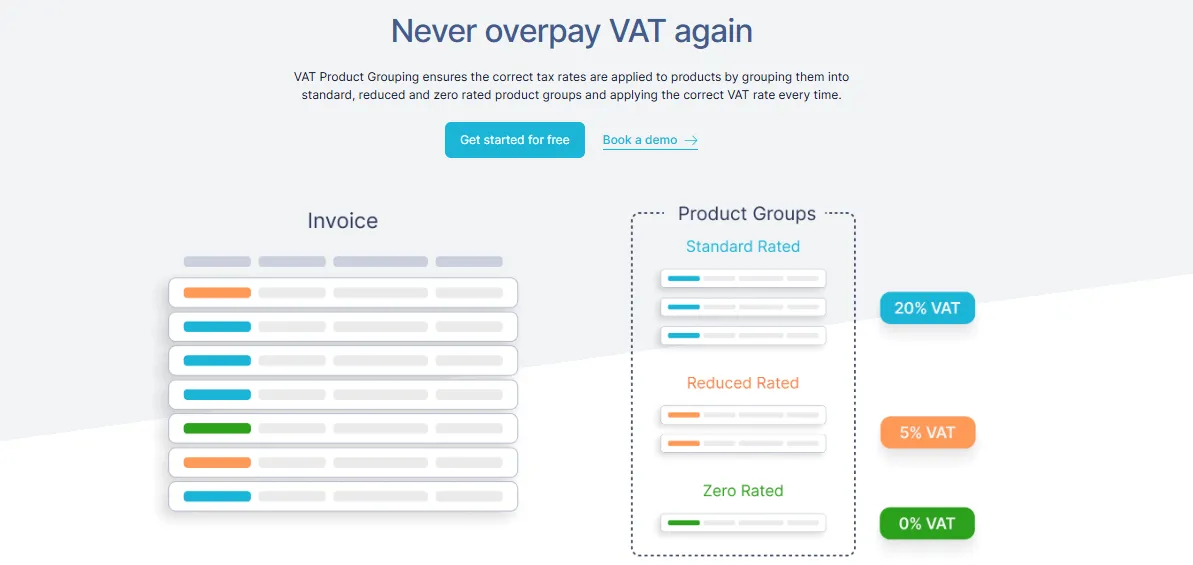
Designed for UK and EU sellers, Link My Books automatically applies VAT and OSS rules. Standard-rated, reduced-rated, and zero-rated sales are separated correctly, preventing the common mistake of overpaying VAT. This feature is especially important for sellers above the £85k UK VAT threshold.
Cross-Channel Reporting
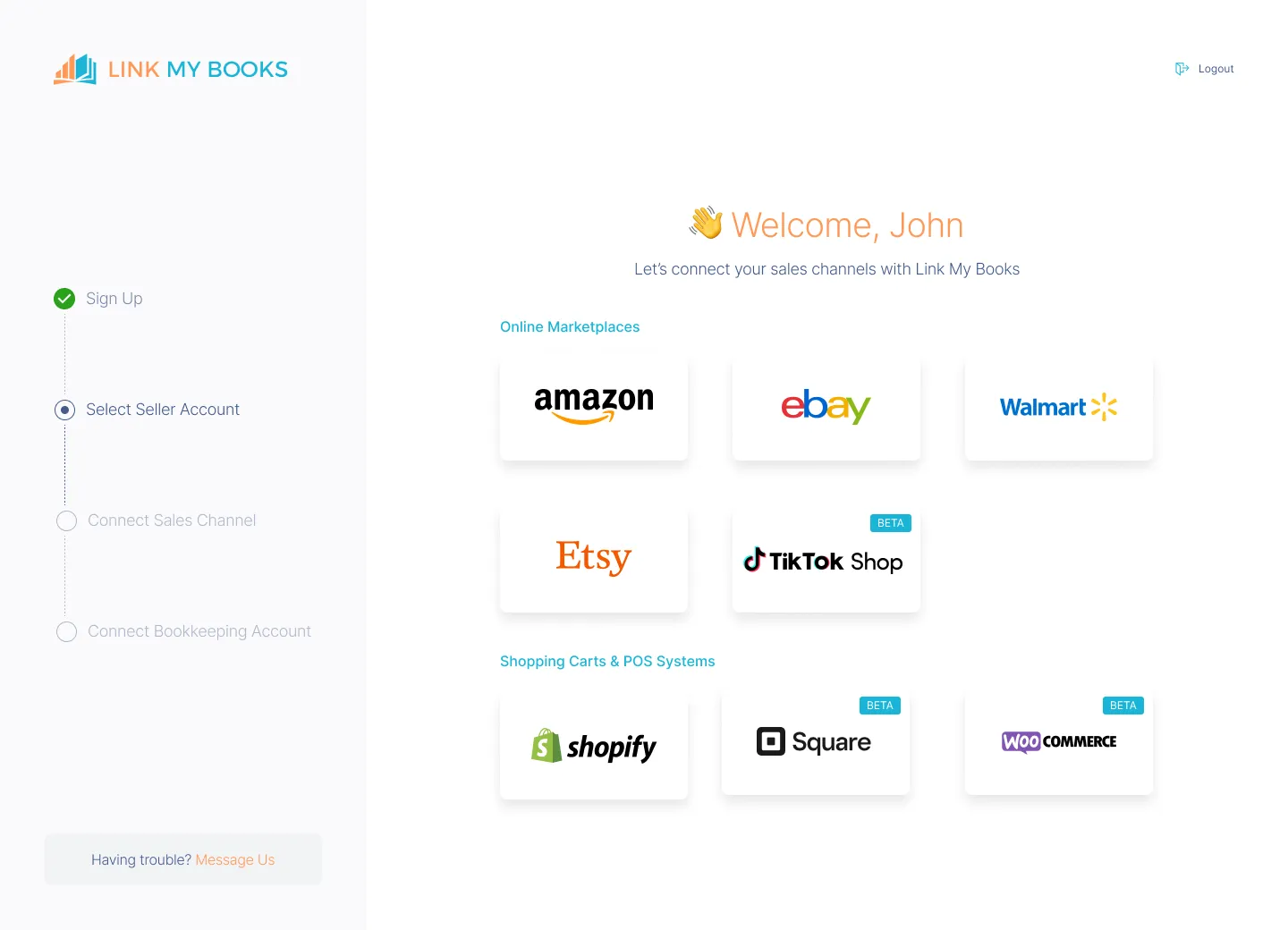
Link My Books isn’t limited to Shopify. You can connect Amazon, eBay, Etsy, TikTok Shop, Square, Walmart, and WooCommerce alongside your Shopify store. The tool gives you Profit & Loss visibility per channel, so you can see which platforms are most profitable and make informed scaling decisions.
Financial Insights & Benchmarking
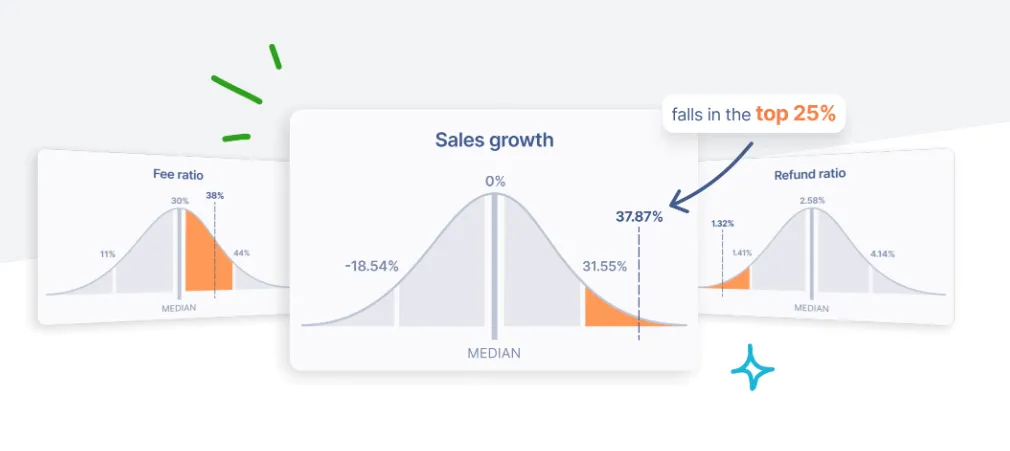
Beyond reconciliation, Link My Books offers industry benchmarking and financial summaries. You can compare refund rates, fees, and margins against other sellers, spot low-performing platforms, and track profitability in real time.
Positives of Link My Books
- Tailored for VAT compliance: With workflows designed by UK-based accountants, Link My Books handles EU VAT complexities that generic accounting tools often miss. It’s a major safeguard for sellers navigating OSS and cross-border rules.
- Multi-channel friendly pricing: Pricing is based on monthly order volume, not the number of sales channels. This means you can connect Shopify, Amazon, and TikTok Shop under one plan without paying for multiple subscriptions.
- Ease of use: The setup wizard walks you through account mapping and tax codes step by step. Even without deep accounting knowledge, most sellers can get started in under 15 minutes, with optional onboarding calls available.
Downsides of Link My Books
- Learning curve during setup: Sellers who have never dealt with VAT or bookkeeping may still prefer to involve their accountant for the initial configuration.
- Historical data limit: Access to older transactions depends on your plan (e.g., 12–24 months). If you need longer history imported, you may need to upgrade or you can purchase extra historical data beyond the default 3 months if needed.
Link My Books pricing
Our pricing is now flexible and scales with your business based on two factors:
- Monthly order volume: whether you process 200 orders or 250,000 orders, you only pay for what you use.
- Number of connected sales channels: one Shopify store, or multiple stores across Amazon, Etsy, TikTok Shop, and eBay.
Check out our price calculator to see where you would land.
[insert shortcode for pricing]
Every subscription includes:
- Unlimited users (ideal for accountants or teams)
- Free onboarding with a qualified accountant
- Built-in VAT and OSS automation
- SKU-level COGS tracking
- Industry benchmarking and profitability insights
- A 14-day free trial with no credit card required
This flexible pricing model makes Link My Books especially attractive for multi-channel sellers, since you’re not forced into separate subscriptions for each marketplace. Instead, you simply pay for your total order volume and number of channels - often saving hundreds or even thousands compared to A2X.
Link My Books vs A2X Pricing (2026)
Link My Books’ dynamic model scales with your order volume and channels, while A2X locks you into separate subscriptions or multi-channel tiers. For most Shopify sellers, especially those expanding across platforms, LMB is consistently cheaper and simpler.
👉 Start your free trial and see why sellers are switching from A2X every day.

Join thousands of e-commerce sellers who trust Link My Books to keep their accounts clean, compliant, and scalable.
FAQ on A2X Pricing
How much does A2X cost for Shopify?
A2X’s Shopify pricing plans start at US$29/month (Mini) and go up through multiple published tiers, including US$45/month (Basic), US$79/month (Professional), and Premium tiers such as US$115/month (Premium 5k) up to US$1,039/month (Premium 100k).
Does A2X Offer a Free Trial?
Yes. The “free trial mode” includes a connection to your store, after which A2X fetches the last 5 to 10 of your payouts, lets you review the last three, and lets you post three of them to your accounting system. This A2X Shopify integration is not limited by time, but rather by the actions you take.
What happens if I exceed my monthly order limit?
If you exceed your monthly order limit in A2X, your account will not immediately stop working or incur surprise overage fees. Instead, A2X will monitor your average order volume over a three-month period and prompt you to upgrade to a more appropriate plan if your volume consistently exceeds your current threshold.
For sellers using Shopify with Xero, this matters because order spikes can affect costs over multiple months. Our breakdown of A2X for Shopify Xero integration explains how plan scaling interacts with bookkeeping workflows.
How many users can you have per A2X account?
A2X states that there is no limit on the number of users you can add to an account. However, A2X also notes that each account has a single Admin user responsible for managing access and subscription settings.
If you are comparing tools with your accountant or finance team, this is often reviewed alongside alternatives in our A2X alternatives comparison.
How many Shopify stores can I connect on each tier?
On the Shopify pricing page:
- Mini, Basic, Professional: 1 Shopify store each
- Premium 5k through Premium 75k: 5 Shopify stores
- Premium 100k: 10 Shopify stores
How do A2X plan upgrades and downgrades work?
A2X supports both manual plan changes inside the app and automatic upgrades or downgrades based on the three-month average order volume rule. A2X documents this process in its support materials and applies it consistently across Shopify and multi-channel plans.
If you are evaluating whether this model fits your business compared to other tools, our A2X vs Taxomate comparison covers how different providers handle scaling.
What does “Max history available” mean on A2X pricing?
Max history available" on A2X pricing means the plan allows you to retrospectively pull all available financial data from your sales channel (such as Amazon, Shopify, eBay, or PayPal.
Does A2X include COGS and the Shopify Giftcard Report?
Yes, A2X includes features for managing both Cost of Goods Sold (COGS) and the Shopify Gift Card Report.
How does Link My Books compare to A2X on pricing?
A2X publishes Shopify pricing starting at $29 per month for up to 200 orders, with multiple higher tiers based on combined monthly order volume. Link My Books publishes its own pricing tiers separately, including how it defines transactions and supports multi-channel sellers.
Automate your Shopify bookkeeping with Link My Books
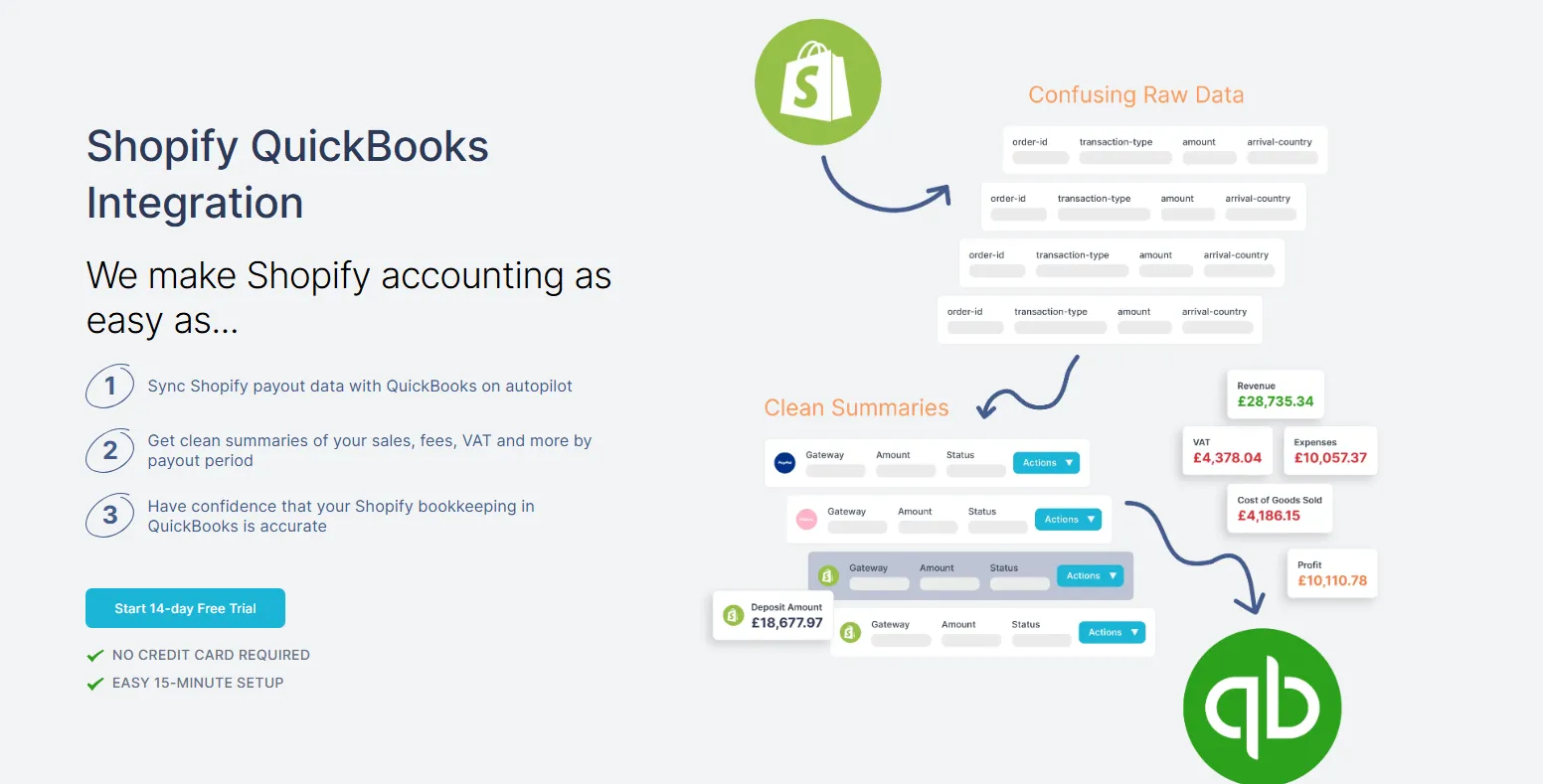
If you sell on Shopify plus other channels, you need a system that posts clean payout summaries into Xero or QuickBooks and lets you reconcile deposits fast. Link My Books does that by breaking each Shopify payout into a summary entry that matches the bank deposit, so reconciliation becomes a one-click match.
Get started in 15 minutes:
- Start a free 14-day trial: No credit card required
- Connect Shopify plus your accounting software: Link My Books supports Shopify to Xero or QuickBooks, and you can connect multiple stores and channels
- Set your tax rules once: Link My Books applies the tax rates you choose during setup based on transaction jurisdiction
- Send your first payout summary: Post it into Xero or QuickBooks, then reconcile against the bank deposit
Ready to stop wrestling with payouts and multi-channel totals?

Start a free trial of Link My Books!




.png)