


Scaling an ecommerce bookkeeping practice is rarely limited by the number of clients you can win. More often, it is limited by the amount of manual work required to service each client. A scalable ecommerce bookkeeping workflow replaces inconsistent processes with repeatable systems that produce accurate financial information every month. When reconciliation, data preparation, and reporting follow the same structured approach across every client, bookkeeping firms can grow without increasing complexity at the same rate. This approach is crucial for sustainable growth, especially when managing multiple clients.
Key Takeaways from this Post
Growth is limited by manual work per client, not client acquisition. Inconsistent processes force bookkeepers to rebuild workflows for every new ecommerce client—creating operational bottlenecks that compound as portfolios expand.
Standardization beats speed. A repeatable five-stage workflow—onboarding, data collection, reconciliation, review, and reporting—eliminates decision fatigue, reduces errors, and makes training scalable across the team.
Automate only after standardizing. Applying automation to inconsistent processes reproduces inconsistencies. Structured marketplace data preparation before it reaches Xero or QuickBooks removes repetitive admin without sacrificing the bookkeeper's review role.







Scaling an ecommerce bookkeeping practice is rarely limited by the number of clients you can win. More often, it is limited by the amount of manual work required to service each client. A scalable ecommerce bookkeeping workflow replaces inconsistent processes with repeatable systems that produce accurate financial information every month. When reconciliation, data preparation, and reporting follow the same structured approach across every client, bookkeeping firms can grow without increasing complexity at the same rate. This approach is crucial for sustainable growth, especially when managing multiple clients.
Why Scaling Ecommerce Bookkeeping is Different
Adding another ecommerce client is not like adding another traditional bookkeeping client. The intricacies of ecommerce financial management demand a specialized approach.
Each business may sell through different marketplaces, use different payment providers, and receive settlements in completely different formats.
- One client may sell exclusively through Shopify.
- Another may trade across Amazon, WooCommerce, TikTok Shop, and eBay.
- A third may combine ecommerce sales with wholesale revenue.
Without standardized processes, every new client introduces another unique workflow. Over time, practices begin managing dozens of different reconciliation methods instead of one consistent operating system. That is what prevents many firms from scaling efficiently and achieving true scalable accounting. The goal is to create an ecommerce bookkeeping strategy that adapts to various platforms while maintaining consistency.
The Biggest Bottlenecks Are Usually Operational
Bookkeepers often assume growth requires hiring more staff. In many cases, the real constraint is inconsistent processes. These operational inefficiencies hinder the development of an efficient ecommerce bookkeeping workflow.
Common operational bottlenecks include:
- Downloading reports from multiple marketplaces.
- Preparing different CSV files for every client.
- Using different reconciliation methods across the team.
- Correcting recurring posting errors.
- Repeating the same manual checks every month.
- Relying on individual team members instead of documented workflows.
None of these tasks directly improve the quality of the bookkeeping. They simply consume time. As client numbers increase, these small inefficiencies compound into significant operational challenges, making it difficult to manage online store finances effectively for multiple clients. Implementing accounting automation tools can alleviate many of these pain points.
A Scalable Bookkeeping Workflow Follows the Same Process Every Month
The most efficient bookkeeping practices rarely rely on shortcuts. Instead, they build repeatable workflows that every team member follows consistently. A scalable ecommerce bookkeeping workflow typically includes five critical stages designed to streamline financial processes.
Stage 1: Standardize Client Onboarding
Every ecommerce client should begin with the same implementation process. This initial standardization is key to building a robust ecommerce bookkeeping strategy.
This includes identifying:
- Sales channels (e.g., Amazon, Shopify, Etsy, WooCommerce).
- Payment providers (e.g., Stripe, PayPal, Amazon Pay).
- Accounting software (e.g., Xero, QuickBooks Online).
- VAT/Sales Tax requirements specific to their regions and products.
- Reporting frequency and specific client needs.
Capturing this information at the start reduces future inconsistencies and ensures a smooth setup for managing online store finances.
Stage 2: Standardize Data Collection
Avoid collecting financial information differently for every client. Whether clients sell through Amazon, Shopify, WooCommerce, or eBay, the process for obtaining marketplace data should remain as consistent as possible. This is a cornerstone of efficient ecommerce bookkeeping.
- Centralized Reporting: Utilize tools that can pull data from various platforms into a unified format.
- Automated Downloads: Implement solutions that automatically download reports, reducing manual effort.
- Consistent Data Fields: Define standard data fields required for all clients, regardless of their sales channels.
Consistency makes the bookkeeping process easier to manage as the practice grows, especially when dealing with multiple clients and diverse online store finances.
Stage 3: Standardize Reconciliation
Every team member should follow the same reconciliation sequence. Rather than creating individual approaches for every client, practices benefit from establishing one documented methodology that can be repeated across multiple businesses. This reduces training time while improving reporting consistency and accuracy through automated reconciliation.
Key steps for standardized reconciliation include:
- Matching Settlements: Clearly defined steps for matching marketplace settlements to bank deposits.
- Categorizing Transactions: Consistent rules for categorizing sales, fees, refunds, and taxes.
- Variance Analysis: A standard procedure for investigating and resolving discrepancies.
This ensures that the ecommerce bookkeeping workflow remains robust and reliable.
Stage 4: Standardize Review Procedures
Before month-end reports are delivered, every client should pass through the same quality control process. Standard review checklists help identify discrepancies before they reach clients while reducing reliance on individual experience. This stage is vital for maintaining the integrity of ecommerce financial management.
Review checklists should cover:
- Verification of all sales channels and payment providers.
- Confirmation of accurate revenue and expense categorization.
- Cross-referencing with bank statements.
- Ensuring compliance with tax regulations.
This proactive approach minimizes errors and builds trust, reinforcing the value of a scalable accounting system.
Stage 5: Standardize Reporting
Clients should receive financial information in a consistent format each month. This makes reporting easier to produce while helping clients understand their financial performance more quickly. Standardized reports are a hallmark of efficient ecommerce bookkeeping.
- Template-Based Reports: Use consistent report templates for profit and loss statements, balance sheets, and cash flow reports.
- Key Performance Indicators (KPIs): Include a standard set of ecommerce-specific KPIs that are relevant to most online store finances.
- Clear Visualizations: Employ consistent charts and graphs to present data clearly.
This consistency not only benefits the client but also streamlines the internal process for multiple clients.
Why Consistency Matters More Than Speed
Many firms try to improve productivity by completing bookkeeping tasks faster. A more sustainable approach is to reduce the number of decisions that need to be made. Every time a bookkeeper has to decide:
- Which report to download.
- Which spreadsheet template to use.
- Which reconciliation method applies.
- How to categorize a marketplace fee.
The workflow slows down. Consistent systems eliminate many of these decisions. As a result, accuracy often improves alongside efficiency, leading to a truly scalable accounting solution. This focus on process quality over raw speed is a critical bookkeeping automation tip.
Where Automation Strengthens the Workflow
Automation is most effective once a standard process already exists. Automating inconsistent workflows usually reproduces inconsistent results. The strongest bookkeeping practices first establish a repeatable reconciliation process. They then automate bookkeeping for the repetitive tasks within that process. This allows the team to focus on reviewing financial information rather than preparing it, enhancing the overall ecommerce bookkeeping workflow.
For ecommerce bookkeeping, this often includes automating:
- Marketplace data collection.
- Settlement preparation and categorization.
- Fee categorization and allocation.
- VAT/Sales Tax allocation and reporting.
- Posting structured summaries into the accounting software.
The objective is not to remove the bookkeeper from the process. It is to remove the repetitive administration that prevents practices from scaling efficiently, allowing for more automated ecommerce bookkeeping. This is where accounting software integration becomes invaluable.
Comparing Workflow Automation Platforms
Several platforms help bookkeeping firms reduce manual administration, but they support different parts of the workflow. Understanding these differences is crucial for selecting the right bookkeeping software for ecommerce.
- Entriwise is primarily focused on Amazon accounting automation and suits practices working mainly with Amazon sellers.
- Dext Commerce helps organize ecommerce financial data across multiple sales channels, supporting broader bookkeeping workflows before information reaches the accounting system.
- Webgility combines accounting automation with inventory management and operational functionality, making it a stronger fit for businesses requiring wider operational control.
- Link My Books focuses specifically on simplifying ecommerce reconciliation. Rather than relying on manual spreadsheets or repetitive imports, it prepares structured accounting summaries by categorizing sales, marketplace fees, VAT, and refunds before posting them into Xero or QuickBooks. This supports a consistent bookkeeping workflow across multiple ecommerce clients while reducing the manual preparation required each month. It exemplifies how accounting automation tools can transform ecommerce financial management.
Practical Ways to Make Your Workflow More Scalable
Once a repeatable process is in place, small improvements can have a significant impact across every ecommerce client, contributing to a robust scalable accounting system.
For example:
Group Clients by Sales Channels
Clients selling through similar marketplaces often face the same reconciliation challenges. Grouping Amazon sellers together, Shopify sellers together, or multi-channel businesses together allows bookkeepers to apply consistent processes instead of constantly switching between different workflows. This is a smart ecommerce bookkeeping strategy for managing multiple clients.
Document Recurring Exceptions
Every practice encounters unusual situations such as delayed settlements, reserve balances, or platform-specific adjustments. Rather than solving the same problem repeatedly, document how these situations should be handled. Over time, this creates an internal knowledge base that reduces reliance on individual team members and supports efficient ecommerce bookkeeping.
Build Review into the Workflow
Scalable bookkeeping is not about removing review. It is about reviewing the right information. When financial data is prepared consistently, bookkeepers can spend their review time identifying genuine issues instead of checking whether data has been imported correctly. This enhances the reliability of your ecommerce bookkeeping workflow.
Common Mistakes That Prevent Bookkeeping Practices From Scaling
Many firms already have capable teams and good clients. What limits growth is often the way work is organized. Avoiding these pitfalls is crucial for building a scalable accounting system.
Some of the most common mistakes include:
Creating a Different Workflow for Every Client
Every ecommerce business is unique, but that does not mean every bookkeeping process should be. A consistent operating framework allows variations to be managed without rebuilding the workflow each time. This is fundamental to a successful ecommerce bookkeeping strategy for multiple clients.
Depending on Spreadsheets for Core Processes
Spreadsheets remain useful for analysis, but they are rarely the best long-term solution for preparing marketplace data. As transaction volumes increase, manual spreadsheets become more difficult to maintain and more susceptible to human error, hindering automated ecommerce bookkeeping. Consider robust bookkeeping software for ecommerce instead.
Measuring Productivity Instead of Process Quality
Completing reconciliations faster does not necessarily create a more scalable practice. A better measure is whether the same workflow can be repeated consistently across every ecommerce client regardless of who completes the work. Focusing on process quality ensures efficient ecommerce bookkeeping and sustainable growth.
How Link My Books Supports a Scalable Workflow
Once a bookkeeping practice has established a consistent operating process, automation becomes significantly more effective. This is where Link My Books fits into the workflow, providing crucial accounting software integration.
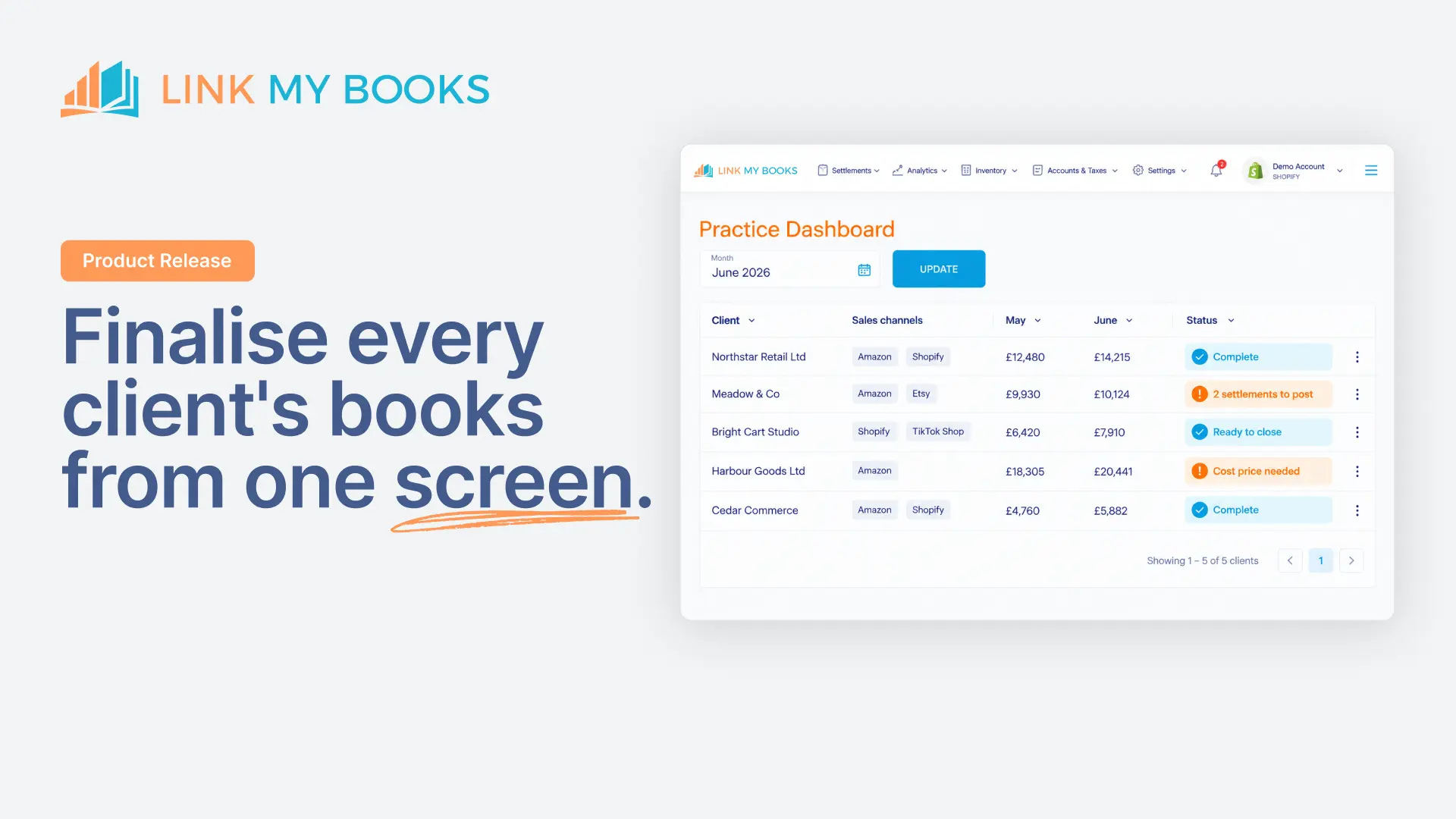
Rather than asking bookkeepers to prepare marketplace reports manually every month, Link My Books automatically categorizes sales, marketplace fees, VAT, refunds, and settlement adjustments before posting structured summaries into Xero or QuickBooks. This removes much of the repetitive preparation that prevents bookkeeping teams from scaling efficiently, making it a powerful accounting automation tool.
Instead of spending valuable time downloading reports, cleaning spreadsheets, and rebuilding settlement data, teams receive bookkeeping-ready information that follows a consistent structure across every client. This ensures an ecommerce bookkeeping workflow that is both consistent and highly efficient.
Customer support is delivered by qualified accountants who understand ecommerce bookkeeping as well as the software itself. That gives practices confidence when onboarding new ecommerce clients or dealing with more complex reconciliation scenarios. This expertise reinforces the E-E-A-T (Expertise, Experience, Authoritativeness, Trustworthiness) of the solution.
For bookkeeping firms looking to grow without continually increasing administrative work, Link My Books becomes part of the operating system rather than simply another piece of software. It's an essential component for achieving scalable accounting systems and mastering ecommerce financial management. To learn more about how Link My Books streamlines operations, you might find our guide on optimizing your accounting tech stack helpful.
FAQ
What makes an ecommerce bookkeeping workflow scalable?
A scalable ecommerce bookkeeping workflow is one that can be repeated consistently across multiple clients without requiring a completely different process each time. It standardizes onboarding, data collection, reconciliation, quality control, and reporting while reducing unnecessary manual work. The objective is not simply to complete bookkeeping faster. It is to create systems that remain accurate and efficient as client numbers grow. Practices with consistent workflows are generally able to onboard new ecommerce clients more easily because the underlying process already exists, supported by accounting automation tools.
Why do bookkeeping practices struggle to scale with ecommerce clients?
Ecommerce businesses generate significantly more complex financial data than many traditional businesses. Different marketplaces use different settlement structures, fee models, and reporting formats, making manual reconciliation increasingly difficult as client portfolios grow. Without documented workflows and automation, bookkeeping teams often develop separate processes for every client. This increases training requirements, creates inconsistencies, and limits the number of ecommerce businesses a practice can support efficiently, hindering true scalable accounting.
How does Link My Books help create a scalable bookkeeping workflow?
Link My Books supports scalability by reducing the manual preparation required before reconciliation begins. It categorizes marketplace sales, fees, VAT, and refunds before posting structured summaries into Xero or QuickBooks, giving bookkeepers consistent financial data across multiple ecommerce clients. Rather than replacing existing bookkeeping processes, it strengthens them by removing repetitive administration and helping practices maintain accuracy as client numbers increase. This is a prime example of automated ecommerce bookkeeping in action. For insights into managing specific platforms, consider reading about integrating Shopify with QuickBooks.
Should bookkeeping practices automate before creating standard processes?
Generally, no. Automation is most effective when it supports a consistent workflow. If every team member follows a different process, automation simply reproduces those inconsistencies. Establishing standard operating procedures first creates a stronger foundation for automation. Once the workflow is documented and repeatable, technology can remove repetitive administration while preserving consistency across every ecommerce client. This sequential approach ensures that accounting automation tools are used effectively within a well-defined ecommerce bookkeeping strategy.
Scaling an ecommerce bookkeeping practice is less about working harder and more about building systems that continue to perform as the business grows.
Standardized workflows, documented processes, and thoughtful automation allow practices to support more clients without sacrificing accuracy or consistency. This is the essence of scalable accounting systems.
For firms looking to strengthen that workflow, Link My Books helps automate bookkeeping for one of the most time-consuming parts of ecommerce bookkeeping by preparing marketplace data before it reaches Xero or QuickBooks. This allows you to focus on high-value tasks and grow your practice. To understand how Link My Books handles specific accounting challenges, explore our article on ecommerce accounting challenges.
If you'd like to see how it fits into your existing processes, book a personalized demo.



.webp)



.png)