


An ecommerce client’s month-end means splitting every settlement into sales, refunds, fees and UK VAT, then matching it to the bank in Xero or QuickBooks.
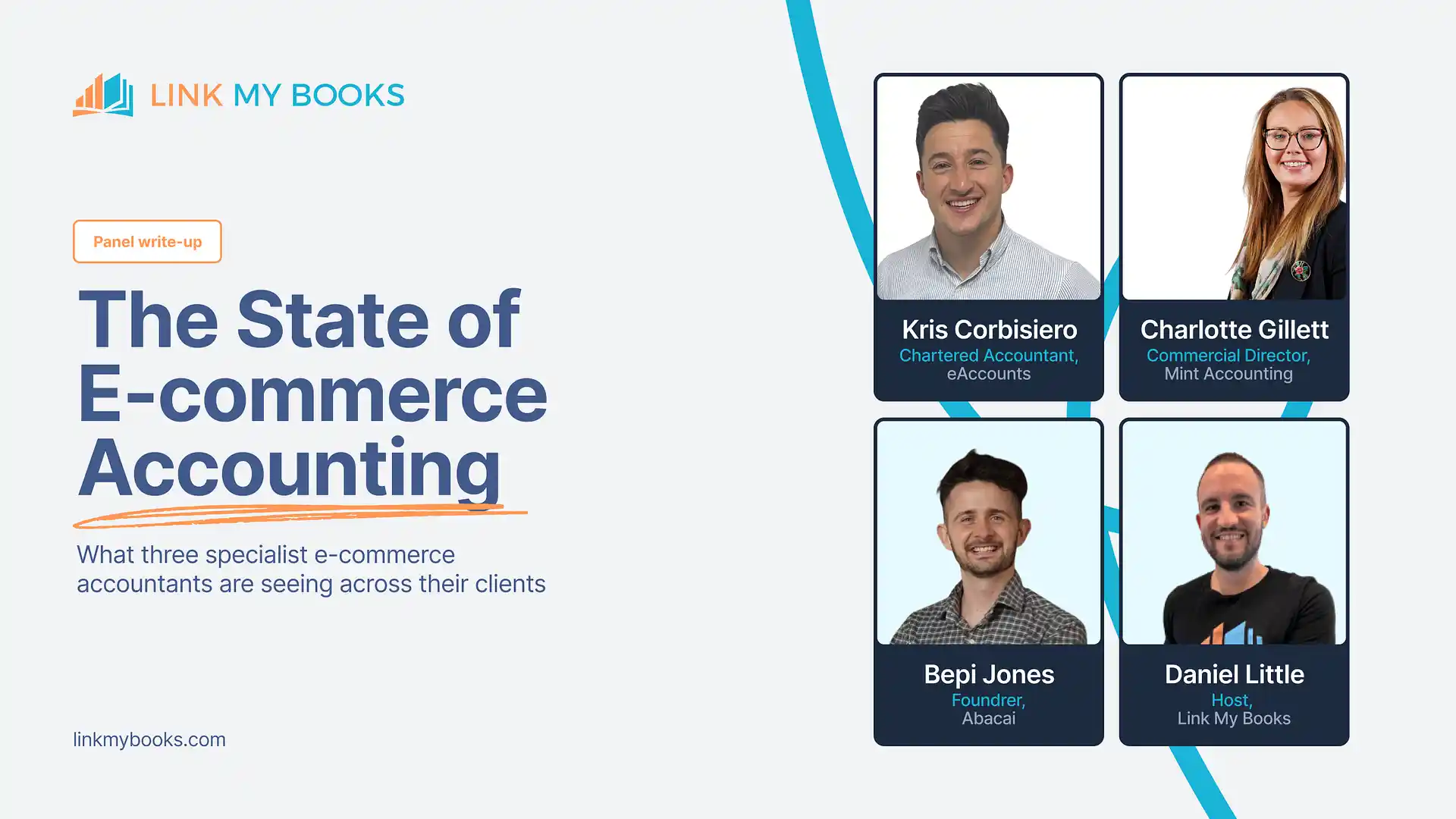
Link My Books Co-Founder (and ex-ecommerce business owner), Daniel Little, showed accounting firms how to automate that job, live.
Firms that run it this way save 5+ hours per client, per month.
This walkthrough covers every step of ecommerce accounting reconciled to the penny, from connecting a new client to a month-end that matches the bank.
Key Takeaways from this Post
The setup is where accuracy is decided. You map each transaction type to the chart of accounts and confirm each UK VAT rate, which follows the product group and where each order ships.
Every settlement posts as one entry that matches the bank deposit. Sales, refunds, fees and taxes land in the right accounts and the right month, so reconciling is one click in Xero or QuickBooks.
Month-end across your whole client book runs from one screen. Pick a month in the accountant portal to see every client’s status, then send each client a monthly report under your practice’s name.







On the 24th of September, Co-Founder (and ex-ecommerce business owner), Daniel Little, spent an hour inside Link My Books.
He took one ecommerce client from sign-up to a reconciled month-end. Then he showed the same job across a whole client book.
Daniel's background is selling, not accountancy. Before starting Link My Books with his co-founder Peter, he built and sold two seven-figure Amazon businesses.
As a seller, he couldn't get accurate finances to make better growth decisions. That's what drove him to build it.
You can watch the full Product Masterclass recording [Contrast replay link] at any time. Here's what it covered, step by step.
How does a new ecommerce client get connected?
Setup starts on your side. You sign in with your practice's Xero or QuickBooks login and pick the client's organisation.
You tell us which channels the client sells on and roughly how many orders they do a month. Then, channel by channel, you choose who connects it.
That choice is new. Some channels now let the accountant connect directly, including Amazon, where you pick the region and can add more than one.
For the rest, the client gets an email. It tells them which channels you've already connected and which ones they still need to connect.
The client's side is deliberately short. They sign in, connect their channels and leave the settings alone.
"We don't want them messing around with any settings. We just want them to connect their sales channels and then leave you to it."
Each channel comes with written steps and a short video of Daniel connecting a real store. Clients can connect more than one store per channel.
Once they're done, you get an email and move on to the setup wizard.
By default, 90 days of history comes in. Depending on the channel, you can go back up to two years: most support 18 months, some 24, and Walmart 12.
Why does the chart of accounts matter for advice?
Daniel called the setup wizard "probably the most important bit", because it sets the rules everything else follows.
The first choice is the chart of accounts. You can use our ecommerce defaults, or map each transaction type to accounts the client already has.
Every Amazon transaction type gets a home. That covers sales, refunds, reimbursements for lost or damaged stock, fees, loans, reserve balances, split-month rollovers and deferred balances.
Daniel recommends the defaults unless the client already has an ecommerce chart of accounts. His reason is about advice, not tidiness.
"Some fees, for example FBA fees and storage fees and advertising costs, they can go up or down depending on how efficient the seller is. Whereas seller fees, they are just a percentage of the sale price. So if you lump all of those together into one account, then it makes it really hard for you to be able to give them good financial advice on how to improve their cost efficiencies."
Revenue works the same way. Put sales, refunds and reimbursements in one account, and "you can't really tell when the refunds are going up or down."
You can go further if the client needs it, splitting out promotional discounts or separating paid advertising from Amazon's lightning deals.
How is UK VAT applied to each sale?
If the client's home country in Xero or QuickBooks is the UK, the wizard asks whether they're VAT registered.
If they are, you reach what Daniel called "possibly the most scary screen". Amazon brings a lot of UK VAT rules into play.
Sales shipped to the UK fall into four groups:
- Standard rated, at 20%
- Reduced rated, at 5%
- Zero rated
- Sales where the marketplace itself accounts for the VAT
That last group is "the one that people can often miss". Those sales still belong in the VAT return, but the seller charges no VAT on them, because Amazon pays it to HMRC.
Sales shipped outside the UK split two ways. Dispatched from a GB warehouse, they're exports and zero rated. Dispatched from outside GB, they're out of scope.
This is where Daniel's warning comes in.
"A lot of customers who come to us will say, the client has told me they only sell in the UK. And I would be very sceptical."
Amazon makes it easy to sell into other countries and store stock there, and hard to opt out. So we check where every order shipped from and to.
Fees follow the same logic. Since August 2024, Amazon bills some fees from its UK branch, with 20% VAT. Others come from its Luxembourg entity, where the reverse charge applies.
Every rate is a suggestion. You can change any of them, and at the end you confirm that you and the client are responsible for the settings.
As Daniel put it: "This is not tax advice, we are just helping you to make the right choices."
How does a payout end up matching the bank?
Once setup is done, each payout shows its status: still processing, or posted to Xero or QuickBooks.
Most firms turn on auto-post. If you'd rather review the first ten settlements yourself before switching it on, you can post them manually.
Behind each payout, we pull every transaction that made it up. We check which rate group each product sits in and where each order shipped from and to.
Then we group it all into one summary entry: an invoice in Xero, or a journal in QuickBooks.
Each line sits in the nominal account you chose at setup, with its net, tax and gross amounts. The total matches the deposit that landed in the client's bank.
"In Xero and in QuickBooks, it'll just be one click and that bank statement line entry is reconciled."
That changes who can do the work. With the setup right, Daniel's view is that the monthly reconciliation "should be able to be done by anyone in the team. It doesn't need a senior accountant."
Payouts in euros post in euros, and Xero or QuickBooks converts them against the deposit.
What happens when a payout covers two months?
Some payouts include transactions from two different months.
We split those into two entries, one for each month, so both months stay on an accrual basis.
The first entry carries its balance forward through a split-month rollover account into the second. It closes at nil straight away.
Only the second entry reconciles against the bank, and the two stay linked.
Can it track cost of goods sold?
Yes. We know which items sold in each payout, so we can post cost of goods sold alongside the sales and fees.
Enter the cost prices, and each settlement posts the monetary value from inventory on the balance sheet to cost of sales on the P&L.
Costs can come from the inventory tab, a Shopify cost sync, Google Sheets, or a profit-tracking tool some sellers already use.
How do you run month-end across a whole client book?
Then Daniel scaled it up: "Say I've got 100 clients, how do I manage all of this for 100 clients?"
The answer is the new accountant portal.
Pick the month you're closing from the dropdown, which Daniel called "probably gonna be your best friend". Every client then shows as completed or requiring action.
Completed means every channel's data for that month is imported and posted. What's left is your part: the bank reconciliation, the client's other expenses, and closing the period.
Requiring action means a connection has dropped, a settlement is still due from the channel, or settlements are waiting to post.
Open a client and the view breaks down by channel. Each one shows what it needs, such as settlements to post or missing product costs.
Around that sit the things that save time on a large book:
- Pinned clients for each user, plus recently viewed clients
- A health column, based on a 12-month rolling average of order count: increasing, stable or declining
- A six-month row showing which months are completed and which need action
- A needs your attention section for dropped channel connections, a disconnected Xero or QuickBooks, and failed auto-posts
- A channels tab, where you add a new channel by sending the client a link
- An activity log of who changed what on each client
- One client file for clients with more than one legal entity
When a channel drops, you can reconnect it yourself, email the client, or copy a link to send them.
Already using Link My Books? The accountant portal is at accountants.linkmybooks.com.
What goes in the monthly client report?
The portal also builds a monthly report for each client, carrying your practice's logo, name and address.
It compares revenue, orders, average order value and refund rate with the previous period, then breaks revenue down by channel. Month on month and year on year sit alongside the P&L, where the history is there.
The channel breakdown is the part Daniel finds most interesting.
"Clients will definitely be attached emotionally to one channel, and they'll think that that's the best one. But if you dive deeper into that in the conversations that you have with them, it might be that all of their profitability comes through a different channel."
The report downloads as a PDF or goes straight to the client by email.
Watch the full Product Masterclass
The recording shows every step on screen, from the first connection to the portal.
Watch the Product Masterclass recording.
Where we fit in
We connect 8 sales channels to Xero and QuickBooks, and every payout arrives split, taxed and matched to the bank deposit. The checking stays with your team.
It's how 500+ firms run their ecommerce clients.
Book a demo to see how firms save 5+ hours per client, per month at month-end.
Frequently asked questions
Can the accountant connect a client's sales channels?
Yes, for some channels, including Amazon. For each channel, you choose whether to connect it yourself or send the client an invite, and the client connects the rest.
How far back can data be imported?
By default, 90 days. You can go back up to two years, depending on the channel. Most support 18 months, some 24, and Walmart 12.
Does it handle the VAT margin scheme?
Not by default. Daniel's advice is a custom setup with no VAT on the revenue side, with the margin scheme adjustments made by the firm. We automate the bookkeeping side, not the margin scheme calculation.
Does someone still check the numbers?
Yes. You confirm every VAT rate at setup, and you can review settlements before turning on auto-post. The bank reconciliation and closing the period stay with your team.
Can a junior run ecommerce month-end?
Once the setup is right, Daniel's view is yes. Each payout posts as one entry that matches the bank deposit, so the monthly work becomes reviewing and approving the matches.


.webp)
-optimized.webp)


.png)