From October 2027, marketplaces will collect the UK VAT on your clients' marketplace sales. Here's who's in scope, what it means for your clients and your firm, and what to check now.
Key Takeaways from this Post
Marketplaces collect the UK VAT from October 2027. HMRC's policy paper says marketplaces will collect the UK VAT on UK sellers' sales to consumers, with the exact day set later.
Every VAT-registered seller is in scope. Unregistered sellers are caught above £90,000 a year on any one platform, tested platform by platform.
Some of the detail is still open. How sales show on the seller's VAT return, and how the Flat Rate Scheme works, are still to be confirmed.







From October 2027, online marketplaces will collect the UK VAT on UK businesses' sales to consumers, according to HMRC's policy paper of 28 October 2026. Every VAT-registered seller is in scope, plus unregistered sellers with more than £90,000 a year in sales on any one platform. Business-to-business sales, second-hand goods and personal sales are excluded.
If you look after clients selling on Amazon, eBay or other marketplaces, their UK VAT is about to work differently.
HMRC's policy paper estimates the change will have a significant impact on around 100,000 businesses.
Some of the detail is still to come. But the scope is set, and so is the year.
We’ve been through HMRC’s policy paper, HM Treasury’s factsheet and the government’s response, so here’s what matters for your clients.
What are the marketplace VAT changes, and when do they start?
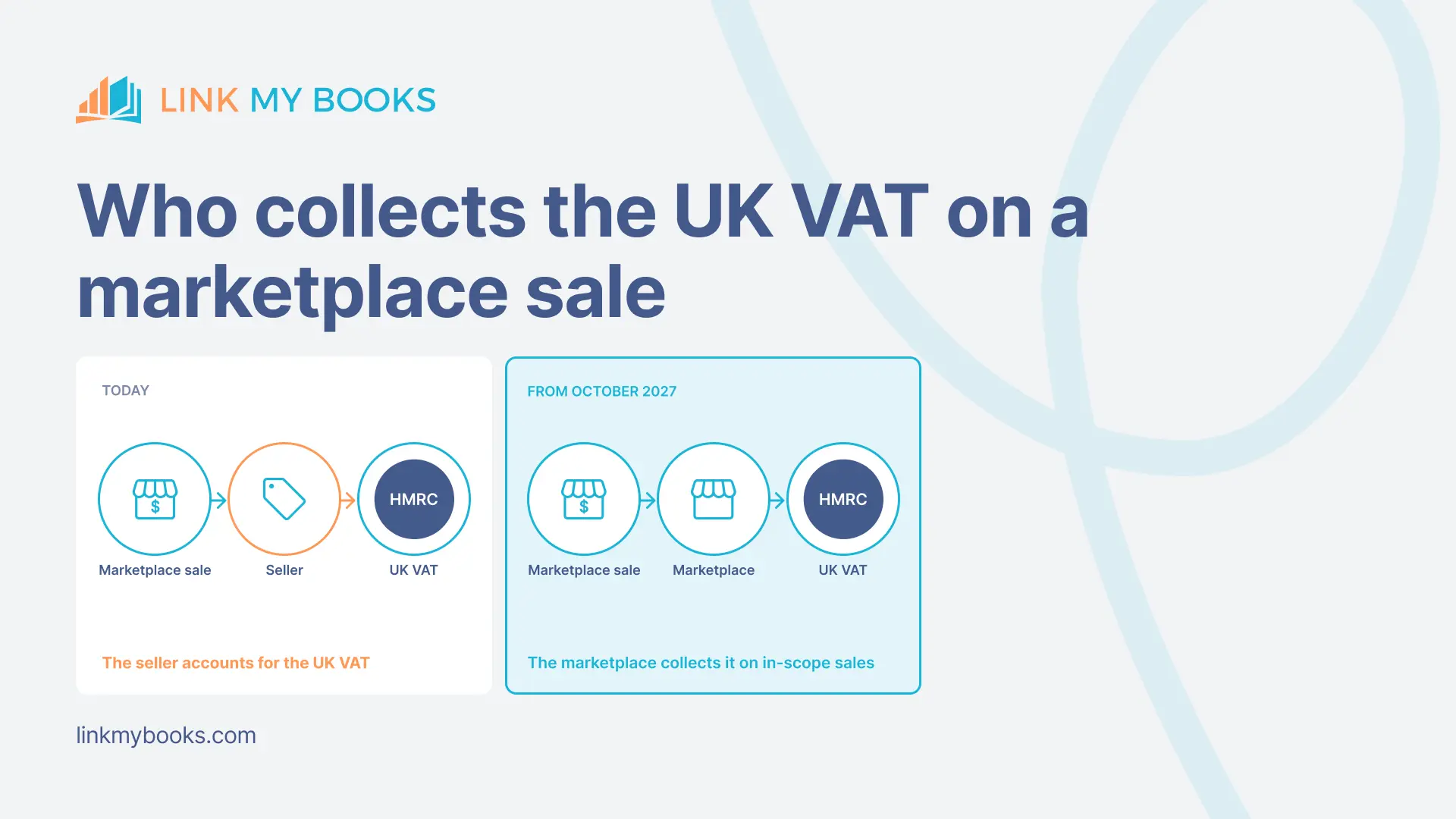
HMRC's policy paper says the VAT these sellers owe will be collected by the marketplace, rather than by the seller.
HM Treasury's factsheet, out the same day, says marketplaces "will become responsible for collecting VAT" on these sales.
The government intends the rules to apply "from October 2027", according to HMRC's policy paper. The exact day will be set later, in secondary legislation.
This isn't new for oversea sellers. Marketplaces have been collecting the VAT directly for overseas sellers (NETPs) since 2021. They cover overseas businesses selling to UK consumers, and imports worth £135 or less.
Our guide to marketplace facilitator VAT explains how those rules already show up in a seller's books.
What's new is that UK businesses selling goods held in the UK are being brought in too.
Which of your clients are in scope?
HMRC's policy paper says the rules cover UK-established businesses selling to consumers through an online marketplace. The goods must be in the UK at the time of sale.
Within that, two groups are caught:
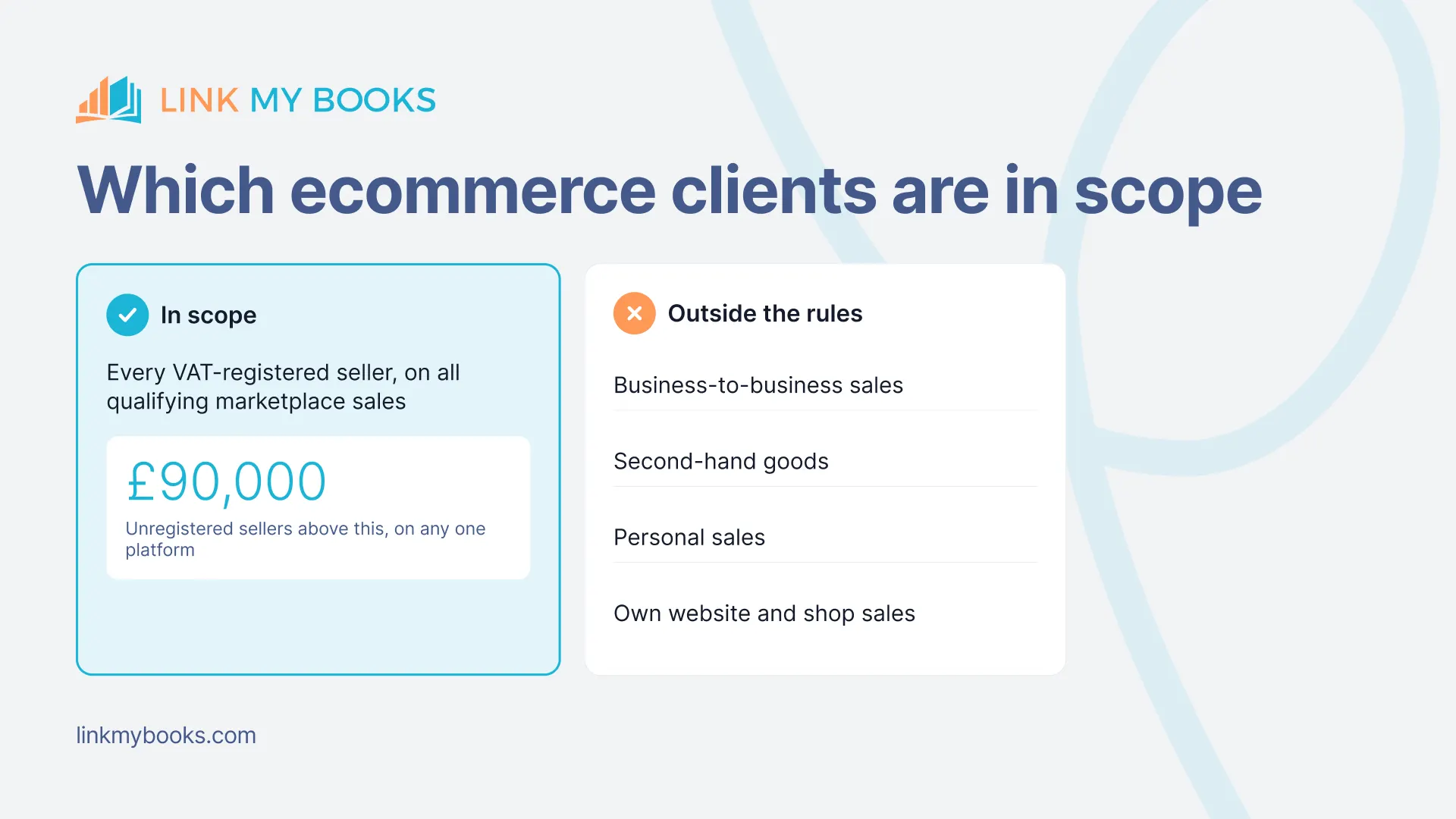
- Every VAT-registered seller. HM Treasury's factsheet says the rules apply to all of their qualifying sales on marketplaces.
- Unregistered sellers above £90,000 on one platform. The factsheet sets the test at more than £90,000 a year on an individual marketplace.
That £90,000 is tested per platform, not as a total. The factsheet says it applies separately to a business's annual sales on each platform where it trades.
The test sits apart from VAT registration, too. The factsheet says it doesn't change anyone's existing registration obligations.
Three types of sale are excluded, according to both documents:
- Business-to-business sales.
- Second-hand goods. The factsheet says sellers of these will keep charging VAT in the usual way.
- Personal sales. The factsheet's example is people selling their own clothes or household belongings.
What do the changes mean for your clients?
The biggest shift is who collects the UK VAT on their marketplace sales. For in-scope sales, that becomes the marketplace.
The exclusions work sale by sale, not client by client. A client selling new and second-hand goods on the same platform could have sales on both sides of the line.
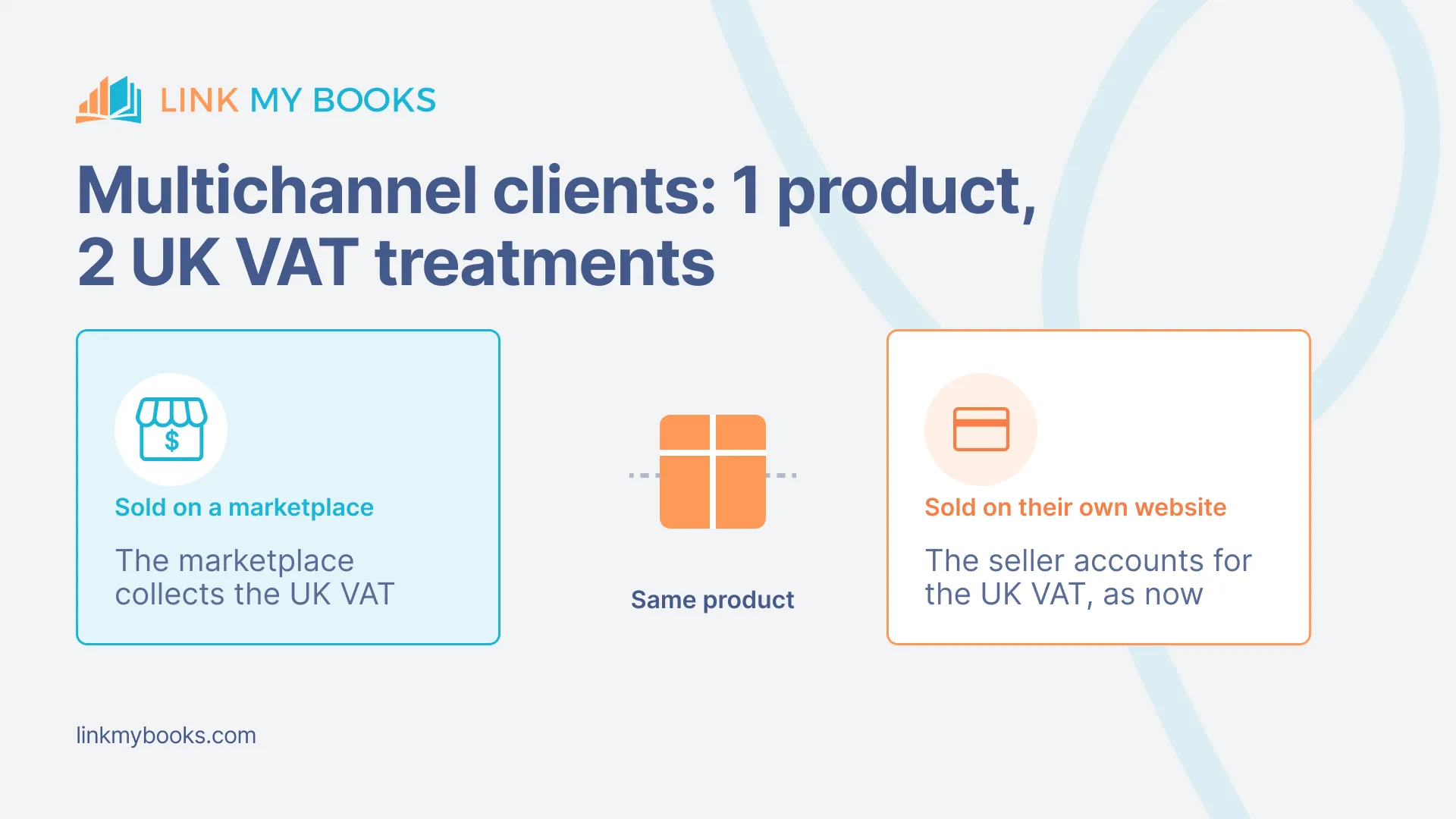
Sales away from marketplaces aren't part of the change. The rules cover sales through an online marketplace, so a client's own website or physical shop sits outside them.
For multichannel clients, that means two VAT treatments for the same product: one for marketplace sales, and one for sales through their own site.
Our piece on UK VAT across multiple sales channels covers where that already gets complicated today.
Some clients may see their VAT position change. HMRC's policy paper says some businesses "may be brought into a repayment position and face additional compliance costs". It doesn't say which ones.
The government's response to the consultation, published in October 2026, says in-scope businesses can apply for monthly VAT returns to help with cash flow.
HMRC's policy paper puts the one-off cost to businesses at £40 million, plus a net £8 million a year in ongoing admin.
What do the changes mean for your firm?
For your firm, this is mostly about reviews and timing.
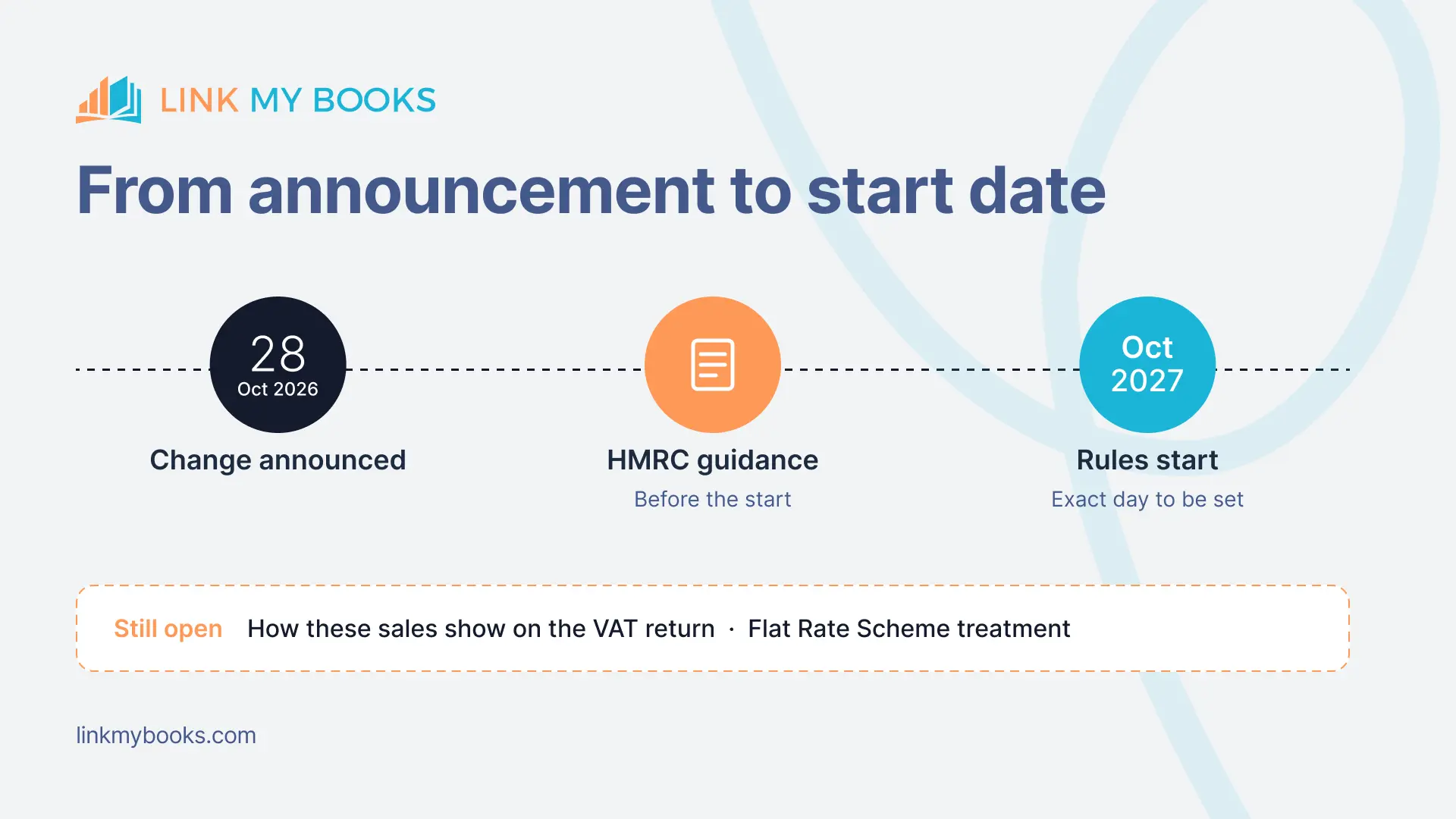
HM Treasury's factsheet says HMRC will publish detailed guidance before the rules start, including any accounting changes affected businesses may need to make.
Once that's out, each in-scope client's UK VAT setup will be worth reviewing before October 2027. If you look after several marketplace clients, those reviews will fall in the same window.
Two points that matter for the VAT return are still open.
The first is how a seller's marketplace sales will show on their own return. The consultation proposed treating each sale as a deemed zero-rated supply to the marketplace.
The government's response recognises "the different views expressed" on how the proposals affect VAT accounting. It says HMRC will provide clear guidance, but doesn't confirm the treatment.
The second is the Flat Rate Scheme. The response says the government will "take more time to consider how the Flat Rate Scheme will function" alongside the new rules.
If you see either point described as settled elsewhere, check it against HMRC's own publications first.
Then there's the client conversation. A client moving into a repayment position, or selling under two sets of rules, will want it explained early.
What can you do with your marketplace clients now?
Nothing changes until October 2027, so this is about knowing where each client stands.
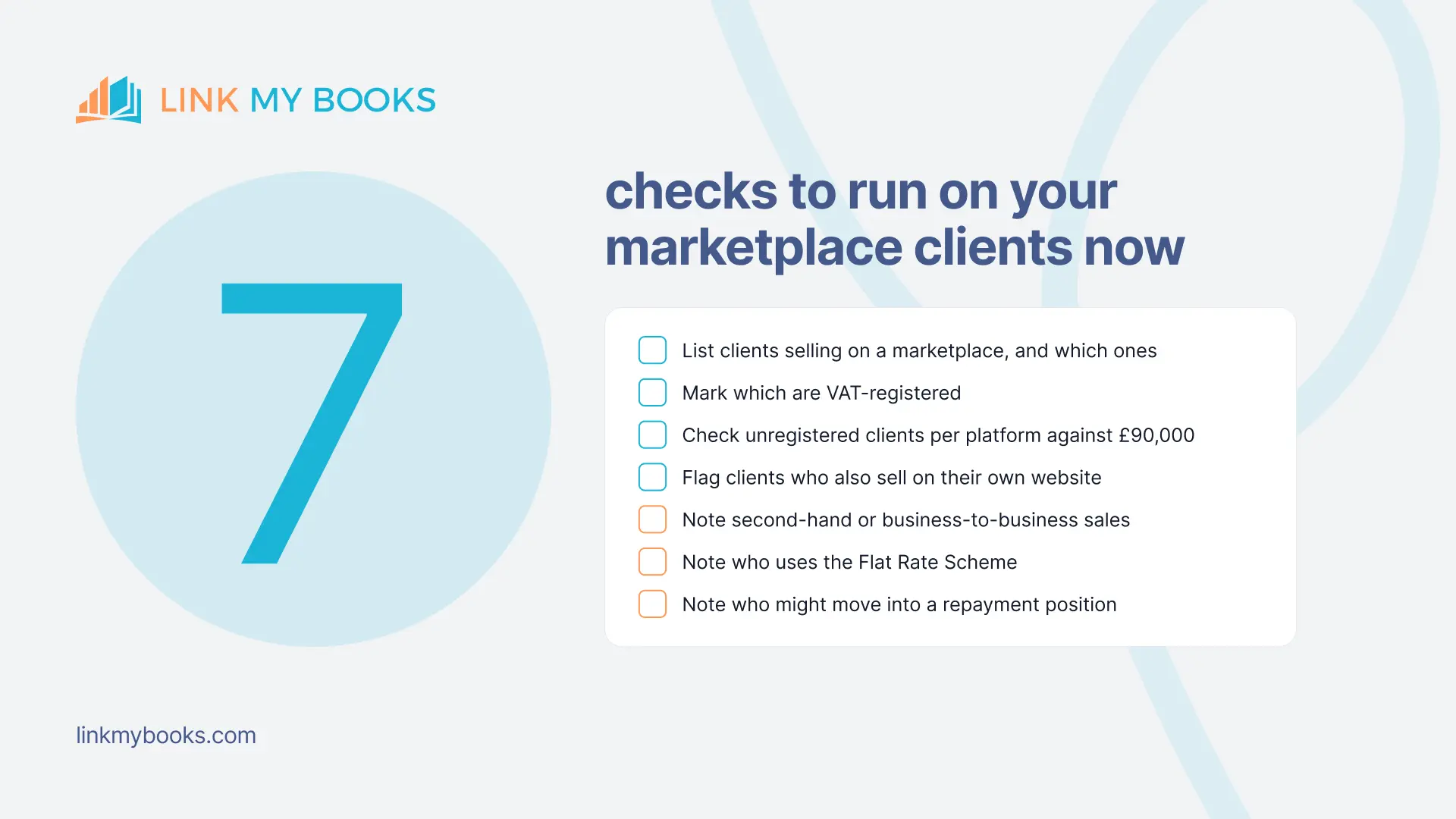
A few checks will show you which clients the change touches:
- List every client selling on an online marketplace, and which platforms they use.
- Mark which of them are VAT-registered, since all of their qualifying marketplace sales are in scope.
- For unregistered clients, look at annual sales on each platform separately, against the £90,000 test.
- Flag clients who also sell through their own website or shop, as they'll have sales under two sets of rules.
- Note anyone selling second-hand goods, or selling to other businesses, on the same platforms.
- Note which clients use the Flat Rate Scheme, so you're ready when HMRC confirms how it's treated.
- Note which clients might move into a repayment position, since in-scope businesses can apply for monthly VAT returns.
When HMRC's guidance arrives, you'll already know which clients to review first, and which ones the change doesn't touch at all.
It also gives you a reason to raise the change with clients well before October 2027.
The change is set, the detail isn't
From October 2027, marketplaces will collect the UK VAT on your clients' in-scope consumer sales.
How that shows up on each client's VAT return is still to be confirmed by HMRC.
Knowing which clients are in scope now means you're ready to act as soon as the guidance lands.
Where we fit in
Link My Books was built by Daniel Little, Co-Founder (and ex-ecommerce business owner), for the way marketplace sales actually reach the books.
It already reads the VAT each marketplace collects from the marketplace’s own data, and posts it apart from the VAT your client collects, into Xero or QuickBooks, reconciled to the bank deposit.
When the new rules come into effect, Link My Books will handle them for your clients, the same way it handles marketplace-collected VAT today.
It's how 500+ accounting and bookkeeping firms save 5+ hours per client, per month.
See how it works for accountants and bookkeepers.
Book a discovery call to see it with your own ecommerce clients in mind.
Which of your marketplace clients will you check first?
Frequently asked questions
When do the marketplace VAT changes start?
HMRC's policy paper says the government intends to apply them from October 2027. The exact day will be set in secondary legislation.
Will Amazon and eBay collect UK VAT for UK sellers?
Yes, for in-scope sales. The rules cover online marketplaces generally, not named platforms, and apply to UK sellers' sales to consumers of goods held in the UK.
Is the £90,000 marketplace threshold per platform?
Yes. HM Treasury's factsheet says it applies separately to sales on each platform. It doesn't change existing VAT registration obligations.
Are sales through a seller's own website affected?
No. The rules cover sales made through an online marketplace. Sales through a seller's own website or physical shop aren't part of the change.
What happens to the Flat Rate Scheme?
That hasn't been decided yet. The government's response to the consultation says it will take more time to consider how the Flat Rate Scheme will work alongside the new rules. HMRC will publish guidance before the rules start.