


Selling digital products through Shopify can create different bookkeeping challenges from selling physical goods. While Shopify allows businesses to configure tax settings, sellers remain responsible for ensuring their accounting records are complete, accurate, and suitable for VAT reporting. This is particularly crucial for UK sellers navigating the complexities of Shopify VAT on digital products.
Key Takeaways from this Post
Digital product VAT is more complex than physical goods. Cross-border rules, reverse charges, and varying EU rates require precise Shopify configuration—errors here corrupt every downstream report and return.
Manual reconciliation breaks under digital product scale. Refunds, multiple VAT rates, and multi-channel growth make spreadsheet-based tracking increasingly error-prone and time-consuming.
Automation must handle digital-specific tax complexity. Solutions that categorize sales, fees, refunds, and VAT correctly before reaching Xero or QuickBooks ensure compliance without manual rebuilds—especially critical for EU VAT digital services.







Selling digital products through Shopify can create different bookkeeping challenges from selling physical goods. While Shopify allows businesses to configure tax settings, sellers remain responsible for ensuring their accounting records are complete, accurate, and suitable for VAT reporting. This is particularly crucial for UK sellers navigating the complexities of Shopify VAT on digital products.
For UK businesses, the real challenge is rarely collecting payments. It is ensuring that sales, taxes, refunds, and fees are reflected correctly in Xero or QuickBooks. As order volumes increase, manual reconciliation quickly becomes difficult to manage, particularly when digital products are sold alongside physical products or through multiple sales channels. Understanding how Shopify VAT on digital products fits into your wider bookkeeping process helps reduce manual work, improves reporting accuracy, and gives both business owners and accountants greater confidence in the numbers.
Why VAT Compliance Matters for Digital Product Sellers
Every ecommerce business depends on reliable financial records, and VAT compliance Shopify is a non-negotiable aspect, especially when dealing with digital goods. When you sell digital products through Shopify, each transaction contributes to your revenue, tax reporting, and profit reporting. If these transactions are not recorded accurately inside your accounting software, month-end reconciliation becomes more complicated and your accountant may need to spend additional time correcting your books. This can lead to significant issues, particularly concerning digital product tax and VAT rates digital products.
Many growing businesses only discover these issues when:
- Preparing VAT returns: Incorrect data can lead to penalties and audits.
- Closing month-end accounts: Delays and discrepancies can hinder financial reporting.
- Moving to Xero or QuickBooks: Inaccurate historical data makes migration challenging.
- Expanding into additional sales channels: Complexity multiplies with each new platform.
- Working with a new accountant: A clean financial slate is essential for new partnerships.
By this stage, correcting historical transactions often requires considerably more work than maintaining accurate records from the beginning. Proactive management of your Shopify tax setup is key to avoiding these pitfalls.
Understanding VAT on Digital Goods
VAT on digital goods is a complex area, especially for cross-border sales. For UK sellers, understanding the nuances of how VAT applies to digital products sold to customers within the UK, the EU, and globally is paramount. Digital products, by their nature, are services that are delivered electronically, such as e-books, online courses, software, music downloads, and streaming services. The place of supply rules determine where VAT is due.
- Sales within the UK: Standard UK VAT rules apply. If you are VAT registered, you charge UK VAT at the prevailing rate.
- Sales to EU consumers (B2C): Since Brexit, UK businesses selling digital services to EU consumers are generally required to register for VAT in an EU member state or use the EU's VAT Mini One Stop Shop (MOSS) scheme (now OSS for services) to declare and pay VAT in the consumer's country of residence. This is a critical aspect of EU VAT digital services compliance.
- Sales to EU businesses (B2B): If you sell digital services to a VAT-registered business in the EU, the "reverse charge" mechanism usually applies, meaning the EU business accounts for the VAT. You would typically zero-rate these sales, provided you obtain and verify the customer's VAT number.
- Sales to Rest of World: VAT rules vary significantly by country. Some countries may require you to register for local sales taxes or VAT.
Accurate international VAT Shopify configuration is essential to ensure you are collecting the correct amount of tax and reporting it appropriately.
Common Challenges UK Sellers Face with Shopify VAT on Digital Products
Although every ecommerce business is different, several patterns appear repeatedly when managing Shopify VAT on digital products.
Manual Reconciliation
Many businesses still rely on spreadsheets to reconcile Shopify payouts. This may work while order volumes remain low, but it becomes increasingly difficult as sales grow and refunds, fees, and multiple transactions accumulate. The sheer volume of transactions, coupled with varying VAT rates digital products and international sales, makes manual tracking prone to errors.
Refunds Create Additional Complexity
Refunds affect more than customer balances. They also change the financial picture of your business. Accurate bookkeeping should reflect refunds alongside sales, fees, and tax information so your accounting records remain complete. This includes correctly adjusting the VAT component of the original sale, which can be particularly tricky for digital product tax calculations.
Multi-Channel Growth
Many Shopify businesses eventually begin selling through Amazon, Etsy, TikTok Shop, or eBay. Every additional marketplace introduces another source of financial data that needs to reconcile accurately inside your accounting software. This is often the point where manual bookkeeping becomes unsustainable, especially when each channel has its own tax implications and reporting requirements for digital goods.
The Commercial Impact of Inaccurate Bookkeeping
Poor bookkeeping affects more than compliance. It can influence:
- Profit reporting: Inaccurate revenue and expense tracking distorts your true profitability.
- Cash flow visibility: Without precise records, managing cash flow becomes a guessing game.
- Business decision-making: Flawed financial data leads to poor strategic choices.
- Accountant efficiency: Accountants spend more time correcting errors than providing valuable insights.
- Month-end reporting: Delays and inaccuracies can impact investor relations or loan applications.
Business owners rely on accurate financial information to understand how their company is performing. If Shopify transactions are incomplete or incorrectly categorised inside Xero or QuickBooks, reports become less useful and identifying genuine business performance becomes more difficult. This is one reason ecommerce bookkeeping automation has become increasingly important for growing online businesses, especially for managing Shopify tax settings effectively.
Where Competitors Fit Into the Market
Several software providers help ecommerce businesses connect Shopify with accounting platforms. While they offer solutions, understanding their focus helps clarify why Link My Books stands out for Shopify VAT on digital products for UK sellers.
Entriwise
Entriwise offers ecommerce accounting automation and reporting capabilities designed to simplify financial data management across ecommerce platforms. They focus on comprehensive financial reporting.
A2X
A2X has established strong relationships with accountants and accounting practices and is widely recognised for ecommerce reconciliation. Many businesses first encounter A2X through accountant recommendations rather than direct product research.
Taxomate
Taxomate primarily focuses on Amazon accounting automation. While suitable for Amazon-first businesses, sellers operating across multiple ecommerce channels may require broader platform coverage, especially when dealing with the intricacies of digital product tax across various platforms.
Each platform aims to reduce manual bookkeeping, but businesses increasingly compare solutions based on onboarding experience, pricing, support, and ease of use. For UK sellers, the specific challenges of VAT on digital goods require a solution that understands these nuances.
Why Link My Books Is Built for Growing Ecommerce Businesses
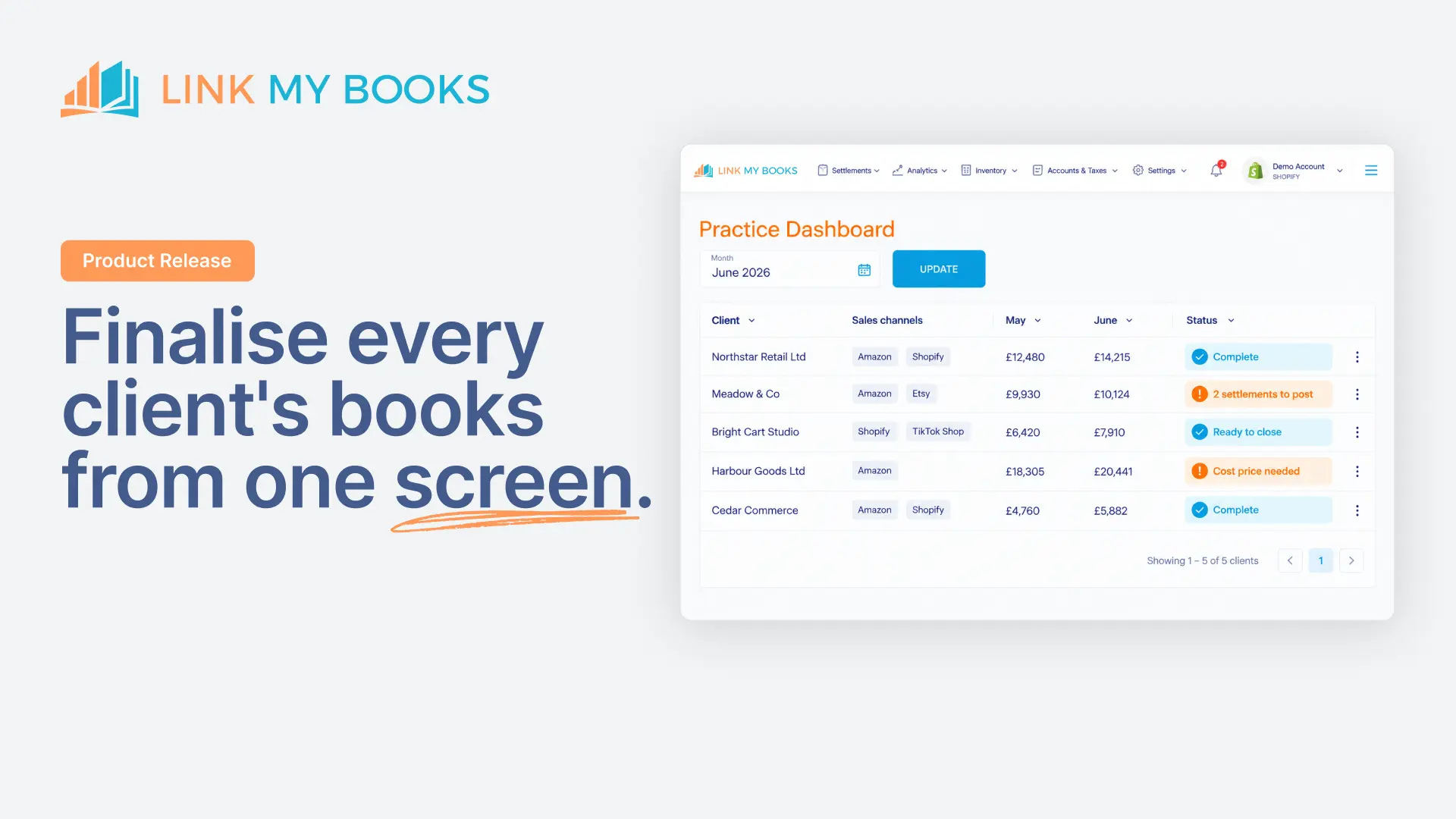
For UK sellers using Shopify with Xero or QuickBooks, Link My Books focuses on solving the bookkeeping challenges that consume time every month, particularly those related to Shopify VAT on digital products. Rather than relying on manual spreadsheets or repetitive reconciliation, Link My Books automates the movement of ecommerce data into accounting software, helping businesses produce accurate financial records with significantly less manual effort. Its core proposition is saving time while improving bookkeeping accuracy for ecommerce businesses.
The platform supports ecommerce businesses by helping automate:
- Sales summaries: Consolidating transactions for clear reporting.
- Marketplace fees: Accurately categorising and reconciling fees.
- Refund tracking: Ensuring refunds are correctly accounted for, including VAT adjustments.
- Reconciliation: Matching payouts to individual transactions.
- Ecommerce bookkeeping workflows: Streamlining the entire financial process.
As businesses expand across multiple marketplaces, this automation becomes increasingly valuable because financial complexity grows much faster than sales volume. This is crucial for managing cross-border VAT and ensuring VAT compliance Shopify across all sales channels.
Another important advantage is support. Unlike traditional customer support teams, Link My Books provides access to accountant-qualified specialists who understand ecommerce bookkeeping and can help businesses configure the platform correctly. This emphasis on accountant-led support is a key differentiator highlighted throughout the brand strategy and customer interviews. This expert guidance is invaluable for navigating complex topics like EU VAT digital services and ensuring your Shopify tax setup is robust.
For many businesses, this means less time correcting bookkeeping issues and more confidence in the numbers that reach their accountant. Link My Books ensures that your financial data for digital goods is always ready for your accountant, reducing their workload and allowing them to focus on strategic advice. You can learn more about how Link My Books integrates with accounting software by visiting their Xero Integration page.
When Should You Review Your Shopify Bookkeeping Process?
Even if your business is operating successfully today, it is worth reviewing your bookkeeping when:
- Order volumes increase: More sales mean more data to manage, making manual processes unsustainable.
- You introduce additional marketplaces: Each new channel adds layers of complexity, especially for international VAT Shopify.
- You move to Xero or QuickBooks: Ensure a smooth transition with accurate historical data.
- Month-end reconciliation becomes increasingly time-consuming: This is a clear sign your current process is inefficient.
- Your accountant identifies recurring bookkeeping issues: Persistent errors indicate a systemic problem.
- Preparing VAT returns takes longer than expected: This points to difficulties in gathering and processing tax-relevant data for digital product tax.
These moments often indicate that manual processes are no longer keeping pace with business growth. Implementing a solution like Link My Books can help you maintain control and accuracy, ensuring your Shopify tax settings are always optimized. For further insights into managing your finances, explore resources like their Blog for expert advice.
FAQ
Does Shopify automatically manage all VAT bookkeeping for digital products?
No. Shopify provides tools for configuring taxes, but bookkeeping extends beyond collecting tax during checkout. Sales, refunds, marketplace fees, and payouts still need to be reflected accurately inside your accounting software. Businesses should ensure their accounting records match their ecommerce activity so financial reporting remains reliable, especially for VAT digital goods. While Shopify's tax settings are a starting point, they don't automate the entire reconciliation process or guarantee full VAT compliance Shopify for all scenarios, such as cross-border VAT.
Why does reconciliation matter for Shopify sellers?
Reconciliation confirms that the transactions recorded inside your accounting software accurately reflect activity within Shopify. As businesses grow, manually matching sales, refunds, fees, and payouts becomes increasingly difficult. Automating reconciliation helps reduce manual work while improving confidence in financial reporting, which is vital for accurate digital product tax calculations and overall financial health. It ensures that your bank statements align with your accounting records, providing a true picture of your business's financial performance.
Is Link My Books suitable for businesses selling through more than Shopify?
Yes. One of Link My Books' strengths is supporting businesses that operate across multiple ecommerce platforms while using Xero or QuickBooks. The business specifically targets multi-channel ecommerce sellers because managing several marketplaces creates greater bookkeeping complexity and stronger demand for automation, particularly for handling diverse Shopify tax setup requirements and international VAT Shopify rules across different platforms.
Why do accountants recommend ecommerce bookkeeping automation?
Accountants need accurate financial information to prepare reports and support their clients. Automating ecommerce bookkeeping reduces repetitive manual work, improves consistency, and allows accountants to spend more time providing advice instead of correcting transaction data. Link My Books has positioned accountant-qualified support and accurate reconciliation as core strengths for both sellers and accounting professionals. This automation ensures that data related to VAT rates digital products and other financial aspects is consistently correct, making their job easier and more strategic.
Selling digital products through Shopify is only one part of running a successful ecommerce business. Maintaining accurate bookkeeping as your business grows is equally important, especially when navigating the complexities of Shopify VAT on digital products. As sales volumes increase and additional marketplaces are introduced, manual reconciliation becomes more difficult and more time-consuming. Link My Books helps UK ecommerce businesses automate reconciliation between Shopify and Xero or QuickBooks, giving sellers and accountants greater confidence in the accuracy of their financial records while reducing the manual effort required each month. It ensures your digital product tax and EU VAT digital services are handled with precision.
If you're looking for a simpler way to manage your ecommerce bookkeeping and ensure robust VAT compliance Shopify, start your free trial with Link My Books today.



.webp)



.png)